Competition means rivalry for the same customers
Definition
Competition: rivalry between producers in the same market, each trying to win customers from the others.
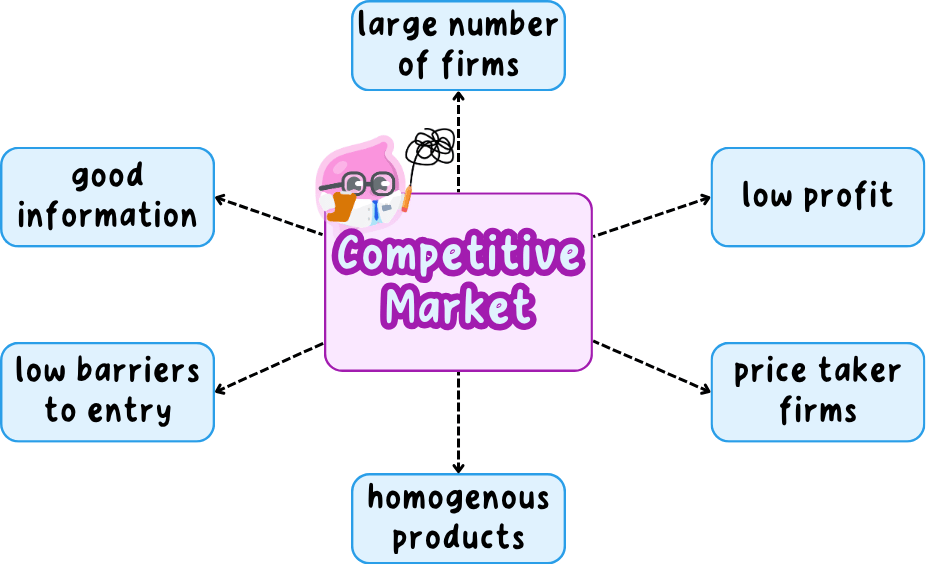
Competitive market: a market with many sellers, where no single one is large enough to set the price.
Market share: the percentage of a market's total sales that one firm accounts for.
- Competition exists because buyers have a choice, so a customer lost to a rival is a sale that firm never makes.
- It is a feature of a market economy, where nobody allocates customers and firms have to attract them, as set out in 2.4.5.
- Market share is how competition is measured, since a firm winning rivalry gains share and a firm losing it gives share away.
Producers compete because customers can walk away
- To win customers: a firm offering a better deal than its rivals takes their sales, which is the direct reward for competing.
- To survive: a firm charging more than rivals for the same good loses its buyers and eventually cannot cover its costs.
- To make more profit: more sales spread the same fixed costs over more units, so each one carries less cost.
- To grow: firms compete for share now because a larger firm is harder for a newcomer to displace later.
Common Mistake
- Do not say firms compete because they have to, since the reason is that buyers can choose and profit depends on being chosen.
- Do not treat competing as only cutting price, because a firm can compete on quality, service or range instead.
Many sellers means no one firm sets the price
- Where many sellers offer much the same thing, a firm charging above the going rate simply loses its buyers.
- Each firm therefore has to accept roughly the market price rather than choose it, which is examined in 2.5.2.
- Buyers being able to switch easily is what gives that pressure its force, since choice on paper is worth nothing if switching is impossible.
Case study
- In the 12 weeks to 9 August 2026, Tesco held 27.8% of the Great Britain grocery market, Sainsbury's 15.2%, Asda 11.5%, Aldi 10.7%, Lidl 8.8% and Morrisons 8.5% (Source: Worldpanel by Numerator).
- Ten or so chains competing hard is real rivalry, and Aldi and Lidl together taking 19.5% shows share genuinely moving between them.
- But the four largest held 65.2% between them, so this is not a market of many small sellers, and that concentration is what 2.5.4 examines.
Saying what a firm is competing on
- Name the dimension when you write about competition, so say the firm cut its price, extended its range or opened more stores.
- Name the rival too, because competition is rivalry with someone and an answer without an opponent is vague.
Exam technique
- Quote a market share figure when the data gives one, since the number is what shows how competitive the market actually is.
- Give the reason a firm competes rather than just saying it does, because the reason is the economics.
Self review
- Define a competitive market in one sentence.
- Give two reasons a producer competes with its rivals.
- What does market share measure?
- Why can a firm in a competitive market not charge above the going rate?
- Name two ways of competing that do not involve price.
