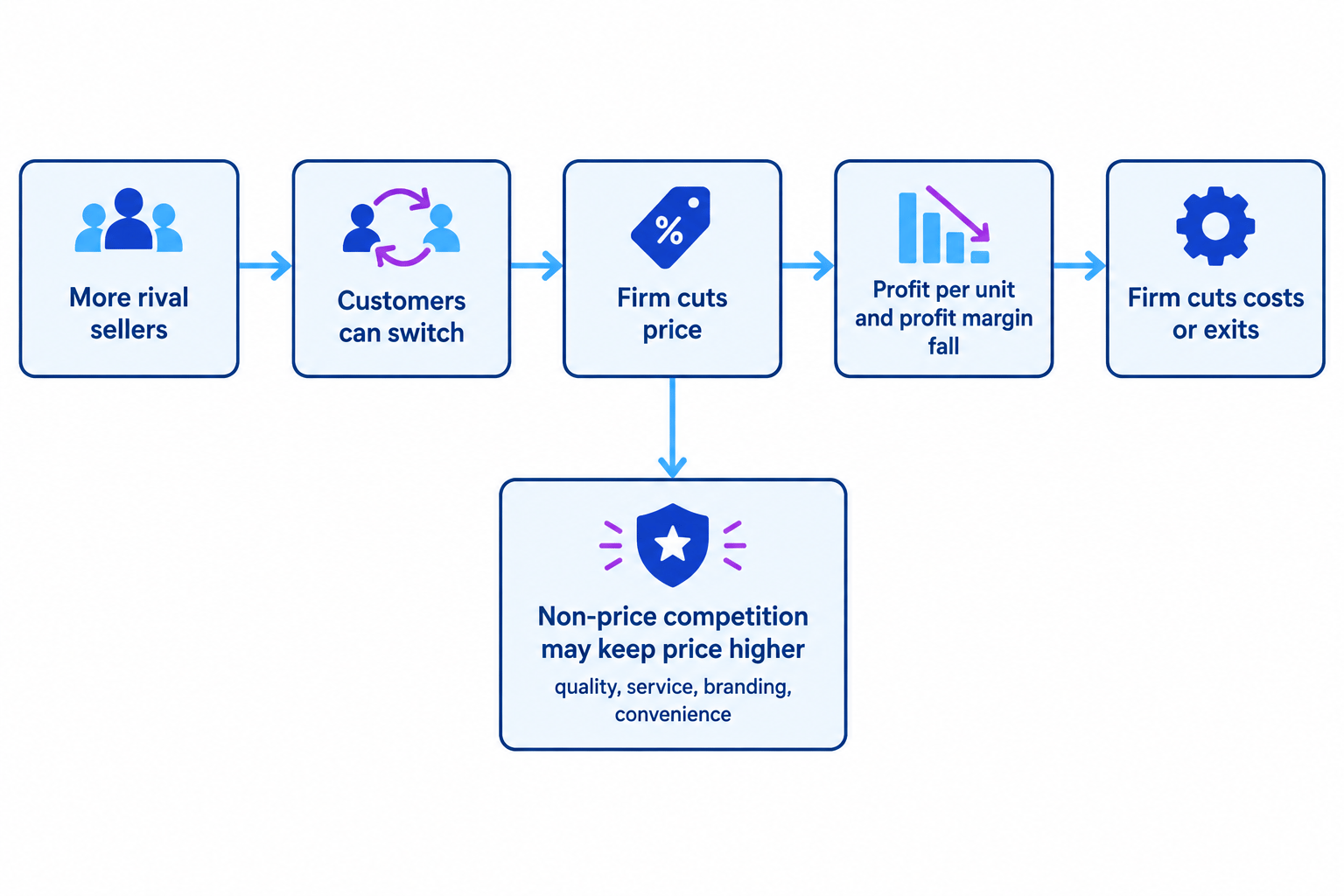
Competition pushes the price down towards cost
Definition
Price taker: a firm that has to accept the market price because it is too small for its own output to affect it.
- A firm charging more than its rivals loses buyers to them, so the going rate acts as a ceiling on what any one seller can charge.
- A firm charging less wins buyers, which pressures the others to match it, and the price settles lower than before.
- The floor is the cost of production, because no firm keeps selling below the cost of making the unit for long, as covered in 2.6.5.
- Competition therefore squeezes the price into the gap between what buyers will pay and what production costs.
A lower price squeezes the profit on each unit
Definition
Profit margin: the profit made on a unit expressed as a percentage of its selling price.
- Cutting the price to match a rival does not cut the cost of production, so the whole reduction comes out of the profit on each unit.
- That is why competition and thin margins go together, and why firms in competitive markets work so hard on cost.
Example
- A sandwich shop sells a sandwich for £4.00 which costs £3.00 to make.
Step 1: find the profit on each unit and express it as a share of the price:
£4.00−£3.00£4.00×100=25% \frac{\pounds4.00 - \pounds3.00}{\pounds4.00} \times 100 = 25\% £4.00£4.00−£3.00×100=25%Step 2: a rival opens next door and the shop cuts its price to £3.50, with costs unchanged:
£3.50−£3.00£3.50×100=14.3% \frac{\pounds3.50 - \pounds3.00}{\pounds3.50} \times 100 = 14.3\% £3.50£3.50−£3.00×100=14.3%- A 50p price cut has taken the margin from 25% to 14.3%, so the shop must either cut its costs or accept far less on every sandwich.
Firms cut costs to survive a lower price
- Because the price is set by the market, the only way to restore the margin is to lower the cost of producing each unit.
- Firms therefore invest in equipment, negotiate harder with suppliers and look for the scale savings covered in 2.6.6.
- This is how competition reaches the whole economy, since a market that squeezes prices also drives up productivity, as in 2.6.2.
- A firm that cannot get its costs down leaves the market, which is the pressure competition applies at its sharpest.
Firms also compete without touching the price
Definition
Non-price competition: competing for customers by any means other than price, such as quality, service, range, branding or convenience.
- Cutting price is easy for a rival to copy within a day, so a price advantage rarely lasts.
- Quality, brand and loyalty schemes are harder to copy, which is why firms in concentrated markets often prefer them.
- Non-price competition can hold the price up rather than push it down, because a firm whose product buyers see as different no longer has to match rivals exactly.
Common Mistake
- Do not assume competition always means falling prices, since firms competing on quality and brand may hold prices up.
- Do not confuse a low price with a low cost, because a firm can cut price without cutting cost and simply earn less.
How far competition lowers price depends on conditions
- It depends on how many sellers there are, because two firms watching each other behave very differently from twenty, as covered in 2.5.4.
- It depends on how easily buyers can switch, since a contract or a loyalty scheme weakens the threat that makes rivals cut prices.
- It depends on how similar the products are, because a firm selling something buyers see as distinctive does not have to match anyone's price.
Exam technique
- Trace the chain from the rival's action to this firm's price to its margin, rather than asserting that competition lowers prices.
- Work out the margin when a question gives a price and a cost, since that is what shows the size of the squeeze.
Self review
- What is a price taker?
- A good sells for £5.00 and costs £4.00 to make. What is the profit margin?
- Why does cutting price to match a rival reduce the profit margin?
- Give two examples of non-price competition.
- Why might competition not lower prices where products are seen as different?