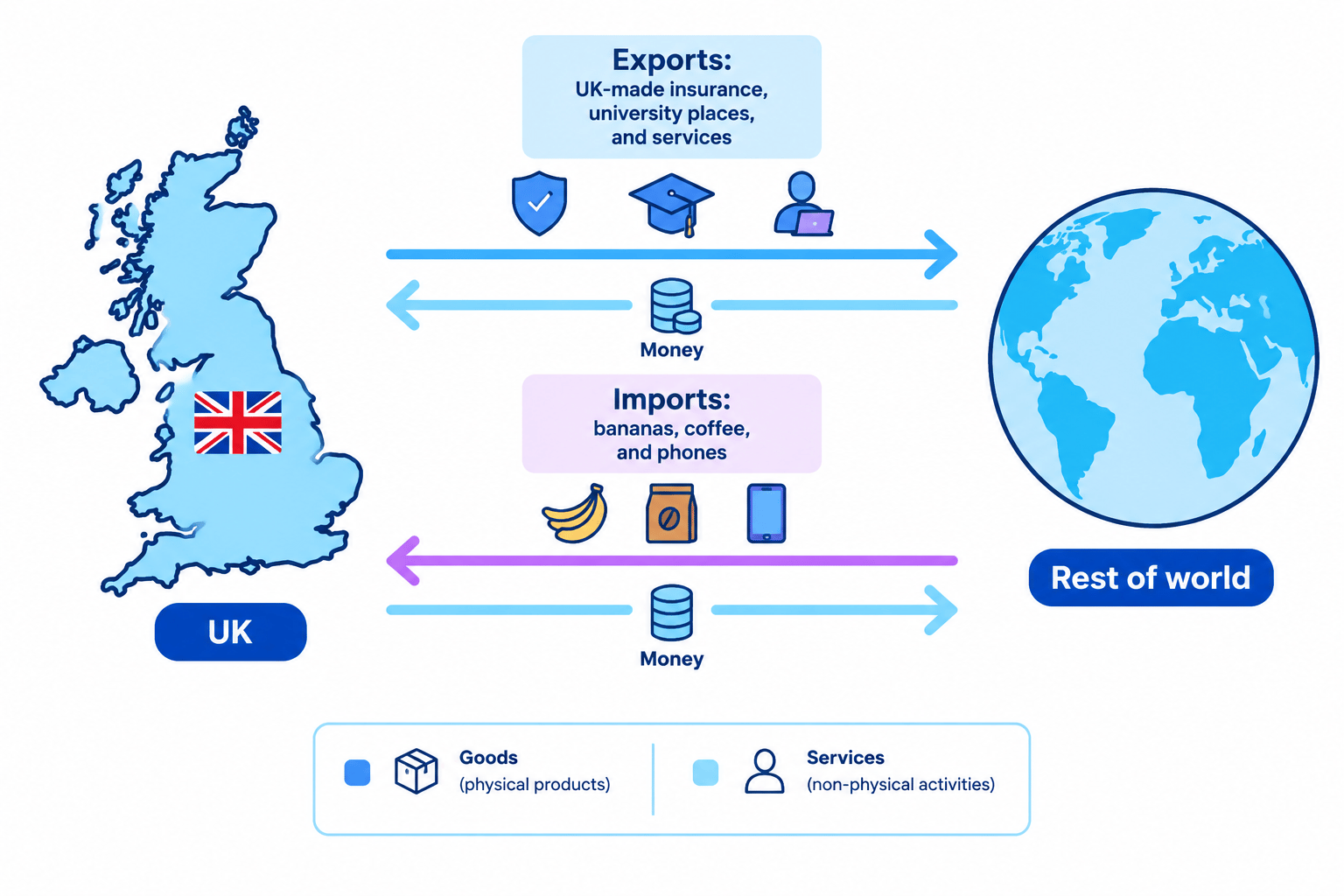
Countries trade because they cannot make everything
International trade: the buying and selling of goods and services between one country and another.
Imports: goods and services a country buys in from abroad, so money flows out to the country that supplied them.
Exports: goods and services made in one country and sold to buyers in another, so money flows into the selling country.
- International trade covers goods you can touch, such as cars, oil and bananas, and services you cannot touch, such as banking, insurance and tourism.
- No country holds every resource, climate and skill it needs, so no country can produce everything its people want.
- Trade fills those gaps, buying in what a country cannot make well and selling abroad what it can.
- The UK sells insurance cover and university places to buyers abroad, and these are exports even though nothing physical crosses a border.
- It buys in bananas, which cannot be grown in the UK climate, and those are imports.
Differences between countries make trade worth doing
- Natural resources are spread unevenly, so a country with oil, gas or fertile farmland can sell what a country without them must buy.
- Climate decides what can be grown, which is why coffee, cocoa and bananas come from hot, wet countries rather than cold northern ones.
- Skills and technology differ, so countries build up strengths in particular products such as medicines, software or aircraft engines.
- Costs of production differ, because wages, land and energy prices vary, so the same good can be made far more cheaply in one country than another.
- Taken together, these differences leave every country cheap at producing some things and expensive at others, and trade lets it act on that.
Why a country concentrates on what it produces best instead of making a little of everything is taken further in 2.1.4.
The UK does not import goods because it has failed at making things. It imports them because the differences above make many goods cheaper to buy in than to produce at home, which leaves UK workers and capital free for the services it sells so well.
Consumers gain lower prices and wider choice
- Lower prices: buying from whichever country produces most cheaply pulls prices down, and competition from imports stops UK firms charging more.
- Wider choice: shoppers can pick from producers all over the world rather than only from the firms based in the UK.
- Access to goods the UK cannot produce: coffee and cocoa cannot be grown in the UK climate, so without imports they would not be on the shelves at all.
- Better quality: facing foreign rivals as well as home ones, producers have to improve what they sell to keep their customers.
- Every one of these lands on the household, which is what makes it a consumer benefit: the group better off at the end is shoppers.
- A UK household in February can buy strawberries grown in a warmer country, a phone assembled abroad and cheese from France.
- Out of season the fruit would not be on sale without imports, and the phone would cost far more if only UK-made models could be bought.
Producers gain bigger markets and cheaper inputs
- Bigger markets to sell into: exporting gives a UK firm customers in dozens of countries rather than only the buyers living in the UK.
- Cheaper raw materials and components: a firm can buy metal, parts and packaging from the cheapest supplier anywhere in the world, which lowers its costs.
- Economies of scale: selling into a much larger market lets a firm produce at higher volume, and the cost of each unit falls as the cost of the factory and machinery is spread across more units.
- Every one of these lands on the firm, which is what makes it a producer benefit: the group better off at the end is businesses.
- Consumer benefits and producer benefits are examined separately, so an answer has to match the group the question names.
- Greater variety of goods is a consumer benefit, so it does not answer a question about producers however true it is.
Sort every benefit by who receives it
- Before writing a benefit down, ask who is better off at the end of it: a household means a consumer benefit, a firm means a producer benefit.
- Some effects reach both groups, since cheaper imported components cut a producer's costs first and may reach the consumer later as a lower price, but the chain must still be explained from the side the question names.
- The two groups can also pull against each other, because the cheap imports widening consumer choice are the same imports taking sales from UK producers who cannot match the price.
How all these imports and exports are added into one record of the UK's trade with the world is covered in 4.2.1.
- What is the difference between an import and an export?
- Give two reasons why countries differ in what they can produce cheaply.
- Did the UK run a surplus or a deficit on trade in goods in 2025?
- State one benefit of international trade for consumers and one for producers.
- Why does greater variety of goods not answer a question about producers?