Question 3
Extract 1: City bicycle market Demand for commuter bicycles rises after a new cycle network opens. At the original price, retailers sell out and maintain waiting lists. Producers can increase output over several months.
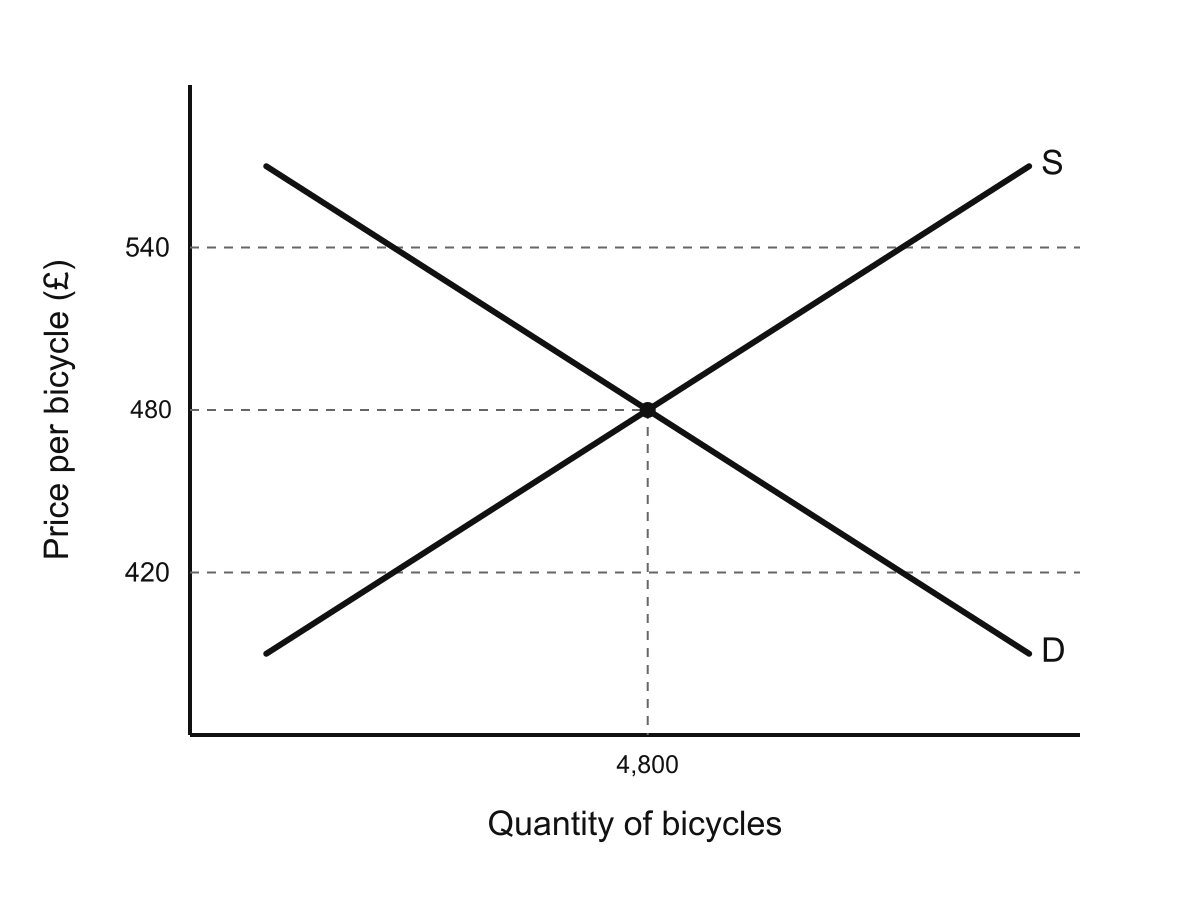
| Price per bicycle | Quantity demanded | Quantity supplied |
|---|---|---|
| £420 | 5,400 | 3,600 |
| £480 | 4,800 | 4,800 |
| £540 | 4,200 | 5,900 |
a.[2]
Using Extract 1, identify the equilibrium price and quantity.
b.[2]
Using the table, calculate the shortage at £420.
c.[6]
Analyse how the new cycle network may move the market to a new equilibrium.
d.i.[2]
State two functions of price in allocating resources.
d.ii.[2]
Explain how the higher bicycle price can transmit consumer preferences to producers.
d.iii.[6]
Evaluate whether allowing the price to rise is the best way to remove the shortage.
2.4 Price Questions
30 exam-style questions on OCR GCSE Economics 2.4 Price, covering 2.4.1 Price and distribution of resources, 2.4.2 Equilibrium price and quantity, 2.4.3 Draw the interaction of demand and supply, 2.4.4 Analyse the interaction of demand and supply, 2.4.5 Role of markets in allocating resources, and 2.4.6 Market forces and equilibrium. Each one has a worked solution and a mark scheme showing where the marks go.