Barter means swapping goods for other goods
Definition
Barter: exchanging one good or service directly for another, with no money involved.
Double coincidence of wants: the situation barter requires, where each person happens to have exactly what the other wants and wants exactly what the other has.
- Finding a match: a baker who wants a haircut has to find a barber who happens to want bread, which can take a long time or never happen at all.
- No common measure: without a single yardstick there is no way to say what a loaf is worth, so every pair of goods needs its own rate of exchange.
- Indivisibility: a farmer with one goat cannot hand over a fifth of it for a haircut, so small purchases are impossible.
- Storing value: goods held to trade later can rot, rust or go out of fashion, so wealth cannot safely be kept.
Example
- A farmer owns a goat and wants a haircut, and a barber wants meat.
- That is the lucky case, but the goat is worth far more than one haircut and cannot be divided, so the trade still fails.
- Every one of these problems disappears the moment both of them accept the same thing in payment.
Money is anything widely accepted in exchange
Definition
Money: anything widely accepted as payment for goods and services, and in settlement of debts.
Medium of exchange: the role money performs when it is accepted in return for goods and services, so buyers and sellers no longer need a double coincidence of wants.
- Money breaks one trade into two, because the farmer sells the goat to whoever wants it and then buys a haircut with the proceeds.
- Nothing about the object itself makes it money; what makes it money is that everybody accepts it, which is why a £10 note works and a promising rock does not.
- Acceptability: people must be confident others will take it, which is why money issued and guaranteed by the state works best.
- Durability, portability and divisibility: it has to survive being handled, be easy to carry, and come in units small enough for a newspaper and large enough for a car.
- Limited supply: it must be scarce and hard to forge, since anything anyone can make loses its value.
Example
- The Bank of England issues banknotes in England and Wales, while UK coins are made and issued by the Royal Mint (Source: Bank of England).
- Notes and coins are only a small part of the money people use, and 8% of the 49.7 billion payments made in the UK in 2025 were in cash (Source: UK Finance).
- A bank transfer is doing exactly the same job as a coin, which shows that money is defined by what it does rather than what it is made of.
A medium of exchange makes specialisation possible
- Without money a worker has to produce most of what they consume, because trading for the rest is too difficult to rely on.
- Once payment is accepted by everyone, a worker can do one job all day and buy everything else, which is the specialisation set out in 2.1.4.
- Specialisation raises output per worker, so the economy produces more from the same resources, which is the productivity gain in 2.6.2.
- Money is therefore not just a convenience; it is what allows a modern economy with millions of separate jobs to exist at all.
Common Mistake
- Do not define money as notes and coins, because most money in the UK sits in bank accounts and never takes a physical form.
- Do not say barter never works, since it works whenever both sides happen to want what the other has; the problem is how rarely that happens.
Money does other jobs besides exchange
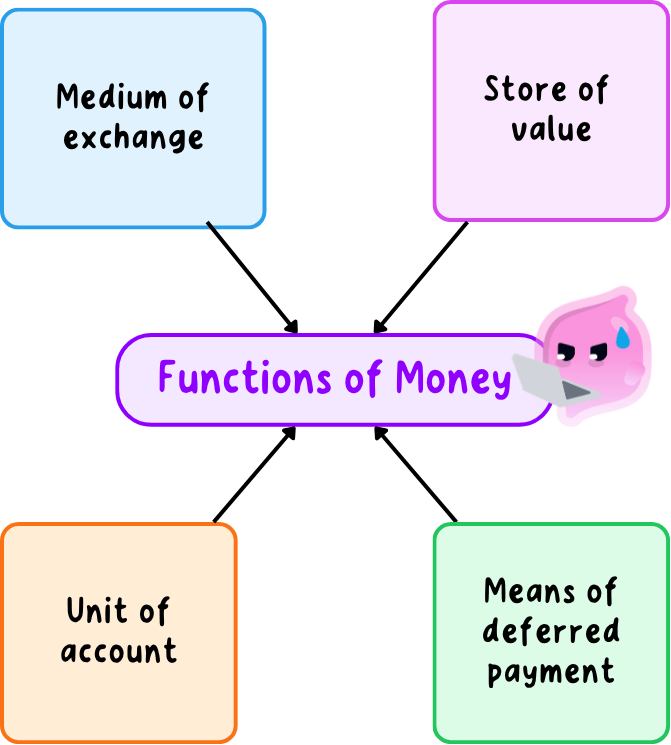
- Store of value: money keeps its worth well enough to be held and spent later, which goods that perish cannot do.
- Unit of account: prices in one currency let any two goods be compared, so a £2 loaf and a £20 shirt can be weighed against each other instantly.
- Means of deferred payment: debts can be written in money, which is what makes borrowing and lending possible, as covered in 2.8.4.
- The medium of exchange is the function that removes the double coincidence of wants, and the other three all depend on money first being accepted in trade.
Exam technique
- Explain the medium of exchange by naming the problem it solves, because the double coincidence of wants is the point of the whole idea.
- Use a two-sided example rather than one, since barter fails because of what the other person wants as much as what you want.
Self review
- What is barter?
- Explain the double coincidence of wants.
- Why can a farmer with one goat not buy a haircut by barter?
- What makes something work as money?
- How does money as a medium of exchange make specialisation possible?
