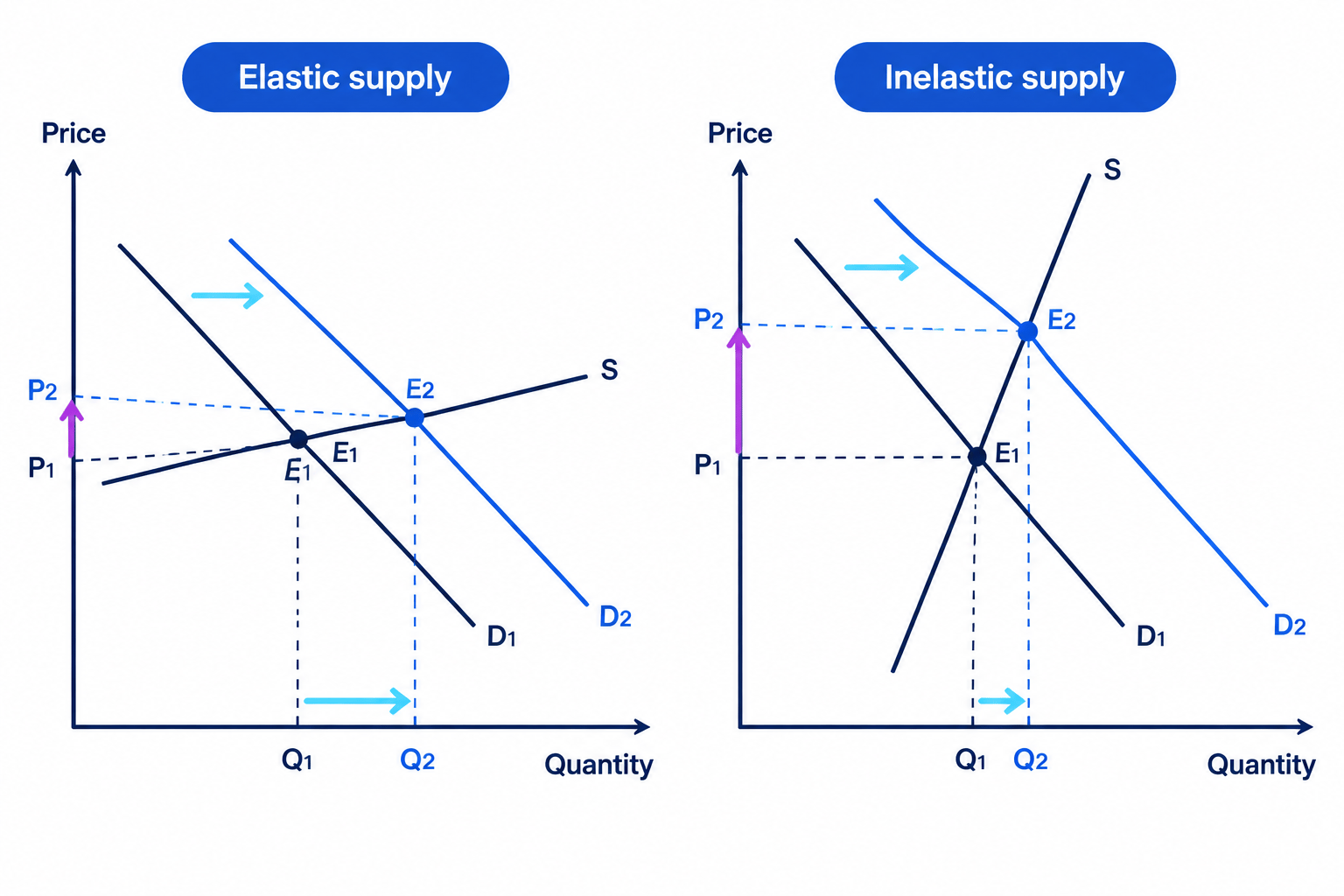
Elasticity decides whether extra demand raises price
- When demand rises, elastic supply meets it with extra output, so the quantity traded grows and the price barely moves.
- When supply is inelastic the same rise in demand runs into a fixed quantity, so almost all of it comes out as a higher price.
- This is why prices for concert tickets and housing in a popular city move so sharply, while prices for mass-produced goods do not.
- How the price finally settles is worked through in 2.4.6; what elasticity settles is how much of the adjustment falls on price rather than quantity.
Producers with elastic supply capture the gain
- A firm that can raise output quickly turns a rise in demand into extra sales and extra revenue, as covered in 2.6.5.
- A firm with inelastic supply watches the price rise without being able to sell much more, so a rival with spare capacity takes the business.
- Inelastic supply cuts both ways, because a producer who cannot expand also cannot cut back when the price falls and is left selling into a weak market.
- This is why firms pay for spare capacity, stock and flexible contracts, since all three buy the ability to respond.
Example
- UK barley production fell 10% to 6.4 million tonnes in 2025 after a wet September held up the harvest (Source: Defra).
- Nothing a grower did that autumn could replace the lost tonnage, because the crop was already in the ground, so supply was close to perfectly inelastic.
- Over the following seasons growers can change what they plant, so the same market becomes far more elastic once a year or two is allowed.
Consumers pay for inelastic supply in price spikes
- Where supply cannot expand, any rise in demand or fall in output reaches consumers almost entirely as a higher price.
- Goods with inelastic supply are also slow to recover after a shock, so the higher price lasts rather than correcting within weeks.
- Consumers gain most from elastic supply, because competition to meet extra demand keeps the price close to the cost of production.
Common Mistake
- Do not confuse elasticity of supply with the amount supplied, since a market can be huge and still be inelastic.
- Do not judge PES without naming the time period, because almost every good is inelastic in the short run and elastic given long enough.
Reaching a judgement on how much PES matters
- It depends on the time period, because a figure that describes this month says nothing about what the same producers can do in three years.
- It depends on what is causing the change, since a demand rise meeting inelastic supply raises price, while a cost rise moves the curve itself.
- It depends on how demand responds, because inelastic supply matters far less where consumers can switch to a substitute, as in 2.2.6.
- Overall: price elasticity of supply decides how much of a market change lands on price and how much on quantity, which makes it central for producers planning capacity and for consumers exposed to price spikes, but it is a short-lived measure that becomes more elastic the longer the period considered.
Exam technique
- Say whether supply is elastic or inelastic and then say what follows for price, because the consequence is what the question is really asking.
- Take consumers and producers separately, since inelastic supply protects some producers' prices while costing consumers directly.
Self review
- Why does a rise in demand raise price sharply when supply is inelastic?
- Give one reason a producer wants elastic supply.
- Why was the 2025 barley harvest an example of inelastic supply?
- How do consumers benefit from elastic supply?
- Reach a judgement: how useful is a single PES figure to a firm planning its capacity?