Elasticity decides what a price change does to revenue
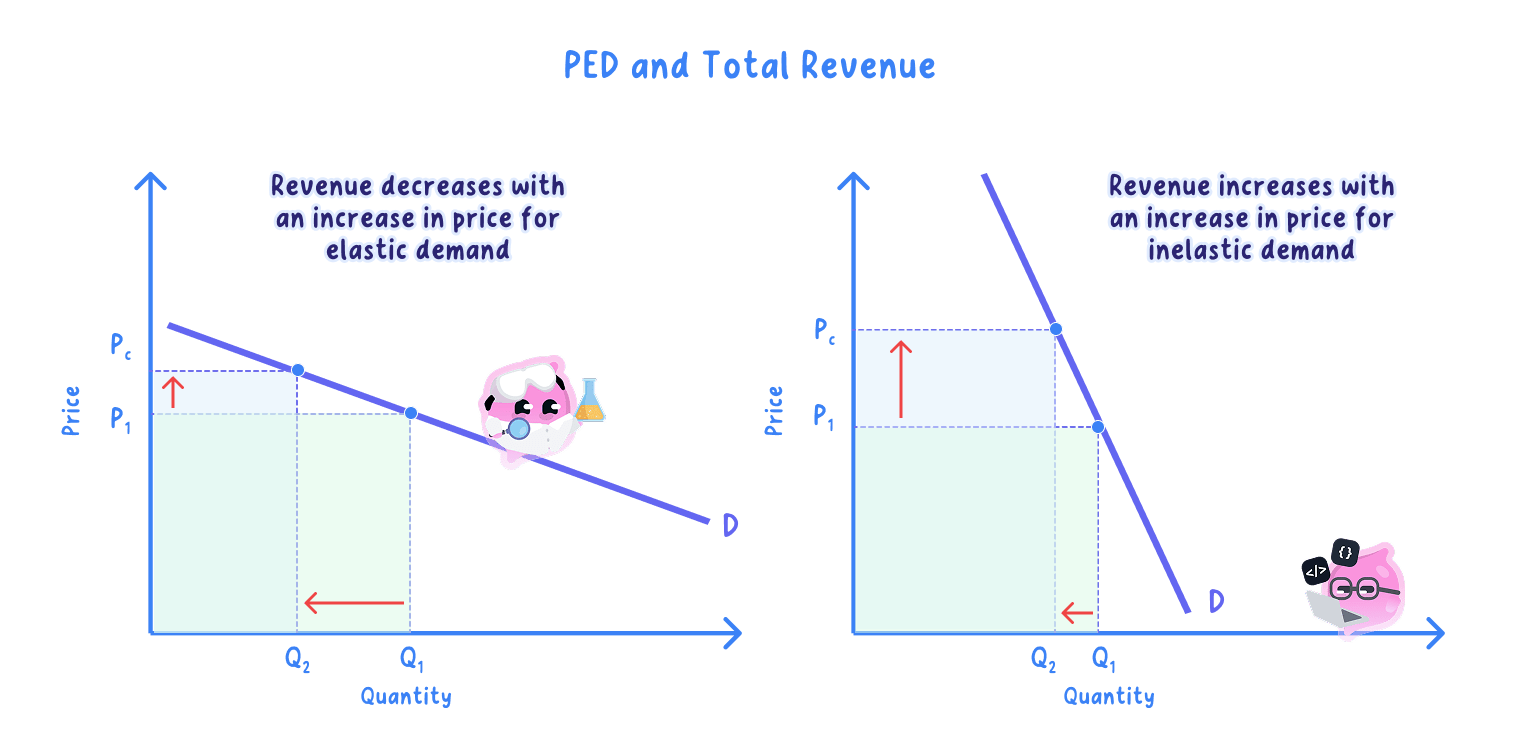
- Total revenue is price multiplied by quantity sold, as set out in 2.6.3, so a price rise pulls the two halves in opposite directions.
- When demand is inelastic the quantity falls proportionally less than the price rises, so revenue goes up.
- When demand is elastic the quantity falls proportionally more, so the price rise loses the firm money.
- This is why the same decision, raising the price, is right for one firm and wrong for another.
Producers use elasticity when setting a price
- A firm with inelastic demand can raise its price and keep most of its customers, which is why necessities and strong brands hold their prices.
- A firm with elastic demand competes on price instead, because a small cut wins a large share of its rivals' buyers.
- Elasticity also shapes non-price decisions, since a firm facing elastic demand advertises to make its own product harder to substitute.
Example
- A good sells 400 units at £2.00, so revenue starts at £800, and its PED is 0.5 in size.
Step 1: apply a 10% price rise, which at a PED of 0.5 cuts quantity demanded by 5%:
new quantity=400−(5%×400)=380 units \text{new quantity} = 400 - (5\% \times 400) = 380\text{ units} new quantity=400−(5%×400)=380 unitsStep 2: multiply the new price by the new quantity:
new revenue=£2.20×380=£836 \text{new revenue} = \pounds2.20 \times 380 = \pounds836 new revenue=£2.20×380=£836- Revenue rises from £800 to £836 because demand is inelastic, and the same 10% rise on an elastic good would have cut revenue instead.
Consumers with no substitute carry the price rise
- Inelastic demand is a weak position for the buyer, because there is nowhere to go when the price goes up.
- That is why a tax on a good with inelastic demand is largely paid by consumers rather than absorbed by producers.
- Consumers facing elastic demand are in the stronger position, since the threat of walking away is what keeps the price down.
Example
- Fuel has relatively price-inelastic demand because many people depend on it for commuting and transport. A rise in price therefore causes only a small fall in quantity demanded, making fuel duty a reliable source of tax revenue for the government.
- Fuel duty is 52.95p per litre, while petrol averaged about 162p per litre in late August 2026. This means fuel duty alone made up roughly one-third of the pump price, before VAT is included (Source: HMRC; DESNZ).
Common Mistake
- Do not say a firm should always raise price when demand is inelastic, because costs, competition law and reputation all constrain it.
- Do not assume elasticity stays the same at every price, since a good can be inelastic near today's price and elastic if that price doubled.
Reaching a judgement on how much elasticity matters
- It depends on how the market is defined, because a firm's own brand is almost always more elastic than the product category it sits in.
- It depends on the time allowed, since demand that looks inelastic this month becomes more elastic once buyers have found alternatives.
- It depends on what else is changing, because a price rise during a fall in real incomes loses more sales than the coefficient alone predicts.
- Overall: price elasticity of demand is the single most useful number a producer can have when setting a price, and it explains why consumers of necessities bear price rises they cannot escape, but it is an estimate for one price range at one moment rather than a fixed property of the good.
Exam technique
- Confirm the direction by working out price multiplied by quantity when a question asks about revenue, rather than asserting which way it moved.
- Take consumers and producers separately, because the same elasticity that helps one of them is what weakens the other.
Self review
- Why does a price rise increase revenue when demand is inelastic?
- A good sells 200 units at £5.00. What is total revenue?
- Why does a firm facing elastic demand compete on price?
- Why is a tax on a good with inelastic demand mostly paid by consumers?
- Reach a judgement: how reliable is a PED figure for a firm making a pricing decision?
