Equilibrium is where the two plans match
Definition
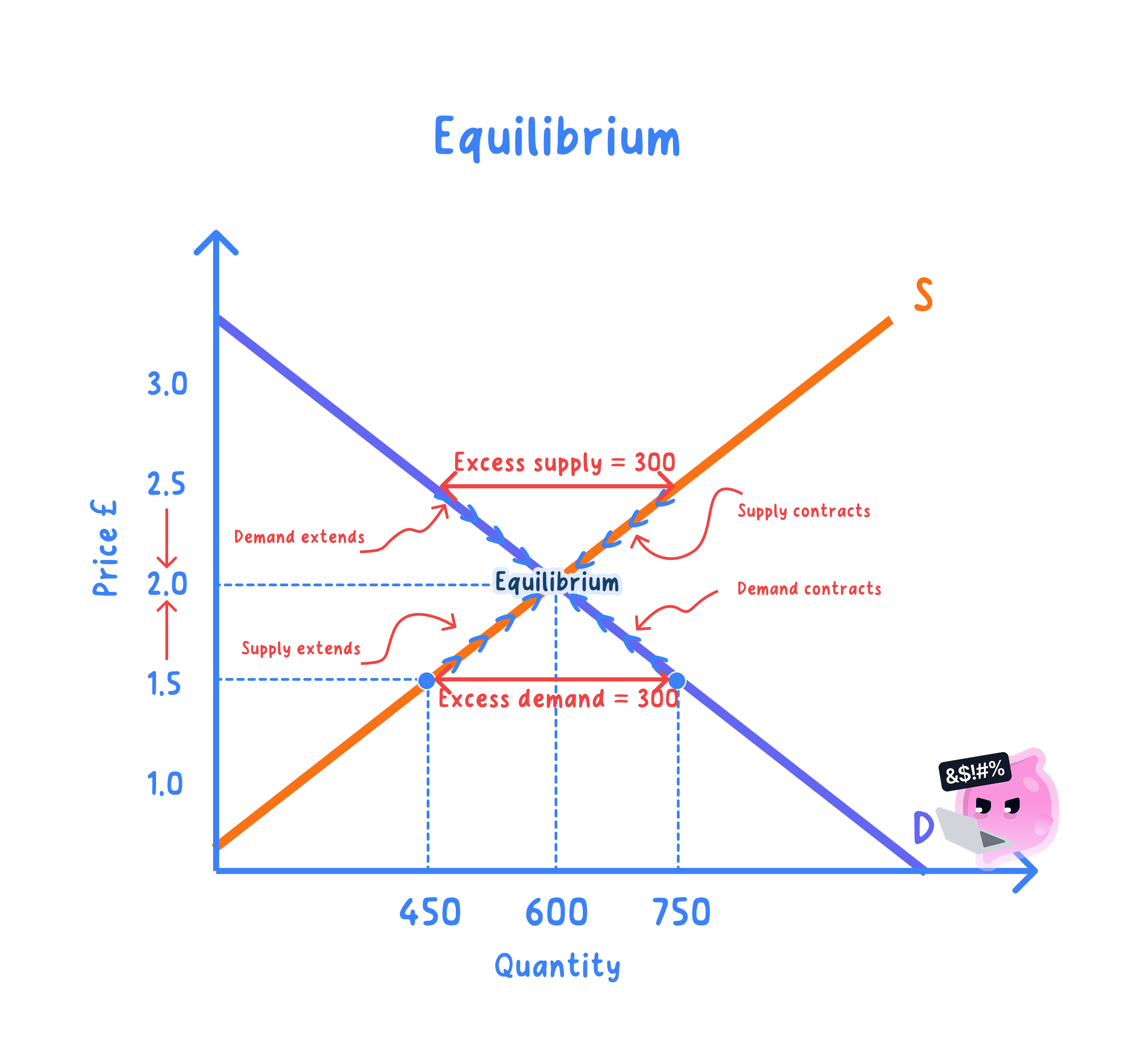
Equilibrium price: the price at which the quantity demanded equals the quantity supplied.
Equilibrium quantity: the quantity bought and sold at the equilibrium price.
Market clearing: the state at equilibrium, where every buyer willing to pay that price finds a seller and every seller willing to sell at it finds a buyer.
- Demand in 2.2.1 and supply in 2.3.1 are separate sets of plans, and equilibrium is the one price at which they agree.
- At that price nothing is left over and nobody is turned away, which is why it is also called the market clearing price.
- Equilibrium is a price and a quantity, so an answer that gives only one of the two is half an answer.
Example
- A market for tubs of butter, with quantities in thousands of tubs a week.
| Price per tub | Quantity demanded | Quantity supplied | Qd − Qs |
|---|---|---|---|
| £1.00 | 900 | 300 | +600 |
| £2.00 | 600 | 600 | 0 |
| £3.00 | 300 | 900 | −600 |
Step 1: work down the schedule subtracting quantity supplied from quantity demanded.
Step 2: find the row where that difference is zero:
600−600=0 600 - 600 = 0 600−600=0- Equilibrium is a price of £2.00 and a quantity of 600 thousand tubs a week, which is the only row where the two plans agree.
Away from equilibrium there is excess demand or supply
Definition
Excess demand: the amount by which quantity demanded exceeds quantity supplied at a price below equilibrium, also called a shortage.
Excess supply: the amount by which quantity supplied exceeds quantity demanded at a price above equilibrium, also called a surplus.
- Subtract quantity supplied from quantity demanded and read the sign, because a positive answer is excess demand and a negative answer is excess supply.
- At £1.00 the butter market shows 900 minus 300, so there is excess demand of 600 thousand tubs a week.
- At £3.00 it shows 300 minus 900, so there is excess supply of the same size in the other direction.
- When you name the size of a surplus in words, quote it as a positive amount, so £3.00 leaves a surplus of 600 thousand tubs.
Common Mistake
- Do not subtract the other way round, since taking demand from supply reverses the sign and turns a shortage into a surplus.
- Do not call excess demand a fall in supply, because at that price supply has not changed at all.
The market corrects itself without anyone deciding
- Excess demand means buyers compete for too few goods, so sellers can raise the price, which brings out more supply and prices some buyers out.
- Excess supply means unsold stock, so sellers cut the price, which brings in more buyers and makes production less attractive.
- Either way the gap narrows as the price moves, and it closes exactly at equilibrium, which is why the market ends up there.
- No authority sets the price, since it is the shortage or the surplus itself that makes it move.
Exam technique
- Give both the price and the quantity, because equilibrium is a pair and an answer with one number is incomplete.
- State the units and the period from the table, since 600 means nothing without thousands of tubs a week attached.
Self review
- Define the equilibrium price in one sentence.
- At £1.00 demand is 900 and supply is 300. State the excess and name it.
- What does market clearing mean?
- Why does excess supply push the price down?
- Why is it wrong to subtract quantity demanded from quantity supplied when finding the gap?
