Economies of scale lower the cost per unit
Definition
Economies of scale: the cost advantages a firm gains as it produces on a larger scale, which lower its average cost.
- The measure is average cost, defined in 2.6.4, so an economy of scale means the cost of each unit falls as output rises.
- Total cost still rises with output, because making more always costs more in materials and labour.
- It is the cost of each unit that falls, which is why a large firm can undercut a small one and still make a profit.
- This is why scale matters for competition, since a large firm's lower average cost is a permanent advantage in the price rivalry of 2.5.2.
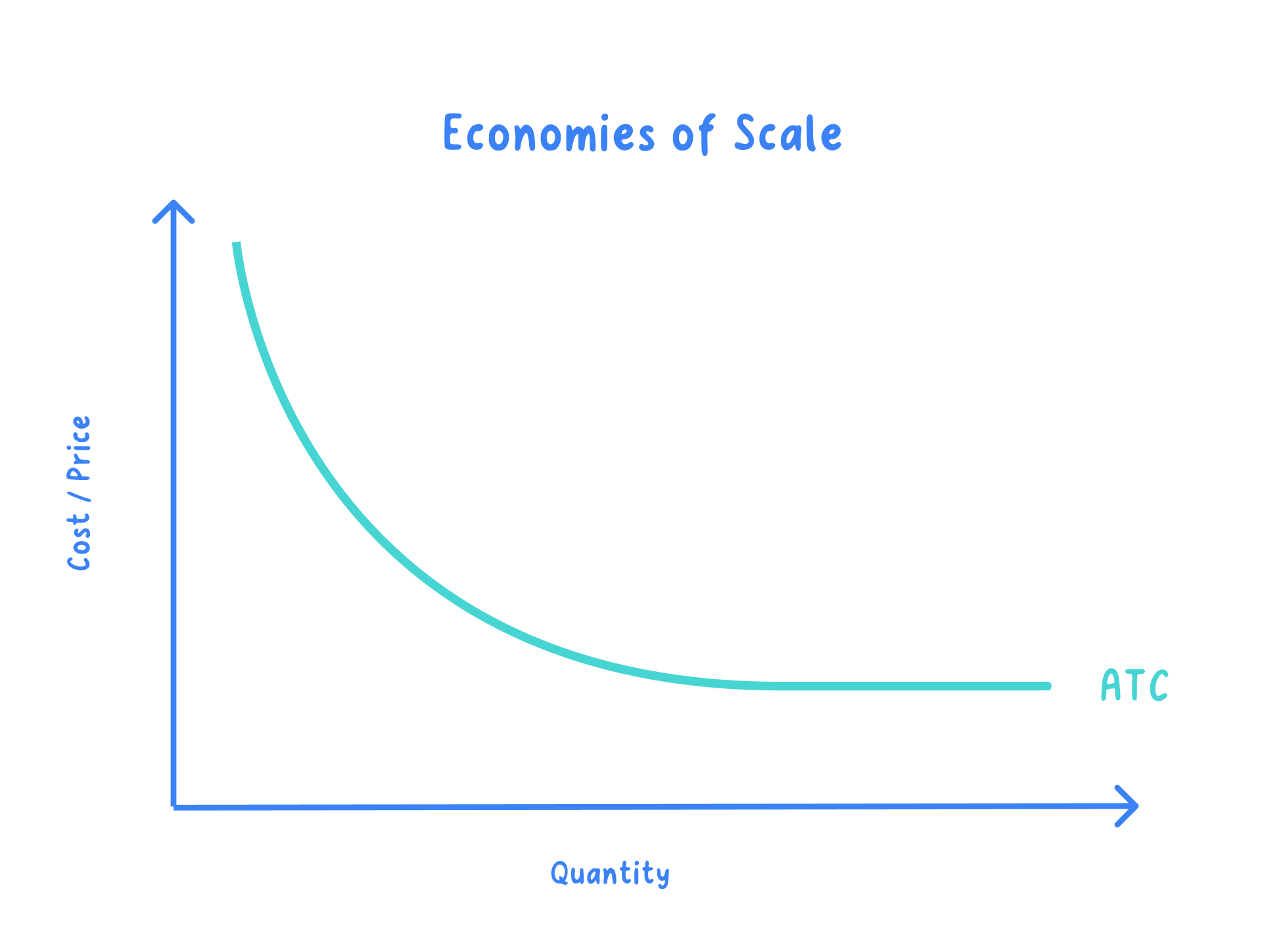
Six routes give a large firm lower costs
- Technical: bigger machinery and longer production runs produce more per hour than small equipment can, and the machine is used fully rather than standing idle.
- Purchasing: a firm buying in bulk negotiates a lower price per unit from its suppliers.
- Managerial: a large firm can employ specialists in buying, marketing and finance, and spread their salaries over far more output.
- Financial: a large firm borrows more cheaply, because lenders treat it as a lower risk than a small one.
- Marketing: the cost of an advertising campaign or a brand is much the same whether output is small or large, so the cost per unit falls as output grows.
- Risk-bearing: a firm selling several products in several markets can carry a setback in one of them, which a single-product firm cannot.

Case study
- Nissan's Sunderland plant has built more than 11 million cars since 1986, with about 6,000 people on site and around five million parts arriving every day (Source: Nissan).
- A plant that size uses machinery no small maker could justify buying, and it buys parts in quantities that command the lowest price per part.
- Tesco's group sales were £66.6 billion in the year to 22 February 2026, and buying on that scale is a purchasing economy in its clearest form (Source: Tesco).
Working out the saving from a schedule
- Calculate average cost at each level of output and compare, because the fall in average cost is what an economy of scale actually is.
- Watch for the fixed cost rising too, since a bigger firm often needs a bigger building, and the saving is the net effect.
Example
- The bakery in 2.6.3 opens a larger plant: fixed costs rise from £600 to £1,000 a week, output rises to 10,000 loaves, and bulk buying cuts the variable cost from 40p to 35p a loaf.
Step 1: find the new total cost:
£1,000+(10,000×£0.35)=£4,500 \pounds1{,}000 + (10{,}000 \times \pounds0.35) = \pounds4{,}500 £1,000+(10,000×£0.35)=£4,500Step 2: divide by the new output to get the average cost:
£4,50010,000=£0.45 a loaf \frac{\pounds4{,}500}{10{,}000} = \pounds0.45\text{ a loaf} 10,000£4,500=£0.45 a loafStep 3: compare with the average cost at the smaller scale:
£0.70−£0.45=£0.25 saved per loaf \pounds0.70 - \pounds0.45 = \pounds0.25\text{ saved per loaf} £0.70−£0.45=£0.25 saved per loaf- Average cost has fallen by 25p a loaf even though fixed costs rose, because the larger output spreads them further and the bulk price is lower.
The fall in average cost does not continue forever
- Beyond some size a firm becomes harder to manage, communication slows and average cost starts to rise again.
- So the average cost curve eventually turns upwards, and being bigger stops being cheaper.
- That is why large firms and small firms coexist in the same industry, since the cheapest scale is not always the largest.
Exam technique
- Use average cost, not total cost, when you explain an economy of scale, because total cost rises with output either way.
- Name the type of economy you mean, so say bulk buying or specialist managers rather than the firm being bigger.
Self review
- Define economies of scale in one sentence.
- Name three types of economy of scale.
- Total cost is £4,000 at an output of 8,000 units. What is average cost?
- Why does total cost still rise even when a firm enjoys economies of scale?
- Why does average cost eventually stop falling as a firm grows?
