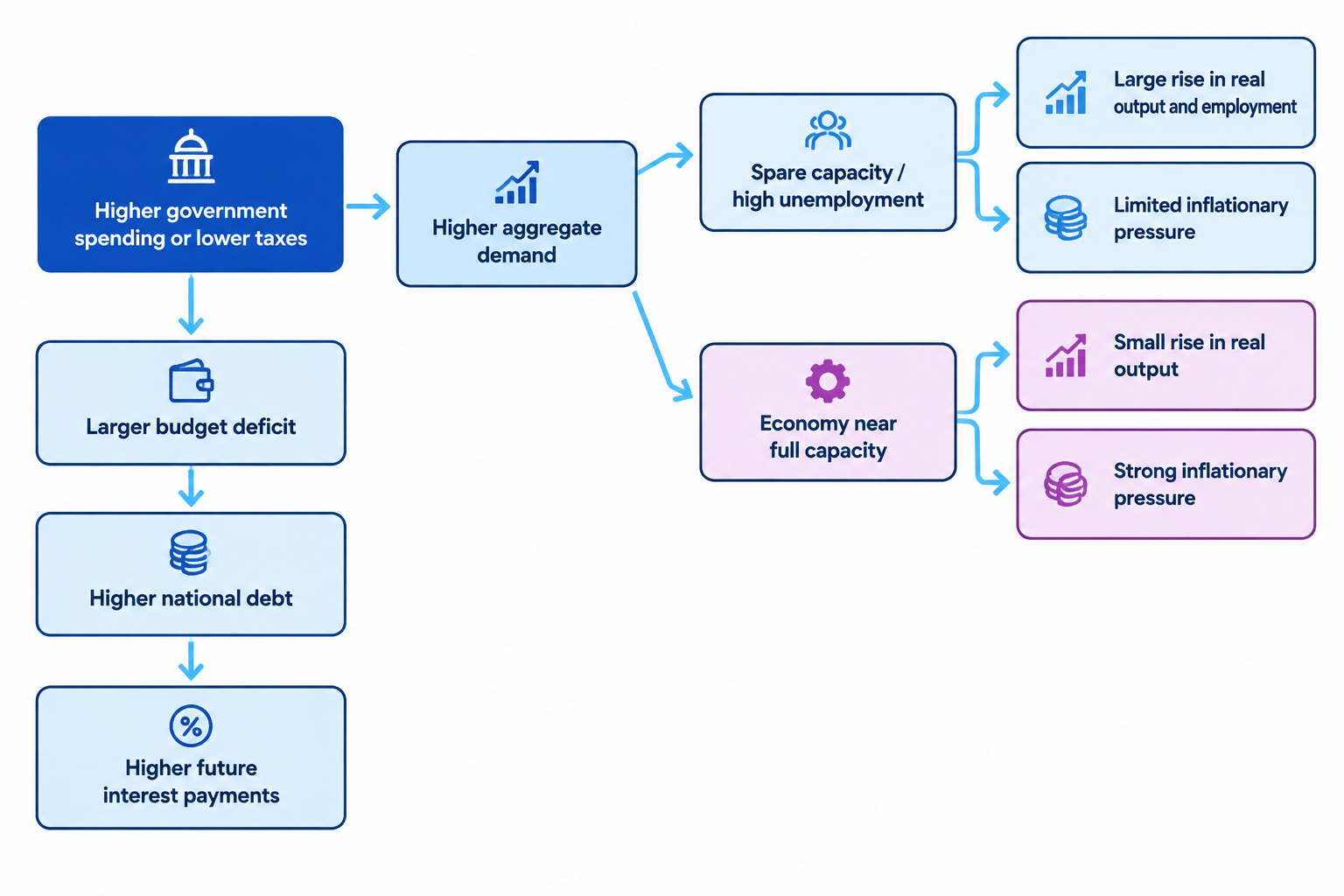
Fiscal policy can lift output and jobs
- It works on total spending directly, so a government that raises its own spending adds demand without waiting for anyone else to act.
- It can be aimed, because spending or a tax change can be directed at one region, one industry or one group of households.
- It reaches people monetary policy struggles to reach, since a benefit increase raises the income of households who do not borrow at all.
- Capital spending raises future capacity as well as present demand, which is the only lever that does both at once.
Example
- UK spending on social protection was around £384 billion in 2024/25, so even a small percentage change in it moves a large amount of money (Source: House of Commons Library).
- That scale is what gives fiscal policy its power, and also what makes any change politically contested.
Every choice carries an opportunity cost
- Government funds are limited, so money spent on one thing is money not spent on another, and that forgone alternative is the opportunity cost of the decision.
- Choosing to build a hospital may mean a planned school is delayed, and the school is the real cost of the hospital.
- Funding the choice by borrowing does not remove the cost, it moves it, because interest has to be paid out of future budgets.
- Funding it by taxation moves the cost onto households and firms, who then have less to spend themselves.
- Naming the specific alternative given up is what turns a vague point about cost into a real one.
Common Mistake
- Do not treat government spending as free money, because every pound comes from taxation, borrowing or another programme.
- Do not stop at saying there is an opportunity cost, since the point only lands once you name what was given up.
Timing and side effects weaken it
- Fiscal policy is slow, because a change usually waits for a Budget and a large project takes years to deliver.
- It can arrive too late, so a boost intended for a downturn can land once recovery is already under way and add to inflation instead.
- Expansionary policy widens the deficit, adds to the national debt and raises the interest bill in every later year.
- High tax rates can weaken incentives, since a very high marginal rate reduces the gain from extra work or extra risk.
- Policy also has to be reversed eventually, and raising taxes or cutting spending is far harder politically than the opposite.
How far fiscal policy is worth using
- It depends on the state of the economy, because expansion in a slack economy buys output and jobs while the same expansion near capacity buys mainly inflation.
- It depends on what the money is spent on, since capital spending that raises future capacity can pay for itself in a way that current spending cannot.
- It depends on the starting level of debt, because a government already paying heavy interest has less room to borrow and faces a higher price for doing so.
- It depends on how quickly the problem needs solving, as monetary policy can be changed within weeks while fiscal policy usually cannot.
- Overall: fiscal policy is the strongest tool available for a deep downturn, because it adds spending directly and can be aimed where it is needed, but it is slow, it widens the deficit and every use of it gives up something else, so it is best kept for problems that monetary policy alone cannot reach.
Exam technique
- Name the alternative given up when you use opportunity cost, because the term earns nothing on its own.
- Say where the economy is starting from, since that single fact decides whether an expansion produces output or prices.
Self review
- Give two advantages of fiscal policy over other ways of influencing the economy.
- What is the opportunity cost of building a new hospital?
- Explain why fiscal policy can arrive too late to help.
- Why does expansionary fiscal policy raise the interest bill in future years?
- Which factor most affects whether expansionary fiscal policy raises output or prices?