Skills, assets and jobs drive the gaps
Definition
Inequality: when income or wealth is spread unevenly across the population.
Relative poverty: when a household's income is far below the typical income in its own country, so it cannot afford what most people there regard as normal.
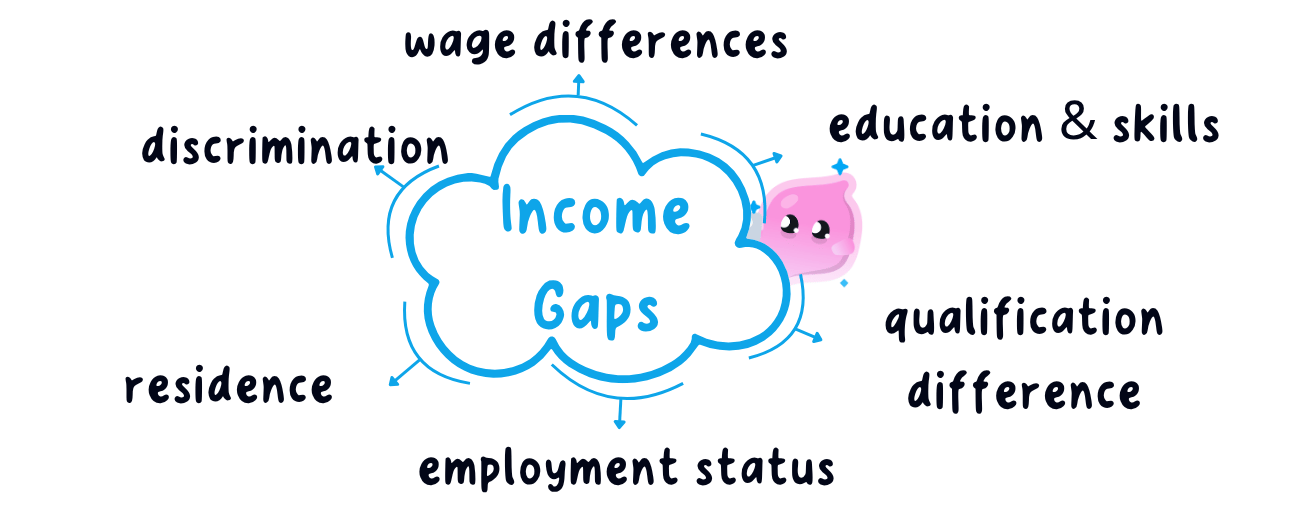
- Skills and qualifications: a worker whose skills are scarce and in demand is paid more, which is the largest single source of differences in earned income.
- The job itself: pay differs by occupation and by industry, and also with how unpleasant, risky or unsociable the work is.
- Hours and employment status: part-time work, insecure hours and spells of unemployment all cut annual income even when the hourly rate is the same.
- Where people live: pay differs by region, because the industries that pay best are concentrated in some areas and absent from others.
- Discrimination: where pay depends on something other than the work done, the groups facing it earn less than their skills would otherwise command.
Example
- In the financial year ending 2024 the richest fifth of UK households had 5.6 times the disposable income of the poorest fifth (Source: ONS).
- The top 1% of individuals received 6.6% of all disposable income in that year.
Wealth gaps come from time and inheritance
- Wealth differences are wider than income differences because assets accumulate, so a small yearly gap in saving compounds into a large gap in holdings.
- Inheritance: wealth passes between generations, so some households begin with assets that others must save for from nothing.
- Home ownership: rising house prices add to the wealth of owners and add nothing at all to the wealth of renters.
- Pension saving: a workplace pension builds a large asset across a career, and workers without one build none.
- Age matters too, because an older household has had longer to save, so part of the measured wealth gap is a gap in life stage rather than in lifetime prosperity.
Some inequality helps and too much hurts
- Incentives: the prospect of higher pay encourages people to train, to work harder and to take the risk of starting a firm, so some inequality raises output.
- Lost potential: where low income stops a child getting a good education, the economy never gets the output that person would have produced.
- Weaker demand: households on low incomes spend a larger share of what they receive, so income concentrated at the top can leave total spending lower than it would otherwise be.
- Public finances: wide inequality raises spending on benefits and support while narrowing the tax base at the bottom.
- Social costs: relative poverty is linked to worse health and higher crime, both of which cost the economy output and cost the government money.
Case study
- The National Living Wage rose to £12.71 an hour for workers aged 21 and over on 1 April 2026 (Source: GOV.UK).
- A floor under hourly pay lifts the income of the lowest-paid workers directly, narrowing the gap without touching tax or benefits.
- It reaches only people in work, so it does nothing for a household with nobody employed.
- It also raises costs for the firms employing those workers, which is why the rate is reviewed each year rather than left to the market.
How far inequality damages the economy
- It depends on how wide the gap is, because a modest spread rewards effort while a very wide one wastes the potential of the people at the bottom.
- It depends on whether people can move between groups, because inequality matters far less if a child born poor can realistically end up well paid, and far more if they cannot.
- It depends on what caused the gap, because differences that reflect skill and effort do different economic work from differences that reflect inheritance or discrimination.
- Overall: some inequality is useful, because it keeps alive the incentive to train and to take risks, but wide and persistent gaps cost an economy output, since talent goes undeveloped, total spending is weaker and the state ends up supporting households that a fairer distribution would have left able to support themselves.
Exam technique
- Separate a cause of the gap from a consequence of it, because a question asking for one gains nothing from the other.
- Say whether you are discussing income or wealth, since the wealth gap in the UK is much the wider of the two and the reasons behind it are different.
Self review
- Give three causes of differences in income between households.
- Why is the wealth gap wider than the income gap?
- Explain one way inequality can raise an economy's output.
- Explain one way inequality can lower an economy's output.
- Why does the National Living Wage not help every low-income household?
