Monetary policy first targets controlling inflation
- The Bank of England's first job is to use monetary policy to control inflation, keeping it close to the government's target.
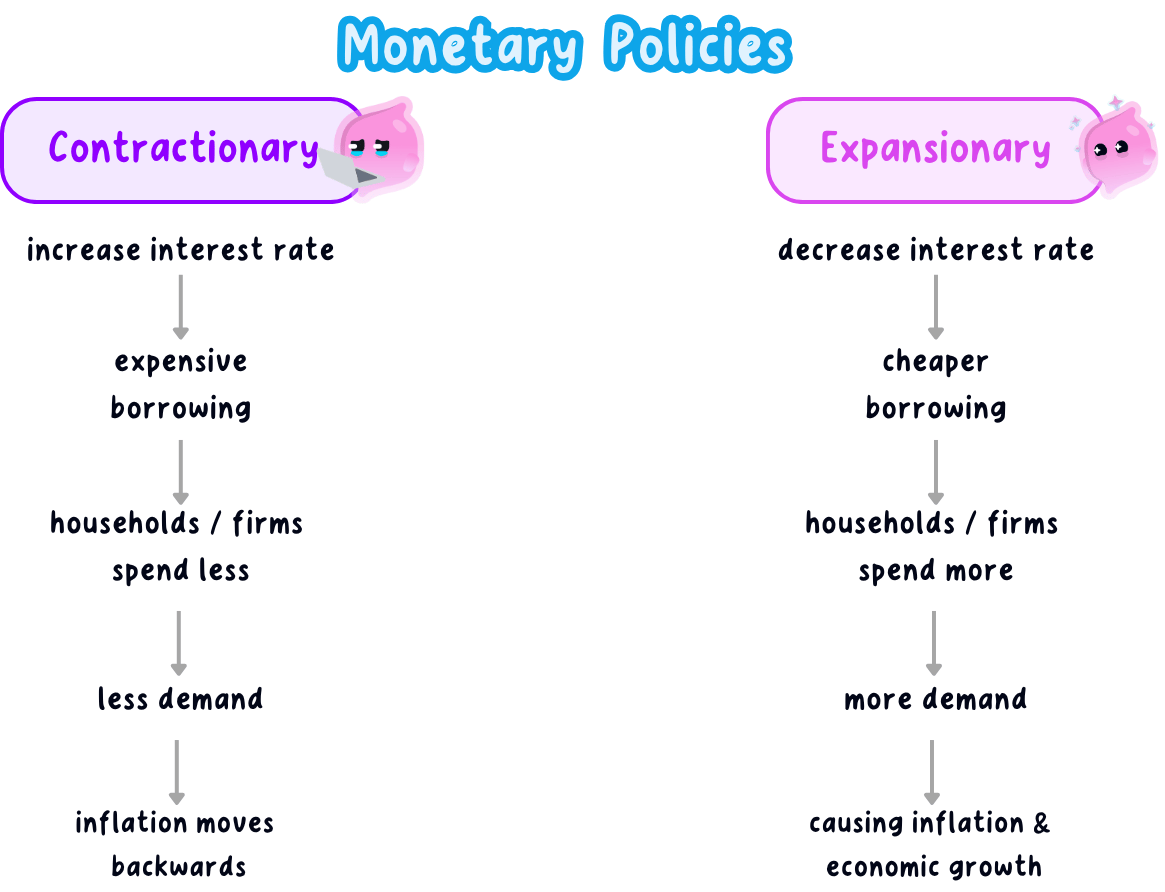
- When inflation rises above target, the Bank tends to raise the base rate.
- More expensive borrowing leads households and firms to borrow and spend less.
- Higher rewards for saving encourage people to save rather than spend.
- With weaker demand, the upward pressure on prices eases and inflation moves back towards the target.
Example
- In July 2026, CPI inflation rose to 2.9 per cent, above the Bank of England's 2 per cent target.
- At its June 2026 meeting, the Monetary Policy Committee held the base rate at 3.75 per cent by a 7 to 2 vote, with the minority wanting a rise to 4.00 per cent because of the risk from rising energy-driven prices.
Monetary policy also supports growth and jobs
- When a central bank instead wants faster growth and more employment, it cuts the base rate.
- Cheaper borrowing encourages households to raise spending and firms to raise investment.
- Lower rewards for saving nudge people to spend rather than save, which supports demand and jobs.
Example
- Between August 2024 and December 2025, the Bank of England cut the base rate six times in a row, from 5.25 per cent down to 3.75 per cent, partly to support growth and jobs as inflation fell.
- This shows the Bank moving the base rate down when it wants to boost demand rather than curb it.
Monetary policy can affect trade through the exchange rate
- Changing the base rate can also move the exchange rate, the value of the pound against other currencies.
- A higher rate tends to attract money into the country and raise the pound's value, while a lower rate can do the reverse.
- A stronger pound makes UK exports dearer abroad and imports cheaper at home, which can widen a trade deficit.
- The UK already runs a trade in goods deficit of around £59.5bn, 7.6 per cent of GDP, in the first quarter of 2026, so exchange rate effects on trade are a live policy concern.
Common Mistake
- It is wrong to think a higher interest rate is good news for everyone.
- A higher rate rewards savers but makes life harder for borrowers, such as families with a mortgage, and can also hurt exporters through a stronger pound.
How far rate changes deliver objectives depends on lags
- It depends on time lags, because interest rate changes take many months to feed through the economy, so the Bank may end up acting on out of date information.
- It depends on confidence, because even a low interest rate may fail to lift spending if households and firms feel too uncertain to borrow.
- It depends on global factors, because a change in the base rate cannot offset a shock such as a global rise in energy prices.
- It depends on who is affected, because a rate rise rewards savers but makes life harder for mortgaged borrowers, so the impact is uneven across groups.
- On balance, higher or lower interest rates can move the economy in the intended direction, but time lags, confidence and events elsewhere in the world all limit how reliably and how quickly they deliver the objective.
Self review
- How does raising the base rate help control inflation?
- How does cutting the base rate support growth and jobs?
- Explain how a change in the base rate can affect the exchange rate.
- Give one reason why an interest rate change might not fully achieve its objective.
- Reach a judgement: how reliable is monetary policy at delivering the government's objectives?