Supply-side policy aims to raise the economy's long-run capacity
Definition
Supply-side policy: a set of government measures designed to raise an economy's productive capacity and efficiency over the long run.
- The aim is to raise productive capacity, the maximum output the economy can produce when resources are used fully and efficiently, not to raise spending today.
- This differs from demand-side policy, which changes total spending in the economy to affect output and jobs in the short run.
- Because it changes the economy's underlying structure, supply-side policy is judged over years rather than weeks or months.
Common Mistake
- Supply-side policy does not give the economy an instant boost, since most measures take years to have an effect.
- It is not a substitute for monetary or fiscal policy when a sudden downturn needs a quick response.
Policies target different parts of the supply side
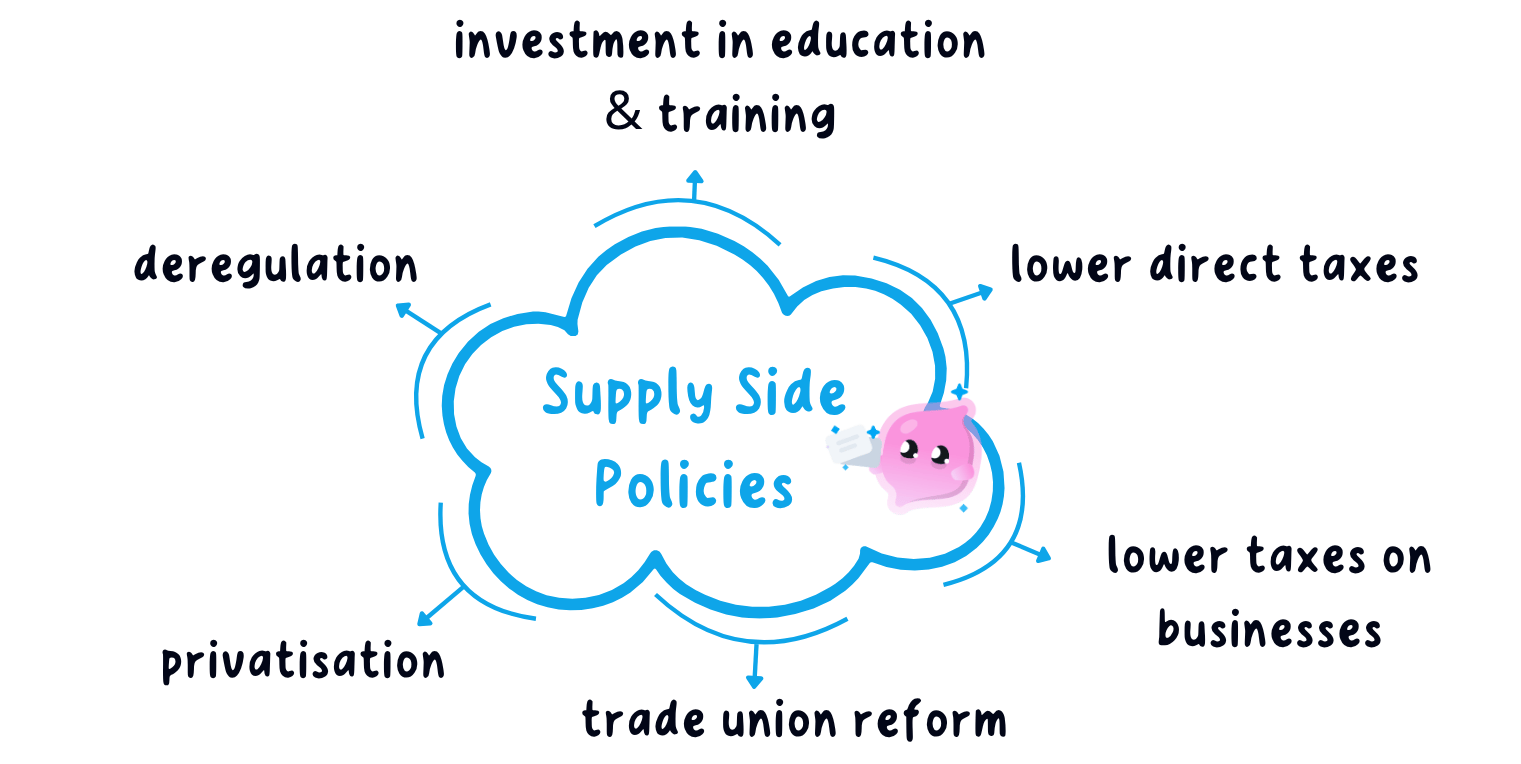
Education and training raises skills to lift productivity
- Education and training: government spending to improve workers' skills and knowledge, for example funding apprenticeships, T-levels and adult retraining.
- Advantage: better-skilled workers produce more per hour, which raises productivity and can lower structural unemployment as skills match the jobs on offer more closely.
- Disadvantage: training is expensive and funded from tax revenue, and it can take years before newly skilled workers enter the workforce.
Example
- Large UK employers fund apprenticeships through the Growth and Skills Levy, formerly called the apprenticeship levy, which was renamed in April 2026 but still charges 0.5 per cent of an employer's pay bill above £3m.
- T-level courses, introduced from 2020, combine classroom study with an industry placement to build technical skills.
Lower direct taxes aim to strengthen incentives to work
- Lower direct taxes: cutting taxes paid directly on income, such as income tax or National Insurance, so workers keep more of what they earn.
- Advantage: a bigger take-home wage can encourage more people to work, to work longer hours, or to delay retirement.
- Disadvantage: cutting direct taxes reduces the tax revenue the government has available for public services.
Example
- A worked example shows the effect using the 2026/27 income tax personal allowance of £12,570 and the 20 per cent basic rate.
Step 1: find the taxable income of a worker earning £20,570 a year:
£20,570−£12,570=£8,000 \pounds20{,}570 - \pounds12{,}570 = \pounds8{,}000 £20,570−£12,570=£8,000Step 2: apply the 20 per cent basic rate to the taxable income:
£8,000×0.20=£1,600 tax \pounds8{,}000 \times 0.20 = \pounds1{,}600 \text{ tax} £8,000×0.20=£1,600 taxStep 3: raise the tax-free personal allowance by £1,000, to £13,570, and recompute the tax:
£20,570−£13,570=£7,000 \pounds20{,}570 - \pounds13{,}570 = \pounds7{,}000 £20,570−£13,570=£7,000 £7,000×0.20=£1,400 tax \pounds7{,}000 \times 0.20 = \pounds1{,}400 \text{ tax} £7,000×0.20=£1,400 taxStep 4: compare the tax paid before and after the tax cut:
£1,600−£1,400=£200 \pounds1{,}600 - \pounds1{,}400 = \pounds200 £1,600−£1,400=£200- For this worker, the £1,000 rise in the personal allowance is worth an extra £200 a year in take-home pay, the same £200 the government gives up in revenue.
Lower taxes on business profits aim to boost investment
- Lower taxes on business profits: cutting corporation tax, the tax UK companies pay on their profits.
- In the 2026/27 tax year the main rate is 25 per cent on profits over £250,000, while a small profits rate of 19 per cent applies to profits of £50,000 or less, with marginal relief tapering the rate in between.
- Advantage: firms keep more of their profit, which can be reinvested in new machinery, technology or premises, raising the capital available to each worker.
- Disadvantage: the tax cut costs the government revenue, and there is no guarantee firms will actually invest the extra profit rather than pay it out to shareholders.
Trade union reform aims to flex the labour market
- Trade union reform: laws that limit the power of trade unions, for example by requiring a minimum turnout before a strike can go ahead.
- The Trade Union Act 2016 requires at least 50 per cent of eligible union members to vote in a strike ballot before the strike is legal, and this threshold was still in force in 2026.
- Advantage: fewer disruptive strikes can lower costs for firms and encourage investment and employment.
- Disadvantage: weaker unions reduce workers' bargaining power, which can hold down wages and weaken protection against poor working conditions.
Privatisation and deregulation expose firms to competition
Definition
Privatisation: transferring a firm or service from government ownership into the private sector.
Deregulation: removing or loosening government rules that restrict how a market operates.
- Advantage: a privatised firm faces competition and the profit motive, which can push it to cut costs and become more efficient, while easing the burden on government finances.
- Disadvantage: a privatised firm can become a private monopoly and raise prices if real competition does not follow.
- Advantage: fewer rules make it cheaper and easier for new firms to enter a market, increasing competition and choice.
- Disadvantage: weaker rules can allow negative externalities, such as pollution or unsafe working conditions, to go unchecked.
Example
- The privatisation of Royal Mail in 2013 sold the UK's postal service into private ownership.
- Bus services outside London were deregulated in 1986, opening routes to competition between private operators.
How far supply-side policies succeed depends on design
- It depends on how well targeted the policy is, because training aimed at a genuine skills gap raises productivity far more than a scheme few workers use.
- It depends on how the policy is funded, because money spent on tax cuts or training has an opportunity cost, since it could have been spent on the NHS, education or reducing debt instead.
- It depends on whether firms and workers actually respond, because a tax cut for business only raises investment if firms choose to spend the extra profit rather than save it.
- It depends on how much time is allowed, because most measures take years to show results, so a policy judged too soon can look as if it has failed.
- Overall, supply-side policies can raise the economy's long-run potential, but their success is uncertain and depends heavily on design, funding and patience.
Exam technique
- Name a specific measure, such as education and training or trade union reform, rather than writing that "the government helped the economy".
- Give one clear advantage and one clear disadvantage for the named measure, stating who gains and who loses.
- Do not evaluate supply-side policy as if it works instantly, since its effects build up over years.
Self review
- Define supply-side policy in one sentence.
- Name the five supply-side policies specified by AQA.
- Give one advantage and one disadvantage of trade union reform.
- Explain why lowering corporation tax does not guarantee higher business investment.
- Why is supply-side policy poorly suited to fixing a sudden recession?