Economic growth is a core macroeconomic objective
- Economic growth means an increase in the real output of goods and services a country produces over time, and governments treat steady growth as one of their main macroeconomic objectives, aiming for national output to keep rising year after year rather than standing still.
Note
- Growth is about producing more, not just spending more.
- A growing economy makes a larger amount of goods and services each year.
Growth raises incomes, employment and living standards
- When firms produce more, they usually need more workers, so employment tends to rise, and higher output means people earn higher incomes and can afford more goods and services.
- Rising output over many years is linked to better living standards for the population as a whole.
Example
- If UK car factories increase production, they may take on extra staff and pay more wages.
- Those workers then spend in local shops, so the benefits of growth spread through the economy.
Governments aim for growth that is steady and sustainable
- Steady growth: output rises at a fairly even pace instead of in sudden booms and slumps.
- Sustainable growth: growth that can be kept going in the future without using up resources or badly harming the environment.
- Governments prefer steady, sustainable growth because it is easier for households and firms to plan around, and because very fast, unsteady growth is harder to maintain and can create problems later.
- When output and incomes rise, the government usually collects more tax revenue, which can help fund public services such as the NHS, schools and roads.
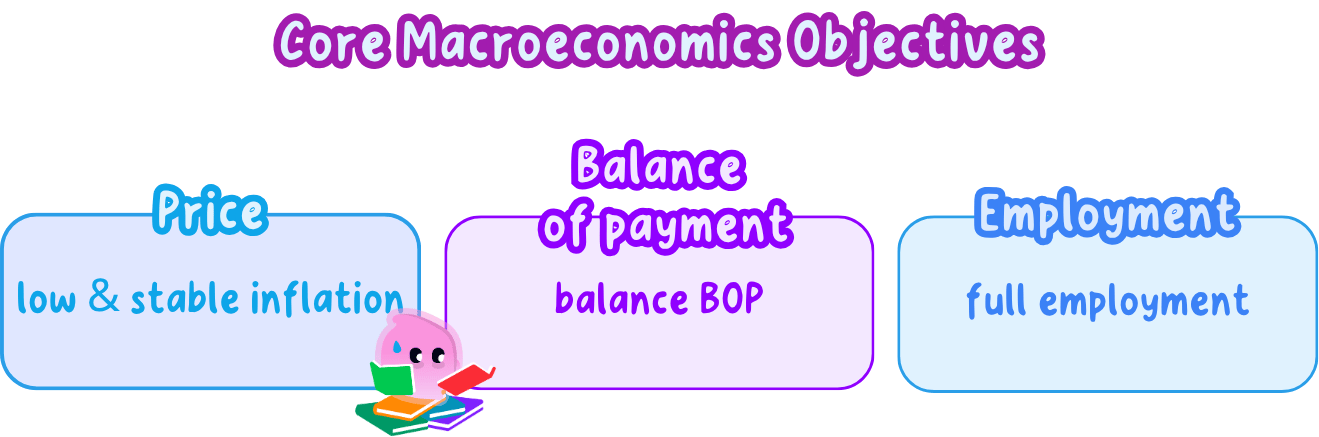
Price stability and full employment are also core objectives
Definition
Price stability: the government's aim of keeping inflation low and stable, so the price level rises slowly and predictably rather than quickly or unevenly.
Full employment: the government's aim of using the labour force as fully as possible, so that as few willing workers as possible are without jobs.
- Price stability does not mean prices never change. It means prices rise gently and steadily, so people are not surprised by sudden jumps.
- Full employment and low unemployment describe the same healthy labour market. The objective is about putting willing workers into productive jobs, not necessarily reaching zero unemployment.
Stable prices support confidence, saving and planning
- When inflation is low and stable, households and firms can plan ahead with confidence about future prices and costs, and firms feel more able to invest and hire.
- Stable prices also protect the value of savings, because money keeps most of its purchasing power over time.
Example
- A family saving £200 a month for a deposit can plan sensibly when prices are stable.
- If prices rose quickly and unpredictably, their savings would buy far less than they expected.
The UK targets two per cent inflation
- In the UK the Bank of England is set a target of keeping CPI inflation at around 2 per cent a year, giving households, firms and the government a clear, predictable benchmark to plan around.
- UK CPI inflation stood at 2.9 per cent in July 2026, above the 2 per cent target, showing that hitting the target is not automatic.
Common Mistake
Low inflation does not mean prices are falling. The aim is a small positive rate such as 2 per cent, not zero and not falling prices, so do not confuse low inflation with no price rises.
Unemployment means output the economy never gets back
- When people who want to work cannot find a job, their labour is wasted and the goods and services they could have made are lost for good, so the whole economy is poorer.
- Using the labour force fully helps the economy produce as much as it can, and long spells without work can also harm people's health, confidence and skills.
Example
- If a skilled builder is out of work for a year, the homes they could have built are simply never made.
- That output is gone for good, which is why idle labour is so costly.
High employment raises incomes and eases pressure on government
- People in work earn incomes, which supports their living standards and spending, and when more people work the government pays out less in unemployment benefits while collecting more tax.
- In April to June 2026 the UK unemployment rate stood at 4.9 per cent, with an employment rate of 75.1 per cent, illustrating that even a healthy labour market keeps some frictional unemployment as people move between jobs.
A stable balance of payments is a core objective
- Governments aim for a stable balance of payments on the current account, avoiding a deficit that is so large or long-lasting that the country cannot keep financing it. The balance of payments records money flowing into and out of the country from trade and other transactions with the rest of the world, and is covered in full in 2.2.5.
Note
- A current account deficit means a country pays out more to the rest of the world than it receives from it.
- A deficit is not automatically a crisis, but a very large or persistent one is harder to sustain.
The UK runs a goods deficit and services surplus
- In the first quarter of 2026 the UK ran a current account deficit of £15.1 billion, equal to 1.9 per cent of GDP, made up of a trade in goods deficit of £59.5 billion but a trade in services surplus of £51.8 billion.
- This goods deficit, services surplus pattern is the standard shape of UK trade: the country imports more goods than it exports, while exporting more services, such as financial and business services, than it imports.
A persistent deficit forces a country to borrow abroad
- To finance a current account deficit, a country must borrow from or sell assets to the rest of the world, which is why the UK's net international investment position stood at a liability of £122.1 billion at the end of March 2026.
- For this reason a stable balance of payments matters alongside growth, price stability and full employment as one of the government's principal objectives.
Self review
- What does economic growth mean, and why do governments prefer it to be steady and sustainable?
- What is the UK's inflation target, and which institution is responsible for hitting it?
- Why is the objective described as full employment rather than zero unemployment?
- What does a current account deficit mean?
- Name the four principal economic objectives of UK government policy.