Land, labour, capital and enterprise make output
Definition
Land: all the natural resources used in production, such as farmland, forests, minerals, rivers and the sea.
Labour: the physical and mental human effort that people put into producing goods and services.
Capital: the man-made goods used to produce other goods and services, such as machinery, tools, vehicles and buildings.
Enterprise: the willingness of an entrepreneur to take risks and organise the other three factors into production.
- Every business uses all four at once, so the skill is placing each named input in the right category.
- Nobody produced land, and its supply is close to fixed, which is why a shop unit on Oxford Street costs far more than one in a market town.
- What a firm gets from labour depends on the education, training and experience of its workers, not just the hours they work.
- A firm builds up its capital through investment, giving up output today to buy equipment that raises output in future years.
- The entrepreneur who supplies enterprise carries the risk, because a business can fail and leave its owner with nothing.
- That risk is why enterprise is a separate factor rather than another kind of labour.
Example
- At a Greggs shop, the site the shop stands on is land.
- The bakers and counter staff are labour.
- The ovens, chillers, tills and delivery vans are capital.
- The franchisee who put up the money and would lose out if the shop failed supplies enterprise.
Each factor earns a different reward
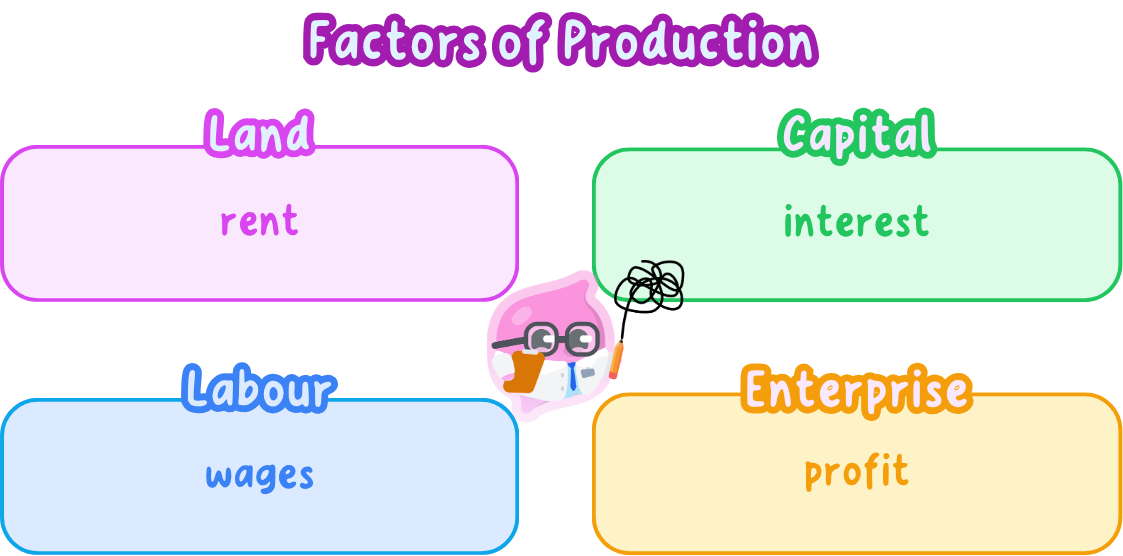
- Land earns rent, the payment for the use of a site or natural resource, such as the monthly rent a coffee shop pays for a unit in a Manchester shopping centre.
- Labour earns wages, the pay a worker receives for their time, such as the hourly rate a Tesco shop assistant gets for a shift.
- In the UK the National Living Wage sets a legal floor under that hourly rate for eligible workers.
- Capital earns interest, the payment for the funds tied up in equipment, such as the interest a haulage firm pays on the loan that bought its lorries.
- Enterprise earns profit, whatever is left for the owner once every other cost is paid, such as the sum a barber keeps after settling the shop rent and the staff wages.
- Profit is the only reward not agreed in advance, which is exactly why it rewards risk.
- These four rewards are also the four kinds of income a UK household can earn, so what a firm pays out as a cost arrives elsewhere as somebody's income.
Common Mistake
- Capital means machinery, equipment, vehicles and buildings, never money.
- The £30,000 a bakery borrows is finance, and only the oven it buys is capital.
- Cash produces nothing by itself, so calling it a factor of production loses the mark.
Spot each factor in a real business
- Work through a case study input by input, quoting the detail as well as naming the factor.
- A natural resource that has been processed becomes capital, so trees in a forest are land while planks in a joiner's workshop are capital.
- The owner of a small business usually supplies two factors, working in it as labour and carrying the risk as enterprise.
- A farmer's tractor is capital even though it never leaves the land, because the test is what the input is, not where it is used.
- Remove any one of the four and output stops, which is why all four are treated as necessary rather than ranked.
Exam technique
- Name the factors as land, labour, capital and enterprise, not everyday words such as staff or tools.
- Pair each factor with its reward: land rent, labour wages, capital interest, enterprise profit.
Self review
- Name the four factors of production.
- What is the reward earned by land?
- Give one example of capital in a bakery.
- Which factor earns profit, and why is that reward not agreed in advance?
- Is the money a firm borrows to buy a machine capital?