Positive externalities help third parties, negative ones harm them
Definition
Positive externality: a benefit of an economic activity that is enjoyed by a third party, so the social benefit is greater than the private benefit.
Negative externality: a cost of an economic activity that is borne by a third party, so the social cost is greater than the private cost.
The private and social costs and benefits used here were set out in 1.6.2a, so this article is about which way the gap between them runs.
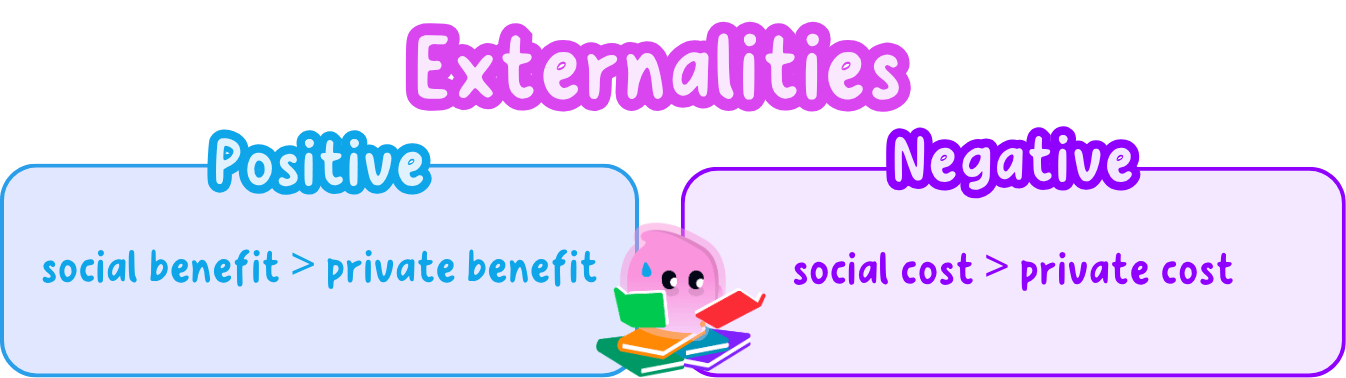
- The test is a single question: is the third party better off or worse off because the activity happened?
- A negative externality means the market has been under-charging, so too many resources flow in and the good is over-produced or over-consumed.
- A positive externality means the market has been under-rewarding, so too few resources flow in and the good is under-produced or under-consumed.
- The two labels describe the spillover, not the good itself, so one activity can easily create both at the same time.
Four questions identify any externality in an unfamiliar context
- Ask who is inside the deal, naming the buyer and the seller, since everything they gain or pay is private.
- Ask who else is affected, and name that group specifically, such as the residents on the flight path rather than society in general.
- Ask whether they gain or lose, because that one answer settles positive against negative.
- Ask whether they were paid or charged for it, since an effect that has already been compensated is part of the price and is no longer external.
Example
- Take a farm buying pesticide and spraying it on its crop.
- The buyer is the farm and the seller is the chemical supplier, so the price of the pesticide and the value of the larger harvest are both private.
- The beekeeper on the neighbouring land bought nothing and sold nothing, so the beekeeper is the third party.
- The spray kills bees and cuts the honey harvest, so the beekeeper is worse off and was never compensated, which makes this a negative externality of production.
Negative externalities arise in production and consumption
- Production externalities are created by the act of making the good, so the harm exists as soon as the firm produces, whether or not anybody ever uses the output.
- A factory discharging waste into a river harms anglers, swimmers and everybody downstream, and Ofwat and the Environment Agency have taken enforcement action against UK water companies over sewage discharges for exactly this reason.
- A quarry imposes dust, noise and heavy lorry traffic on the village beside it, none of which appears in the price of the stone.
- Consumption externalities are created by the act of using the good, so the harm appears at the moment somebody consumes it rather than at the factory.
- A driver's exhaust is produced when the fuel is burned, harming the pedestrians and cyclists sharing the street, which is what the London ULEZ charges for.
- A smoker's second-hand smoke harmed bar staff and other customers who had bought nothing, until the smoking ban removed it from enclosed public places.
- Litter and late-night noise from drinking fall on residents and on the councils that clear up afterwards.
- The distinction changes the policy, because a production externality is tackled at the factory gate through regulation or a tax on the producer, while a consumption externality has to be tackled at the point of use.
Positive externalities arise from both sides too
- In production, a firm that trains its staff creates skills that stay in the economy when those workers later move to other employers who paid nothing for the training.
- A firm that develops new technology does the same, since rivals and suppliers learn from it without covering any of the research bill.
- In consumption, a person who is vaccinated protects everybody they would otherwise have infected, so third parties gain protection they never paid for.
- A person who stays in education raises their own earnings and also produces a more skilled workforce, higher tax revenue and lower spending on crime and benefits.
Common Mistake
- An externality falls on a third party, never on the buyer or the seller inside the deal.
- A cost the firm pays itself, such as wages or a fine, is a private cost, not an external one.
- Label the externality by who is acting, not by the good: a factory polluting is production, a driver's exhaust is consumption.
One activity can create both types at once
- Expanding an airport such as Heathrow gives other firms faster trade links and creates jobs across the region, while imposing noise, emissions and traffic on the villages beneath the flight path.
- Both spillovers land on people outside the transaction, so both are genuine externalities and neither cancels the other out by definition.
- Identifying an activity therefore means naming each spillover and the group it lands on, rather than deciding which single label the activity deserves.
Exam technique
- Say whether the externality arises in production or in consumption: the specification names both, and an answer that only mentions factory pollution misses the consumption half.
- Name the third party specifically, such as residents beside the quarry rather than society in general.
- Finish the link in the same sentence: negative means social cost above private cost and over-production, positive means social benefit above private benefit and under-consumption.
Self review
- What single question tells you whether an externality is positive or negative?
- Give one negative externality of production and one of consumption.
- Why is a driver's exhaust a consumption externality rather than a production one?
- Give one positive externality of production and one of consumption.
- Why does a negative externality lead to over-production and a positive one to under-consumption?