The cheapest way to produce is not always right
Ethical behaviour: acting in the way most people would judge to be morally right, such as paying suppliers fairly, keeping workers safe and limiting damage to the environment, even where a cheaper alternative is available.
Stakeholder: any group affected by what a producer does, including its owners, its workers, its customers, its suppliers, the local community and the environment.
- The conflict exists because the groups a firm affects are not the group that owns it, so a cost the firm avoids usually lands on somebody else.
- Cutting a cost is the same action whatever the cost happens to be, so the pressure that pushes a firm to waste less packaging also pushes it to pay less and inspect less.
- Nothing in the profit calculation charges a producer for the harm it causes, which is why the law and the regulators have to do it instead.
How profit itself is calculated is 1.4.1c, and why the prospect of profit drives producers to expand is 1.4.1d.
Cutting labour or environmental costs lifts profit
- Wages and working conditions are the largest cost most producers control, so holding pay at the legal minimum, using insecure contracts or pressing a supplier for a lower price per garment raises profit per unit directly.
- An independent review of Boohoo in 2020 found serious failings in its Leicester supply chain, including workers paid below the minimum wage, and the same cost pressure sits behind fast fashion prices at Primark and its rivals.
- The environment is cheaper to damage than to protect, since dumping waste, using single use plastic packaging and burning the cheapest fuel all cut the producer's cost while the cost of the damage falls on everyone.
- English water companies have repeatedly released untreated sewage into rivers and the sea rather than spend on treatment capacity, and Ofwat has fined them for it.
Misleading customers boosts revenue, squeezing suppliers cuts cost
- Honesty towards consumers: advertising that overstates what a product does, charges that only appear at checkout and vague environmental claims all raise revenue without raising cost.
- Greenwashing is the version the Competition and Markets Authority now polices, where a product is sold as recyclable, natural or carbon neutral on evidence that will not stand up.
- Suppliers: a large buyer can squeeze the price it pays a small supplier, and UK dairy farmers have at times been paid less per litre than the milk cost them to produce, which is why the Groceries Code Adjudicator exists.
- Animal welfare: cheaper eggs, chicken and pork come from more intensive systems, so a producer choosing free range is deliberately choosing a higher cost per unit.
- Fast fashion: a £6 t-shirt has to be designed, cut, stitched, finished, shipped and sold with a profit still left over, so the pressure to cut every cost falls hardest on the wages paid where it is made.
- The retailer usually does not own the factory but buys from suppliers bidding against each other on price, and that distance makes the conflict easy to ignore until an investigation makes it public.
- Primark and Boohoo have both since published supplier lists and audit findings and joined monitoring schemes, which is a real cost accepted to protect the brand.
Acting ethically can also raise profit
- Reputation is an asset, so a scandal that reaches the news costs a firm sales for years while a clean record supports a higher price.
- Some consumers will pay more for a product they trust, which is why Fairtrade chocolate, free range eggs and British sourced meat sell alongside the cheaper versions instead of being driven out by them.
- Penalties are avoided, so a producer that meets environmental, safety and advertising rules escapes fines, clean up orders and the management time an investigation swallows.
- Fairtrade: a chocolate bar carrying the mark guarantees the cocoa farmer a minimum price plus a premium, so the bar costs the manufacturer more to make.
- Shoppers who choose it accept a higher shelf price, so the extra cost is recovered in the price rather than taken out of profit.
- The Co-op moved its own label chocolate to Fairtrade cocoa and uses that sourcing in its advertising, which only works because enough of its customers care.
Whether profit and ethics conflict depends on the market
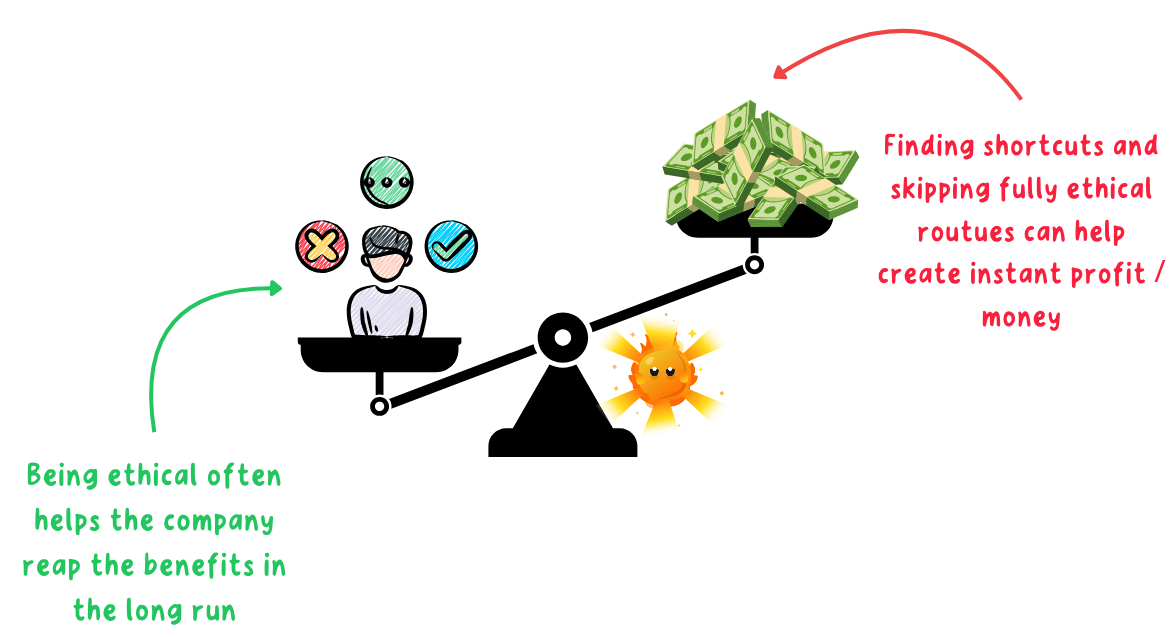
- It depends on how well informed consumers are, because a shopper who cannot see how a product was made cannot reward the firm that made it well, so the ethical producer carries the cost for nothing.
- It depends on whether consumers will pay more, since a household on a tight budget buys on price, which is why the ethical premium shrinks when incomes are squeezed.
- It depends on how tight the regulation is, because a rule enforced with real fines turns an ethical cost into an unavoidable cost for every firm at once, so no rival gains by ignoring it.
Judgement: the conflict is real but it is not fixed, because it narrows wherever consumers can see what a producer does and regulation makes behaving badly costly, so the useful question is never whether firms are greedy but whether the market they sell in makes good behaviour pay.
Regulation and information close a genuine conflict
- The law sets a floor under every producer, through the National Minimum Wage and National Living Wage, health and safety law and environmental permits.
- Information does the rest, since labelling, published audits and investigative journalism let consumers act on what they now know.
- What is meant by ethical behaviour by a producer?
- Name three stakeholder groups whose interests can conflict with higher profit.
- Explain one way in which cutting a cost raises profit but harms a stakeholder.
- Give two ways in which acting ethically can raise a producer's profit.
- Name one UK regulator and the behaviour it acts against.