A market is an opportunity to trade
Definition
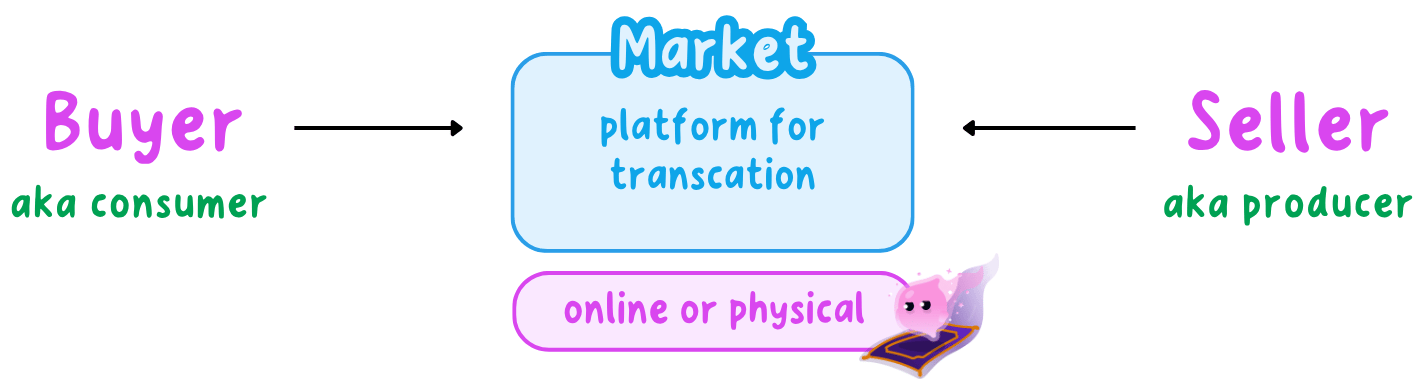
Market: an opportunity for buyers and sellers to interact in order to establish a price for a good or a service.
- The key word is opportunity, because what makes a market is the chance to trade, not a building or an address.
- Two traders who never meet are in the same market as long as each can reach the other.
- Every market is built from four parts, and removing any one of them leaves no market.
- The buyer is willing and able to pay for the product.
- The seller offers that product in return for money.
- The product is the good or service traded, such as a punnet of strawberries or a train ticket.
- The transaction is one completed exchange of the product for money at an agreed price.
- Markets are counted by the product traded, so everyone trading one product is in one market however far apart they are.
Example
- At Borough Market in Southwark, a shopper hands £2 to a stallholder for a punnet of strawberries.
- The shopper is the buyer, the stallholder the seller, the strawberries the product, and that swap the transaction.
- The hall is dozens of markets rather than one, because the cheese stalls and the fish stalls trade different products.
Online markets count as much as physical ones
- A physical market gives both sides a place to meet, such as Borough Market or a high street car showroom.
- An online market links them through a website or an app instead, such as eBay or Tesco.com.
- Neither is more of a market, because the test is whether buyers and sellers can reach each other.
- Some markets have no home at all, since the UK second-hand car market is spread across dealers, driveways and websites.
- The boundary is set by who can trade with whom, so a market can be one street wide or worldwide.
Common Mistake
- A market is not a place with stalls, since an app or a phone call creates the same opportunity.
- A seller need not be a shop, because a household selling a used bike on eBay is also a seller.
Interaction between both sides settles the price
- Neither side fixes the price alone, because a price only becomes real once the other side agrees to it.
- A seller asking more than buyers will pay is left with unsold stock, so the asking price comes down.
- A buyer offering less than sellers will accept goes home with nothing, so the offer comes up.
- The price that survives is the one at which trade actually takes place, which is what establishing a price means.
- An eBay auction makes this visible, because the bidding is the interaction and the winning bid is the price.
- A supermarket does the same quietly, since stock priced too high sits on the shelf until Tesco cuts the price.
Self review
- What is a market?
- Name the four parts of every market.
- Give one physical and one online example.
- Why does a market not need to be a single place?
- Who establishes the price in a market?