Prices allocate scarce resources without a planner
Definition
Allocation of resources: deciding which uses the scarce land, labour, capital and enterprise available are put to, and therefore which wants are met and which are not.
Price mechanism: the process by which prices, arising from the decisions of buyers and sellers, direct resources between those competing uses.
- Allocation is unavoidable because resources are scarce, so every use a resource is put to is another use given up.
- The striking thing about a market is that nobody takes the decision, yet it is taken millions of times a day.
- Each firm and household reacts only to the prices in front of it, and the pattern that results is nobody's plan.
- A price can do this because it is public, so both sides read the same figure without anyone collecting or sending information.
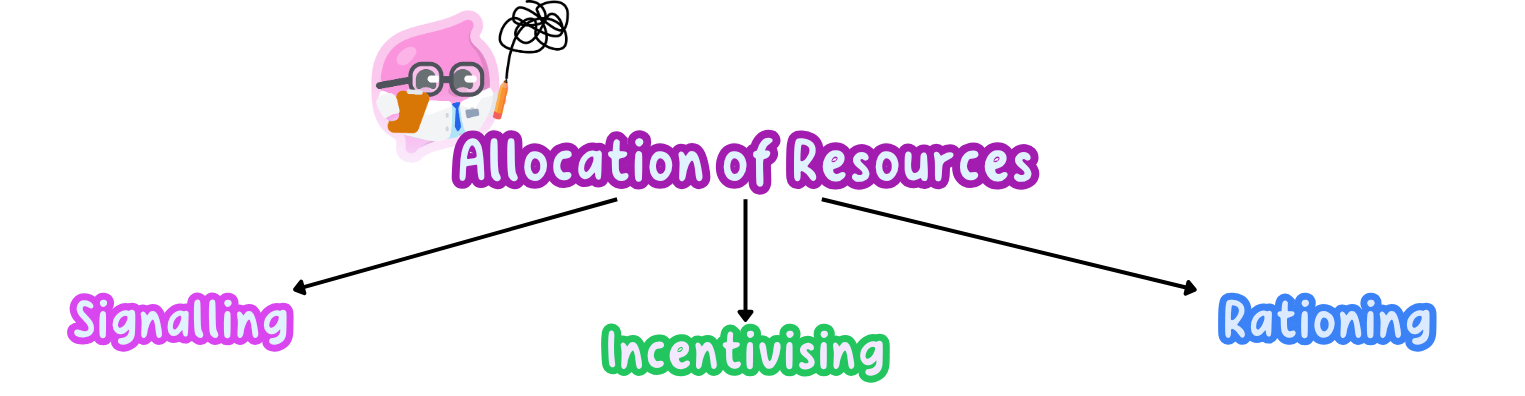
- A price works in three ways, by signalling, by acting as an incentive and by rationing.
Example
- No government department decides how many loaves London needs, yet every borough's shelves are stocked by opening time.
- The prices of wheat, flour and bread are the only messages passing along the chain from the farm to the shopper.
- When shoppers switch to pasta, the falling bread price carries that news back down the chain to the farmer.
Signalling shows where resources are wanted
- Signalling means the price carries information about how scarce something is relative to what buyers want.
- A rising price says buyers want more or that supplying it has become harder, and a falling price says the opposite.
- Avian flu cut UK laying flocks in 2022, and the rising shelf price told every baker, caterer and shopper that eggs had become scarce.
- None of them needed to have heard about the outbreak, because the price alone carried the message.
- The signal also reaches firms in other markets, since they are deciding where to put their money next.
Incentive gives a reason to act
- Incentive means the price offers a reward large enough to make somebody act on the signal.
- A higher price earns extra revenue on every unit sold, so existing firms supply more and new firms enter the market.
- UK haulage firms raised HGV drivers' pay sharply in the 2021 driver shortage, pulling drivers back into the job from other work.
- That is labour, a scarce resource, reallocated by a price rather than by anyone directing it.
- For buyers the incentive runs the other way, because a higher price rewards buying less or switching to a substitute.
Common Mistake
- Signalling is not incentive: signalling is the information the price carries, the incentive is the reward for acting on it.
- The price mechanism is not an organisation, since the decisions are taken by buyers and sellers responding to prices.
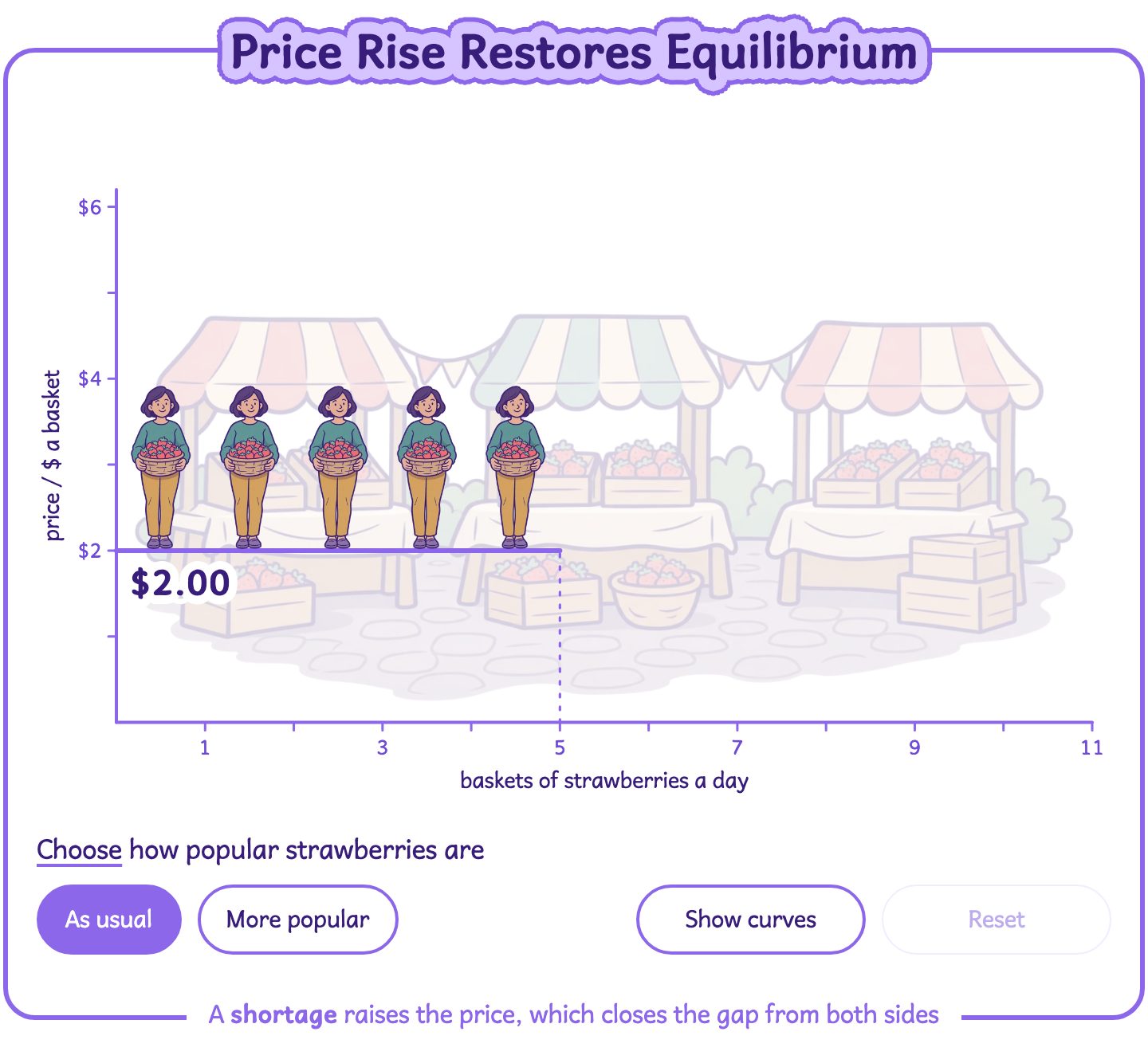
Create a shortage and watch the higher price signal buyers to cut back and tempt firms to supply more.
Rationing shares a limited quantity between buyers
- Rationing means the price itself decides who goes without, rising until the quantity wanted matches the quantity available.
- The rise removes the buyers who will not or cannot pay, so the limited supply reaches those who value it most in money terms.
- Rationing here means allocation by price alone, not coupons or queues.
- Peak-time rail fares between Manchester and London ration a fixed number of seats among commuters who all want the same trains.
- The scarcer the good, the higher the price has to climb before the two quantities match.
Case study
- Avian flu forced UK producers to cull millions of laying hens over the winter of 2022, leaving far fewer eggs than shoppers had planned to buy.
- The rising price signalled the shortage to bakeries, cafes and supermarkets at the same moment.
- It gave unaffected producers an incentive to expand flocks, and gave importers a reason to bring eggs in from abroad.
- It rationed the eggs that did exist, as some cafes dropped egg dishes and some shoppers bought fewer boxes.
- Feed, sheds and farm labour moved back into egg production, and prices eased once flocks recovered.
Together they answer what, how and for whom
- What to produce is answered by signalling and incentive together, as resources move into goods whose price has risen against the cost of making them.
- Rising UK sales of electric cars pulled investment into battery capacity and out of diesel engine parts.
- How to produce is answered by the prices of the factors themselves, since firms pick whichever mix of resources is cheapest for the output they want.
- Rising UK wages made self-service checkouts cheaper than extra staff for the big supermarket chains.
- For whom to produce is answered by rationing, so output goes to whoever is willing and able to pay the price.
- The distribution of goods therefore follows the distribution of income, which is why the market answer is not the fair answer.
- The process never stops, because any change in wants, costs or resources moves a price and starts the sequence again.
Exam technique
- Name the function you are using, signalling, incentive or rationing, and apply it to the good in the question.
- Run the chain in order: the change in wants or costs, the price movement, the response, then the resources that move.
- Finish on the resources, because an answer that stops at the price movement has only done half the job.
Self review
- What is meant by the allocation of resources?
- Name the three functions of price.
- What does a rising price tell firms in other markets?
- How did higher pay reallocate labour in the 2021 HGV driver shortage?
- On what basis does rationing decide who goes without?