Revision notes for Edexcel GCSE Computer Science Issues of AI, machine learning and robotics. Open the guide for explanations and worked examples. Written against the Edexcel GCSE Computer Science (1CP2) specification, so the content matches what's examinable rather than general Computer Science background.
Issues of AI, machine learning and robotics
Artificial Intelligence, machine learning, and robotics are transforming how we live, work, and make decisions. However, replacing human decision-making and physical labour with automated systems introduces significant ethical and legal challenges.
In this topic, we will examine the risks and responsibilities associated with these technologies, specifically looking at the four pillars required by your Edexcel specification: algorithmic bias, safety, accountability, and legal liability.
What you'll learn
- The definitions of Artificial Intelligence (AI), machine learning, and robotics.
- How human bias becomes coded into automated systems (algorithmic bias).
- The distinction between accountability and legal liability when autonomous systems fail.
- The safety implications of deploying AI and physical robots in the real world.
1. Defining the Technologies
Before we can evaluate the ethical and legal issues, we must understand what these technologies actually are. They are closely related, but they are not the same thing.
Definition
Artificial Intelligence (AI)
Artificial Intelligence (AI) is the broader concept of machines or software systems performing tasks that would typically require human intelligence, such as visual perception, decision-making, and translation between languages.
Definition
Machine Learning (ML)
Machine Learning (ML) is a specific subset of AI. Instead of a programmer writing explicit step-by-step rules to solve a problem, a machine learning system is trained on vast amounts of data. The system automatically identifies patterns and creates its own internal rules to make predictions or decisions.
Definition
Robotics
Robotics refers to the design, construction, and operation of physical machines (robots) that can perform tasks automatically. While some robots are programmed with simple, repetitive instructions, modern robotics increasingly integrates AI and machine learning to allow robots to navigate and interact with dynamic real-world environments.
2. Algorithmic Bias
One of the most significant ethical concerns with machine learning is algorithmic bias. Because machine learning models learn how to make decisions by looking at past data, they do not automatically make fair or objective decisions.
Definition
Algorithmic Bias
Algorithmic bias occurs when a computer system reflects the human biases and prejudices present in its training data, resulting in unfair, systematic, or discriminatory outcomes against certain groups of people.
How Algorithmic Bias Occurs
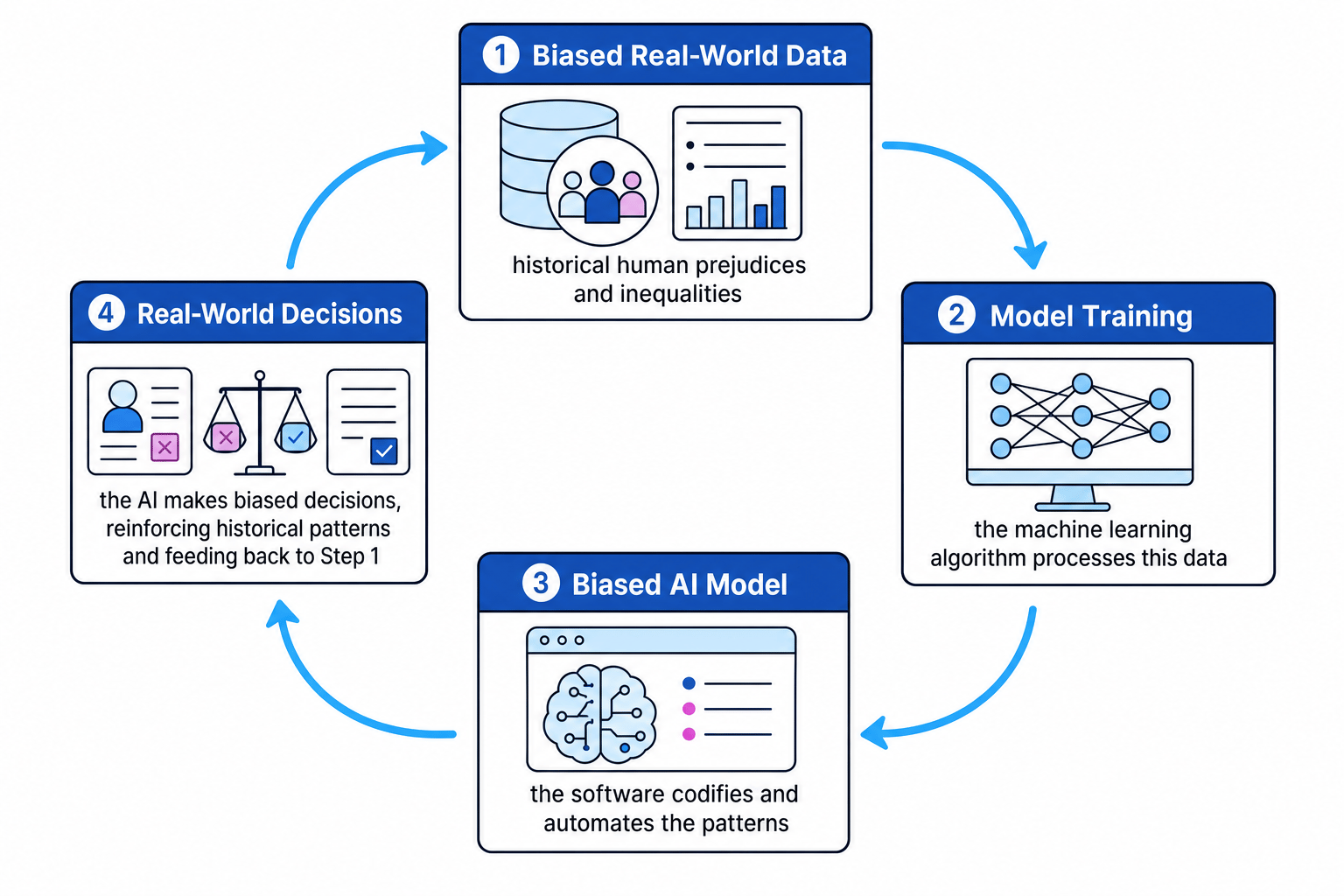
Many people assume computers are naturally neutral. However, an algorithm is only as good as the data used to train it. If the training data is flawed, incomplete, or reflects historical inequalities, the resulting AI model will copy and even amplify those flaws.
This creates a dangerous feedback loop, which you can see in the diagram below:
Common Sources of Bias
- Unrepresentative Training Data: If a facial recognition system is trained primarily on images of light-skinned individuals, it will perform poorly and make more errors when identifying people with darker skin tones.
- Historical Prejudices: If an automated CV-screening tool is trained on historical hiring data from a company where men were disproportionately hired for leadership roles, the AI will learn that being male is a desirable trait and penalise female applicants.
Common Mistake
The 'Computers are objective' myth
Do not assume that an automated decision is automatically fair or neutral just because a computer made it. Software developers are human, and the training data they select is often biased. Always critically evaluate where the data came from.
3. Safety
Deploying AI and robotics into critical areas of society raises major safety concerns. If a piece of software or a physical robot malfunctions, the consequences can range from financial loss to physical injury or loss of life.
Physical Safety (Robotics)
As robots move out of secure industrial cages and onto public streets or into homes, physical safety becomes paramount. Examples include:
- Self-driving cars (autonomous vehicles): Must be able to accurately detect pedestrians, cyclists, and unexpected obstacles in all weather and lighting conditions.
- Surgical robots: Must perform highly delicate physical procedures inside a human body without mechanical lag or sudden errors.
Digital and Decision Safety (AI)
Even without a physical body, AI decision-making software can pose safety risks:
- Medical diagnosis tools: An AI that analyses X-rays to detect cancer must be highly accurate. A false negative (missing a tumour) could prevent a patient from receiving life-saving treatment.
- Autonomous weapons systems: Military drones that select targets without human intervention raise profound ethical questions about life-and-death decisions.
4. Accountability and Legal Liability
When an autonomous system makes a mistake, who is to blame? This is one of the most complex areas of modern computer science law, and it hinges on the difference between accountability and legal liability.
Key Idea
Accountability vs Legal Liability
- Accountability is about moral and professional responsibility. It asks: Who should explain, justify, or answer for the actions of this system?
- Legal Liability is about legal responsibility. It asks: Who is legally responsible under the law for damages, and who must pay compensation or face prosecution?
The Accountability Gap
When a traditional computer program fails, the cause is usually a specific bug written by a programmer. The developer is held accountable.
However, with machine learning, the system writes its own internal rules based on billions of data points. This creates a "black box" where even the original programmers cannot explain exactly why the AI made a specific decision. This lack of transparency makes it incredibly difficult to hold any single person accountable.
The Challenge of Legal Liability
Under existing laws in most countries, legal liability is designed for humans or corporations. If an autonomous machine causes harm, the law struggles to decide who is legally responsible.
Consider a collision involving a self-driving car. Who is legally liable?
- The owner/passenger (who was not driving)?
- The manufacturer of the car?
- The software engineers who programmed the vision algorithm?
- The third-party company that compiled the training data?
Analogy
The Autonomous Autopilot
Imagine a passenger on a commercial airplane. If the human pilot makes a mistake and crashes, the pilot or airline is liable. But if the plane is on autopilot and crashes because of a rare sensor glitch, the blame shifts to the manufacturer of the autopilot system.
With AI, this boundary is incredibly blurry because the "autopilot" is constantly learning and changing its own behavior over time.
Worked Example: Scenario Analysis
Example
Analysing issues in an automated medical triage system
A hospital introduces a machine learning algorithm to triage (prioritise) patients arriving at the emergency department. The system is trained on historical hospital records. After a month, clinicians notice that patients from a specific ethnic minority background are systematically being given lower priority scores, despite presenting with severe symptoms.
Identify and analyse the ethical and legal issues in this scenario.
-
Identify the source of algorithmic bias: First, examine the training data. Because the system was trained on historical hospital records, it likely inherited historical human prejudices or inequalities in healthcare access. For example, if doctors historically underestimated the pain levels of minority patients, this bias became embedded in the training data, leading the AI to learn that these patients require lower priority.
-
Evaluate the safety implications: Next, consider the threat to human life. Giving critically ill patients a lower priority score is a severe safety failure. It delays their access to urgent medical treatment, directly risking physical harm, deterioration of health, or death.
-
Determine accountability: Next, identify who is morally responsible for explaining this failure. The hospital management (who decided to deploy the tool), the clinical team (who trusted the system), and the software development team (who failed to test the system for bias before release) share the moral accountability.
-
Assess legal liability: Finally, consider legal consequences under current laws. If a patient is harmed because of a delayed triage, they or their family could sue for negligence. The legal liability would likely fall on the hospital trust for failing in their duty of care, though the hospital may in turn sue the software provider for selling a defective medical device.
Summary of the Key Issues
| Issue | Key Question | Example in Practice |
|---|---|---|
| Algorithmic Bias | Does the system treat people unfairly based on biased data? | An AI recruitment tool rejecting female applicants because historical hiring data favoured men. |
| Safety | Could the system cause physical or digital harm to humans? | A self-driving car failing to detect a pedestrian in low-light conditions. |
| Accountability | Who is morally responsible for explaining why a decision was made? | A doctor relying on an AI diagnosis tool that misses a tumour. |
| Legal Liability | Who is legally responsible in court for damage or injury? | Determining if the developer or car manufacturer pays damages after a self-driving car crash. |
Tip
Spec Advice: State and Explain
In Edexcel GCSE exams, questions on this topic will often ask you to "discuss" or "explain" ethical and legal issues. Always link your point directly to a scenario. Don't just say "there might be bias"—explain how the bias got there (biased training data) and what the impact is on the individuals involved.
Exam technique
In the exam
- Define your terms: If a question mentions AI, machine learning, or robotics, begin your answer by briefly defining the term to show the examiner you understand the technology.
- Be specific about bias: When writing about algorithmic bias, always mention training data. You must explain that the algorithm is not inherently evil; it is simply reproducing patterns found in biased human data.
- Distinguish legal from ethical: Make sure you clearly separate "moral accountability" (what should happen ethically) from "legal liability" (what the law can actually enforce).
- Structure your response: Use clear paragraphs. For a 6-mark or 8-mark discussion question, use PEEL structures (Point, Evidence, Explanation, Link) for each of the issues (Safety, Bias, Liability).
Self review
Check yourself
- Can you explain how a machine learning system can become biased even if the programmer had no prejudiced intentions?
- Who are the different parties that could be held legally liable if an autonomous delivery drone crashes into a house?
- Why is it difficult to hold someone accountable for a decision made by a "black box" deep learning model?
You've reached the end
Test yourself on this topic, or move on to the next guide.
How was this guide?