Revision notes for Edexcel GCSE Computer Science Environmental issues of digital devices. Open the guide for explanations and worked examples. Written against the Edexcel GCSE Computer Science (1CP2) specification, so the content matches what's examinable rather than general Computer Science background.
Environmental issues of digital devices
What you'll learn
- How digital devices affect the environment during their whole life cycle.
- Why energy consumption is only one part of the environmental impact.
- How manufacture, replacement cycles and disposal create waste and emissions.
- How to explain these issues clearly in GCSE-style answers.
The big picture: devices have a life cycle
A digital device is an electronic device that processes data, such as a smartphone, laptop, tablet, games console, smart watch, router or server.
When thinking about environmental issues, do not only think about the moment you are using the device. The environment can be affected before you buy it, while you use it, and after you throw it away.
Definition
Life cycle
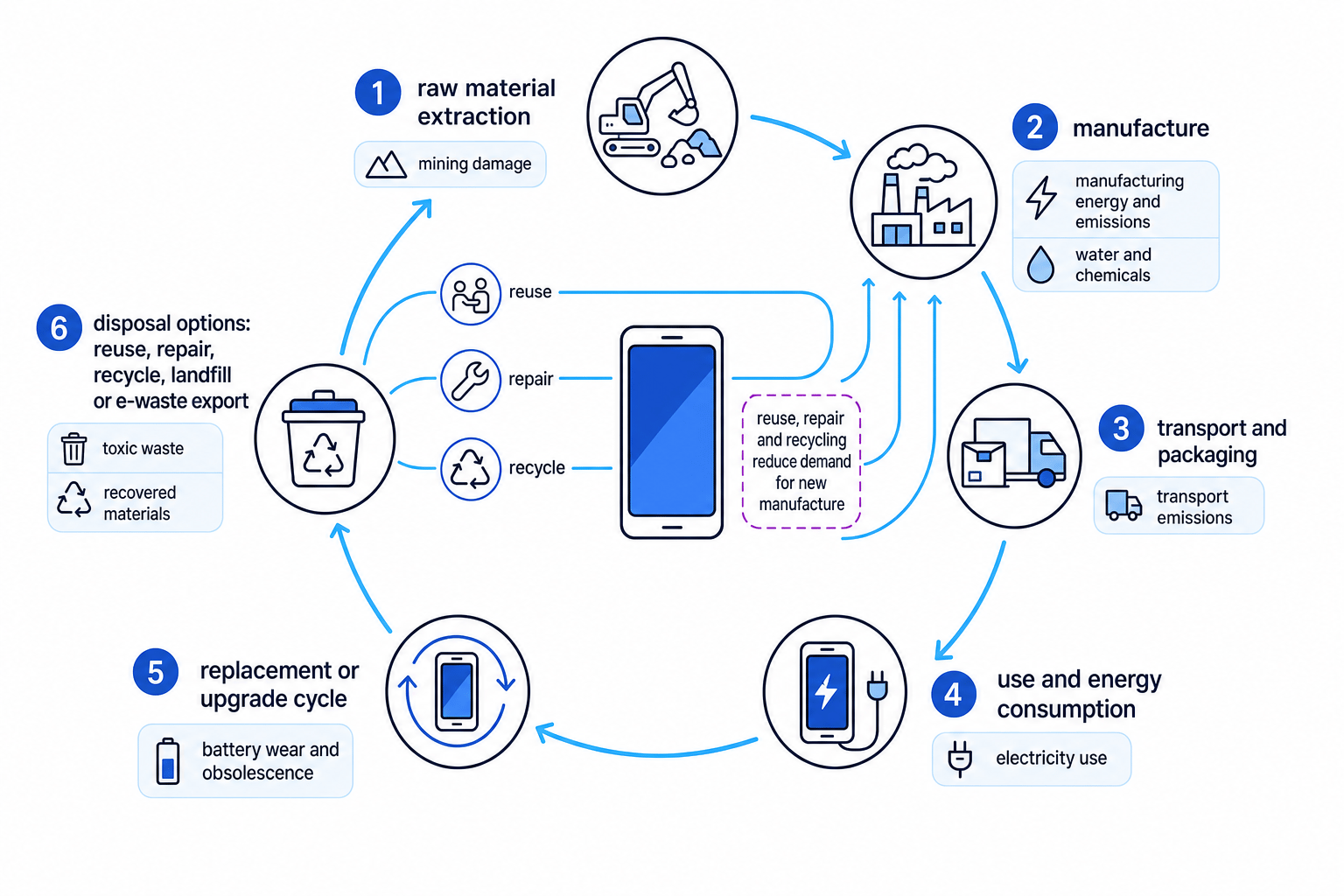
The life cycle of a digital device means all the stages it goes through: raw materials, manufacture, transport, use, replacement, and disposal.
The 1CP2 specification focuses on four linked environmental issues: energy consumption, manufacture, replacement cycle, and disposal. A good answer often follows the device through these stages.
Key Idea
Think whole life cycle
A device can have environmental impacts even when it is not switched on: making it, replacing it too often, and disposing of it badly can all damage the environment.
1. Energy consumption
Energy consumption means the amount of electrical energy used by a device or digital service.
Digital devices need electricity to run. This includes obvious uses, such as charging a phone or powering a gaming PC, but also less obvious uses, such as:
- Wi-Fi routers and mobile phone masts
- data centres storing files and running online services
- cooling systems for servers
- screens, processors and graphics cards
- standby power when a device is not fully switched off
If the electricity comes from burning fossil fuels, such as coal or gas, this can produce greenhouse gases such as carbon dioxide. These contribute to climate change.
Some devices use far more energy than others. For example, a high-powered gaming PC normally uses more energy than a smartphone. A large data centre uses much more energy than one personal device, especially because servers may run all day and night.
Reducing energy consumption
Energy use can be reduced by:
- using energy-efficient hardware
- switching devices off instead of leaving them on standby
- reducing screen brightness
- using sleep mode
- improving software so it uses less processing power
- using renewable electricity where possible
Example
Explaining a streaming-service impact
A student says, “Streaming a video does not affect the environment because nothing physical is being used.” Explain why this is not fully correct.
- The video is watched on a digital device, so the device itself uses electricity for the screen, processor and network connection.
- The video data must travel through network equipment, such as routers, mobile masts or broadband infrastructure, which also uses electricity.
- The video may be stored and sent from data centres, where servers and cooling systems can run continuously.
- Therefore, streaming has an environmental impact if the electricity used is generated in a way that produces emissions, even though the video is not a physical object.
Common Mistake
Only mentioning charging
Do not write as if energy consumption only means charging a battery. For online services, networks and data centres may also use energy.
2. Manufacture
Manufacture means making the device. This includes getting raw materials, producing components, assembling the product, packaging it and transporting it.
Digital devices contain many materials, including metals, plastics, glass and chemicals. Batteries may need materials such as lithium or cobalt. Chips, circuit boards and screens require complex factory processes.
Manufacture can affect the environment because:
- mining raw materials can damage habitats and landscapes
- factories use large amounts of electricity and water
- chemical processes can create pollution if not managed safely
- transport and packaging add further emissions and waste
- producing new devices creates demand for more raw materials
For many devices, a large part of their environmental impact happens before the user even turns them on for the first time.
More sustainable manufacture
Manufacturers can reduce environmental harm by:
- using recycled materials
- designing devices to last longer
- making batteries or screens easier to replace
- reducing packaging
- using renewable energy in factories
- reducing waste during production
Example
Linking manufacture to environmental damage
A company advertises that its new laptop is “greener” because it uses less electricity than the old model. What manufacturing issue should you still consider?
- Compare more than just energy use during operation: a new laptop still has to be manufactured.
- Manufacturing requires raw materials, factory energy, water, chemicals, packaging and transport.
- If the old laptop still works, replacing it immediately may create extra environmental impact from producing a new device.
- The new model may be better overall only if the energy savings and longer useful life outweigh the impact of manufacturing it.
3. Replacement cycle
The replacement cycle is how often a device is replaced with a newer one.
A short replacement cycle means devices are replaced frequently. For example, someone might buy a new phone every year even if the old one still works.
A long replacement cycle means devices are kept for longer before being replaced.
Definition
Obsolescence
Obsolescence means a device becomes outdated or unsuitable, even if it has not completely stopped working.
Devices may be replaced because:
- the battery no longer holds charge well
- the device becomes slow for newer software
- the operating system stops receiving updates
- the screen or case is damaged
- repairs are expensive or difficult
- users want the newest model
- companies encourage frequent upgrades
A short replacement cycle usually increases environmental impact because more devices must be manufactured and more old devices must be disposed of.
Repair, upgrade and reuse
Keeping a device useful for longer can reduce environmental harm. This might involve replacing a battery, repairing a screen, adding more storage, reinstalling software, passing the device to another user, or using it for a less demanding task.
However, there is a balance. Very old devices may use more electricity, may not run required software, or may stop receiving security updates. The best environmental choice depends on the situation.
Example
Choosing between repair and replacement
A school has 100 tablets that are three years old. Option A is to replace all 100 tablets. Option B is to replace the batteries in 30 tablets and keep using all tablets for two more years. Which option is likely to have the lower environmental impact?
- Option A creates demand for 100 new devices, so it has a large manufacturing impact from materials, factories, transport and packaging.
- Option B still has an impact because 30 new batteries must be made, but this is usually less than manufacturing 100 complete tablets.
- Option B extends the replacement cycle, so fewer devices are disposed of immediately and fewer new devices are needed.
- Option B is likely to be lower impact, as long as the tablets still meet the school’s needs and can be used safely.
Tip
Useful phrase
A strong answer often says: “Extending the life of a device reduces the need to manufacture a replacement and reduces e-waste.”
4. Disposal
Disposal means what happens to a device when the owner no longer wants or can no longer use it.
Definition
E-waste
E-waste means electronic waste, such as broken phones, computers, monitors, batteries, cables and circuit boards.
Disposal is an environmental issue because digital devices may contain materials that are harmful if released into the environment. For example, batteries and circuit boards can contain chemicals and metals that should not simply be dumped.
Poor disposal can lead to:
- toxic substances leaking into soil or water
- useful materials being wasted in landfill
- pollution from burning electronic waste
- unsafe recycling in places without proper environmental controls
- more mining because valuable materials are not recovered
Better disposal options
Better options usually follow this order:
- Reuse the device if it still works.
- Repair it if a fault can be fixed.
- Donate or resell it so someone else can use it.
- Recycle it using a proper e-waste recycling scheme.
- Avoid general landfill wherever possible.
Recycling can recover useful materials, which reduces the need for new mining. However, recycling is not perfect: it uses energy, not all materials can be recovered, and devices still need to be collected and processed.
Example
Choosing a disposal route
A person has an old smartphone with a cracked screen. They can put it in general rubbish, repair it, sell it for parts, or take it to an e-waste recycling point. Which choices are better environmentally?
- General rubbish is the worst choice because the phone may go to landfill, wasting materials and risking pollution from electronic components.
- Repairing the screen is best if the phone can still be used, because it extends the device’s life and delays the need for a replacement.
- Selling it for parts or using an e-waste recycling point is better than landfill because components or materials may be reused or recovered.
- The best option depends on whether the phone can realistically be repaired and used again.
Common Mistake
Saying recycling solves everything
Recycling is better than landfill, but it does not remove all environmental impact. Reuse and repair are often better because they keep the whole device in use for longer.
Pulling the four issues together
For this topic, you should be able to explain how each issue affects the environment:
- Energy consumption: electricity is needed to power devices, networks and servers; this may cause emissions depending on how the electricity is generated.
- Manufacture: making devices uses raw materials, water, chemicals, energy, packaging and transport.
- Replacement cycle: frequent upgrades mean more devices are manufactured and more old devices become waste.
- Disposal: e-waste can pollute the environment if dumped, but reuse, repair and recycling can reduce harm.
A good GCSE answer usually links an issue to a consequence. For example, do not just say “manufacture is bad”. Say that manufacture uses raw materials and energy, which can cause habitat damage, pollution and greenhouse gas emissions.
Exam technique
In the exam
- Cover more than one stage of the device life cycle: energy use, manufacture, replacement cycle and disposal.
- Use clear cause-and-effect language, such as “this means”, “because”, and “therefore”.
- Make your answer specific to the scenario, such as phones, laptops, school tablets, servers or gaming devices.
Self review
Check yourself
- Why can replacing a working device still be bad for the environment?
- Give two environmental impacts of manufacturing digital devices.
- Why is recycling e-waste better than landfill, but still not a perfect solution?
You've reached the end
Test yourself on this topic, or move on to the next guide.
How was this guide?