Revision notes for Edexcel GCSE Computer Science Applying logical operators in truth tables. Open the guide for explanations and worked examples. Written against the Edexcel GCSE Computer Science (1CP2) specification, so the content matches what's examinable rather than general Computer Science background.
Applying logical operators in truth tables
What you'll learn
- How the logical operators AND, OR and NOT work.
- How to build truth tables with one, two or three inputs.
- How to add intermediate columns so complex expressions become manageable.
- How to use a truth table to solve a simple problem or decision rule.
The basic idea: logic uses True and False
In Computer Science, many decisions are based on whether something is True or False.
For truth tables, we usually represent:
- True as 1
- False as 0
For example, a variable called DoorOpen could be:
- 1 if the door is open
- 0 if the door is not open
Definition
Boolean value
A Boolean value is a value that can only be True or False. In truth tables, these are usually shown as 1 and 0.
Inputs, outputs and logical operators
An input is a Boolean value that goes into a logic expression or logic gate.
An output is the Boolean result that comes out.
A logical operator is a rule that combines or changes Boolean values. For this topic, you need to apply:
- NOT
- AND
- OR
Definition
Logical operator
A logical operator is a rule used to work with Boolean values. It takes one or more inputs and produces a Boolean output.
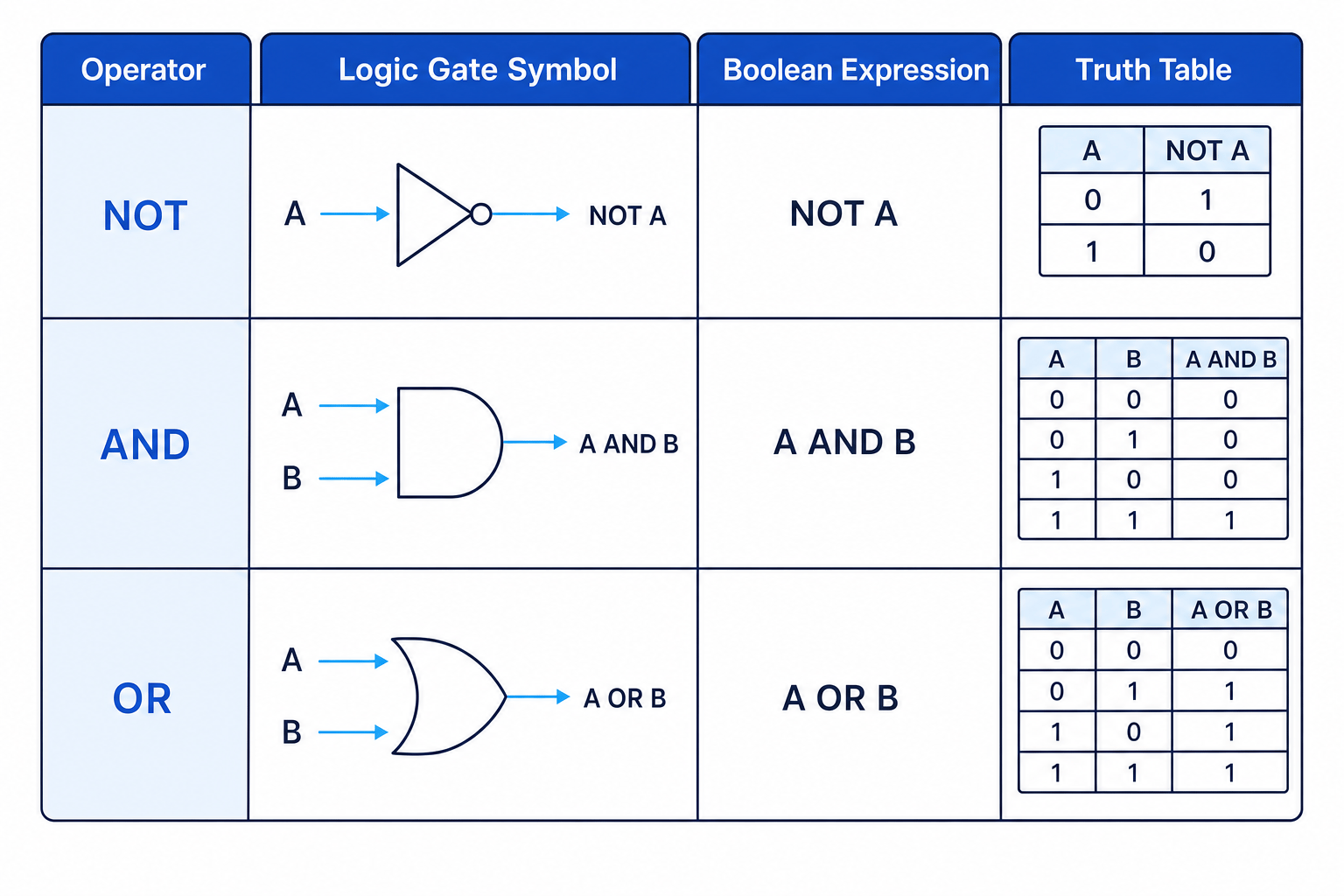
This reference diagram summarises the three operators you need for Edexcel GCSE Computer Science.
NOT: reversing a value
NOT takes one input and reverses it.
| A | NOT A |
|---|---|
| 0 | 1 |
| 1 | 0 |
So:
NOT 0becomes 1NOT 1becomes 0
Key Idea
NOT flips the value
NOT changes 1 to 0, and 0 to 1.
AND: both must be true
AND takes two inputs. The output is 1 only if both inputs are 1.
| A | B | A AND B |
|---|---|---|
| 0 | 0 | 0 |
| 0 | 1 | 0 |
| 1 | 0 | 0 |
| 1 | 1 | 1 |
A common real-life version is: “You may enter if you have a ticket AND your ticket is valid.” Both conditions must be true.
OR: at least one must be true
OR takes two inputs. The output is 1 if at least one input is 1.
| A | B | A OR B |
|---|---|---|
| 0 | 0 | 0 |
| 0 | 1 | 1 |
| 1 | 0 | 1 |
| 1 | 1 | 1 |
Common Mistake
Thinking OR means only one
In GCSE logic, OR is inclusive. That means A OR B is also 1 when both A and B are 1.
Example
Applying AND and OR
Complete the outputs for A AND B and A OR B when A = 1 and B = 0.
-
For
A AND B, check whether both inputs are 1. Here,Ais 1 butBis 0, so the output is 0. -
For
A OR B, check whether at least one input is 1. Here,Ais 1, so the output is 1. -
Compare the two results: AND is stricter than OR because AND needs every input to be true.
| A | B | A AND B | A OR B |
|---|---|---|---|
| 1 | 0 | 0 | 1 |
What a truth table does
A truth table lists every possible combination of input values, then shows the output for each combination.
If there are nnn inputs, the number of rows is 2n2^n2n.
So:
- 1 input gives 2 rows
- 2 inputs gives 4 rows
- 3 inputs gives 8 rows
For Edexcel GCSE 1CP2, you need to handle truth tables with up to three inputs.
Definition
Truth table
A truth table is a table that shows the output of a logic expression for every possible combination of its input values.
Listing input combinations systematically
For two inputs, the usual order is:
| A | B |
|---|---|
| 0 | 0 |
| 0 | 1 |
| 1 | 0 |
| 1 | 1 |
For three inputs, count from 000 to 111:
| A | B | C |
|---|---|---|
| 0 | 0 | 0 |
| 0 | 0 | 1 |
| 0 | 1 | 0 |
| 0 | 1 | 1 |
| 1 | 0 | 0 |
| 1 | 0 | 1 |
| 1 | 1 | 0 |
| 1 | 1 | 1 |
Tip
Use binary counting
For three inputs, think of A B C as a 3-bit binary count from 000 to 111. This helps you avoid missing or repeating a row.
Example
Finding the number of rows
How many rows are needed for a truth table with three inputs: A, B and C?
-
Identify the number of inputs. There are three inputs, so
n = 3. -
Use the truth table row rule: the number of rows is 2n2^n2n.
-
Substitute the number of inputs: 23=82^3 = 823=8, so the table needs 8 input rows.
Building a truth table for a combined expression
More difficult questions often combine operators, such as:
(A AND B) OR C
Do not try to do the whole expression in your head. Instead, add an intermediate column for part of the expression.
Definition
Intermediate column
An intermediate column is an extra column in a truth table used to calculate part of a logic expression before calculating the final output.
For (A AND B) OR C, a useful intermediate column is:
A AND B
Then the final output column is:
(A AND B) OR C
Example
Completing a three-input truth table
Complete the truth table for (A AND B) OR C.
-
Start with all input combinations for
A,BandC. Because there are three inputs, there are 8 rows. -
Calculate
A AND Bfor each row. This column is 1 only when bothAandBare 1. -
Calculate the final output
(A AND B) OR C. This is 1 when either the intermediate result is 1, orCis 1, or both are 1.
| A | B | C | A AND B | (A AND B) OR C |
|---|---|---|---|---|
| 0 | 0 | 0 | 0 | 0 |
| 0 | 0 | 1 | 0 | 1 |
| 0 | 1 | 0 | 0 | 0 |
| 0 | 1 | 1 | 0 | 1 |
| 1 | 0 | 0 | 0 | 0 |
| 1 | 0 | 1 | 0 | 1 |
| 1 | 1 | 0 | 1 | 1 |
| 1 | 1 | 1 | 1 | 1 |
Using NOT inside a larger expression
NOT is often used to mean a condition is not happening.
For example:
NOT Locked
This means the output is 1 when Locked is 0.
In a larger expression, calculate the NOT part first by flipping that column.
Example
Using NOT in a combined expression
Complete the output for:
A AND NOT B
-
Create the input rows for
AandB. There are two inputs, so there are 4 rows. -
Add an intermediate column for
NOT B. This flips every value in theBcolumn. -
Apply AND between
AandNOT B. The final output is 1 only whenAis 1 andNOT Bis also 1.
| A | B | NOT B | A AND NOT B |
|---|---|---|---|
| 0 | 0 | 1 | 0 |
| 0 | 1 | 0 | 0 |
| 1 | 0 | 1 | 1 |
| 1 | 1 | 0 | 0 |
Solving problems using truth tables
A problem may describe a real system in words. Your job is to turn the words into a logic expression, then use a truth table.
Example conditions:
CardValidis 1 if a user has a valid card.PINCorrectis 1 if the user entered the correct PIN.AccountLockedis 1 if the account is locked.
A cash machine might allow access only if:
CardValid AND PINCorrect AND NOT AccountLocked
This means all the good conditions must be true, and the bad condition must be false.
Example
Deciding when access is allowed
A system allows access when:
CardValid AND PINCorrect AND NOT AccountLocked
Find the rows where access is allowed.
-
Calculate
NOT AccountLocked. This is 1 whenAccountLockedis 0, because the account must not be locked. -
Apply the first AND condition.
CardValid AND PINCorrectis 1 only when both the card is valid and the PIN is correct. -
Apply the final AND with
NOT AccountLocked. Access is allowed only when all three required parts are 1.
| CardValid | PINCorrect | AccountLocked | NOT AccountLocked | AccessAllowed |
|---|---|---|---|---|
| 0 | 0 | 0 | 1 | 0 |
| 0 | 0 | 1 | 0 | 0 |
| 0 | 1 | 0 | 1 | 0 |
| 0 | 1 | 1 | 0 | 0 |
| 1 | 0 | 0 | 1 | 0 |
| 1 | 0 | 1 | 0 | 0 |
| 1 | 1 | 0 | 1 | 1 |
| 1 | 1 | 1 | 0 | 0 |
Only one row gives AccessAllowed = 1: the card is valid, the PIN is correct, and the account is not locked.
A reliable method for any GCSE truth table
When you see a truth table question, slow down and use columns.
- Write the input columns.
- List all possible input combinations.
- Add intermediate columns for smaller parts of the expression.
- Fill each intermediate column using one operator at a time.
- Fill the final output column.
Key Idea
Break expressions into smaller columns
Truth tables become much easier when you do one logical operator at a time. Intermediate columns reduce mistakes.
Exam technique
In the exam
-
For three inputs, make sure you have exactly 8 rows and no repeated input combinations.
-
Treat OR as “at least one is true”, not “only one is true”.
-
If the expression contains several operators, add intermediate columns such as
NOT CorA AND Bbefore calculating the final output.
Self review
Check yourself
- Why does a truth table with three inputs need 8 rows?
- What is the difference between
A AND BandA OR Bwhen both inputs are 1? - How would you start a truth table for
A AND (B OR NOT C)?
You've reached the end
Test yourself on this topic, or move on to the next guide.
How was this guide?