Revision notes for AQA GCSE Computer Science Fundamentals of cyber security. Open each subtopic for explanations, worked examples, and summaries of Fundamentals of cyber security. Written against the AQA GCSE Computer Science (8525) specification, so the content matches what's examinable rather than general Computer Science background.
Fundamentals of cyber security
What you'll learn
- What cyber security means in GCSE Computer Science.
- The main things cyber security protects: networks, computers, programs and data.
- The problems cyber security protects against: attack, damage and unauthorised access.
- How to describe the main purposes of cyber security clearly in an exam answer.
Why cyber security matters
Modern computer systems store, process and send valuable information. Schools store student records, shops store customer orders, banks store financial data, and hospitals store patient details.
The more useful a system is, the more important it becomes to protect it. A computer connected to a network can share data quickly, but that connection can also create routes for attackers or mistakes to cause harm.
Definition
Asset
An asset is something valuable that needs protecting. In cyber security, assets include data, devices, software, networks and services.
Cyber security is about reducing risk — the chance that something harmful might happen. It does not usually mean making a system “impossible to attack”. Instead, it means using sensible measures to make attacks less likely, reduce damage, and recover more easily if something goes wrong.
The GCSE definition of cyber security
Definition
Cyber security
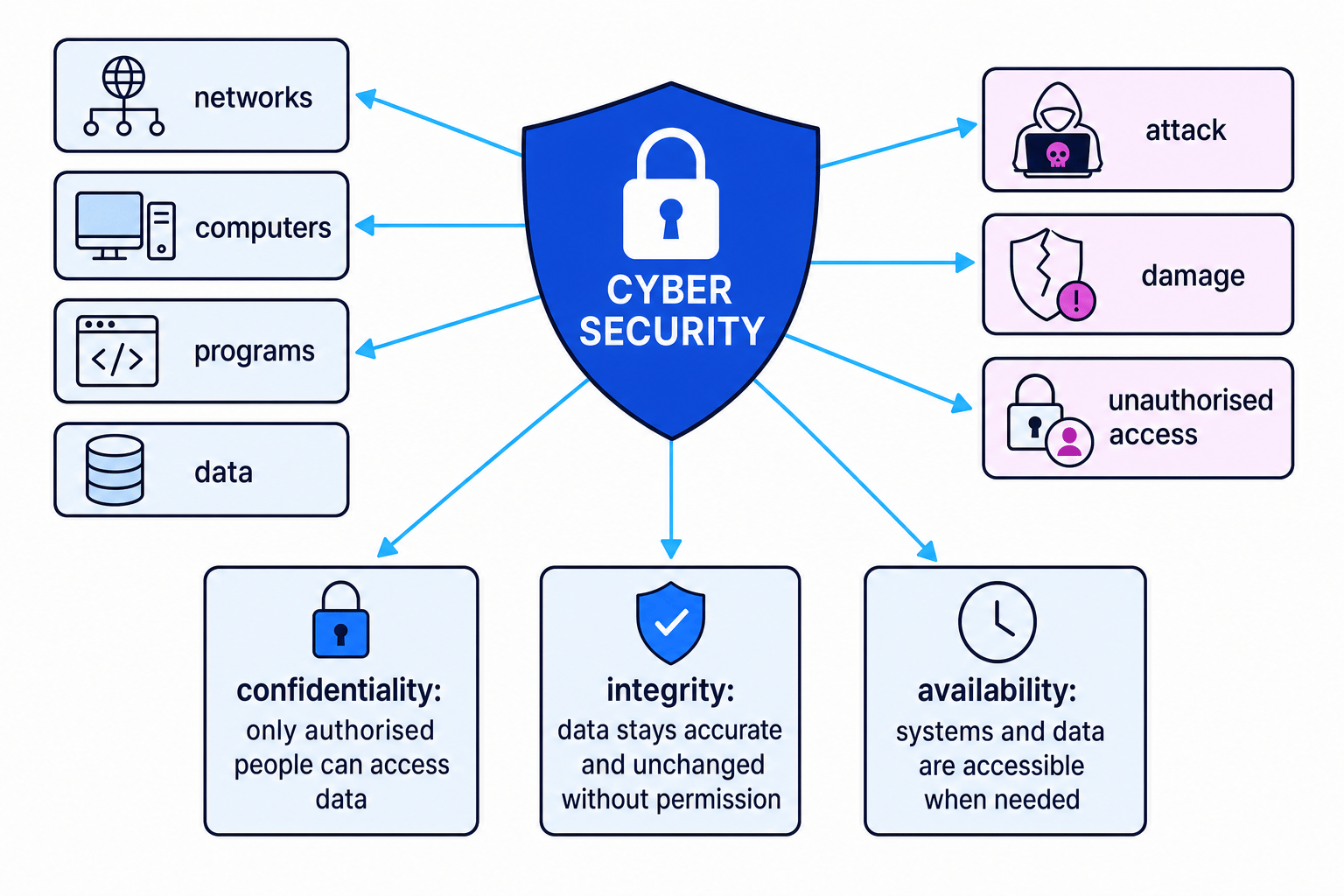
Cyber security consists of the processes, practices and technologies designed to protect networks, computers, programs and data from attack, damage or unauthorised access.
That definition is worth learning closely because it contains the key parts exam questions often look for:
- How protection is done: processes, practices and technologies.
- What is protected: networks, computers, programs and data.
- What it is protected from: attack, damage and unauthorised access.
This concept map shows the main parts of the definition and the three big security goals you will use when explaining purposes.
Key Idea
The core idea
Cyber security is not just one tool or one action. It is a combination of rules, habits and technical measures used to protect computer systems and data.
What is being protected?
Networks
A network is a set of connected computers or devices that can share data and resources. For example, a school network might connect classroom computers, printers, servers and Wi-Fi access points.
If a network is not protected, an attacker may try to intercept data, disrupt communication, or gain access to connected devices.
Computers
A computer is a device that processes data by following instructions. This includes desktops, laptops, servers, tablets and many embedded systems.
Cyber security helps stop computers being misused, damaged, or taken over by someone who should not control them.
Programs
A program is a set of instructions that a computer can run. Programs include operating systems, apps, websites and database software.
If programs are not protected, they may be changed, misused, or exploited so that they behave in an unintended way.
Data
Data means facts and values stored or processed by a computer system. Examples include names, passwords, medical records, messages, marks, bank details and files.
Data is often the most valuable asset because it can be private, difficult to replace, or useful to criminals.
Common Mistake
Only thinking about hardware
Cyber security is not just about protecting physical computers. It also protects software, networks and especially data.
What is it being protected from?
Attack
An attack is a deliberate attempt to harm, disrupt, exploit or gain access to a computer system or its data.
An attack might aim to steal data, stop a service working, change information, or gain control of a device. You do not need to list every type of attack for this sub-topic, but you should understand the general idea: an attack is intentional.
Damage
Damage means harm to a system, program or data. This could include files being deleted, data being corrupted, software being changed, or a service being made unavailable.
Damage can be caused by an attacker, but it can also result from poor security procedures, mistakes, or failures.
Unauthorised access
Unauthorised access means a person or program gets into a system, file, account or area of a network without permission.
For example, a student using a teacher’s account to view marks would be unauthorised access, even if the student does not change anything.
Example
Classifying a security incident
A student guesses a teacher’s password, opens the school marks database, views the class marks, and changes two results. Identify the cyber security problems involved.
- The marks database is data, so one protected asset is the stored information about students’ results.
- Guessing and using the teacher’s password means the student accessed an account without permission, so this is unauthorised access.
- Viewing marks they should not see breaks confidentiality, because private data has been revealed to someone who is not authorised.
- Changing two results damages the accuracy of the data, so it affects integrity.
- If the marks database still opens and works normally, availability is not the main problem in this scenario.
Tip
Separate the asset from the problem
In scenario questions, first ask “what is being protected?” Then ask “what went wrong?” This helps you avoid vague answers like “the computer got hacked”.
Processes, practices and technologies
The definition says cyber security uses processes, practices and technologies. These are three different kinds of protection.
Processes
A process is a planned set of steps that people follow. For example, a school might have a process for resetting passwords, reporting suspicious emails, or restoring files from backups.
Processes matter because even good technical tools can fail if people do not know what to do.
Practices
A practice is a regular behaviour or habit. For example, users might be expected to lock their screen when leaving a computer, use strong passwords, and avoid sharing login details.
Good practices reduce the chance of mistakes and make attacks harder.
Technologies
A technology is hardware or software used to help protect systems. Examples include anti-malware software, firewalls, encryption and access controls.
You will learn about specific security methods later, but for this section you mainly need to know that technology is only one part of cyber security.
Common Mistake
Thinking one product solves everything
Installing security software is useful, but it is not the whole of cyber security. People, procedures and regular habits are also part of the protection.
The main purposes of cyber security
The main purpose is to protect computer systems and data from harm. A useful way to organise this is with three goals: confidentiality, integrity and availability.
Confidentiality
Definition
Confidentiality
Confidentiality means making sure information is only seen by people who are authorised to see it.
For example, medical records should only be available to the correct medical staff and the patient, not to random users.
Confidentiality is about privacy and secrecy.
Integrity
Definition
Integrity
Integrity means making sure data remains accurate, complete and not changed without permission.
For example, if a bank balance is changed incorrectly, the data has lost integrity. Even if no one else sees the data, it is still a serious security problem because the data can no longer be trusted.
Integrity is about correctness and trustworthiness.
Availability
Definition
Availability
Availability means making sure systems and data are accessible to authorised users when they are needed.
For example, a hospital system must be available when doctors need patient information. If the system is down, the data might still be private and accurate, but it is not useful at that moment.
Availability is about access for the right people at the right time.
Example
Identifying the security purpose
An online shop has three incidents in one week: customer addresses are leaked, product prices are changed without permission, and the website goes offline for two hours. Match each incident to the main security purpose affected.
- Customer addresses being leaked means private information has been revealed to people who should not see it, so the main purpose affected is confidentiality.
- Product prices being changed without permission means the stored data is no longer reliable, so the main purpose affected is integrity.
- The website going offline means legitimate customers cannot use the service when needed, so the main purpose affected is availability.
Tip
Remember CIA
A quick memory aid is CIA: Confidentiality, Integrity, Availability. In an exam, do not just write the letters — explain what each one means.
Writing a strong answer
If you are asked to define cyber security, aim to include the full idea rather than a vague phrase like “keeping computers safe”.
A strong answer should mention:
- Processes, practices and technologies.
- Protection of networks, computers, programs and data.
- Protection from attack, damage or unauthorised access.
For a “describe the purpose” question, focus on what cyber security is trying to achieve. You could say it helps keep data private, accurate and available, and helps prevent attackers or unauthorised users from harming systems.
Exam technique
In the exam
- For a definition question, include all three parts: how protection is done, what is protected, and what it is protected from.
- For a scenario question, identify the asset first, then decide whether the issue is attack, damage, unauthorised access, confidentiality, integrity or availability.
- Use precise terms such as unauthorised access, damage, confidentiality, integrity and availability instead of vague phrases like “it got hacked”.
Self review
Check yourself
- Can you define cyber security using the words processes, practices, technologies, networks, computers, programs and data?
- Can you explain the difference between confidentiality, integrity and availability?
- If a system is working normally but private customer records are leaked, which main security purpose has been affected?

Recap questions
Test yourself with 5 quick questions on this guide. Answer them all correctly to complete it.
You've reached the end
Test yourself on this topic, or move on to the next guide.
How was this guide?