Revision notes for AQA GCSE Computer Science Ethical, legal and environmental impacts of digital technology on wider society, including issues of privacy. Open the guide for explanations and worked examples. Written against the AQA GCSE Computer Science (8525) specification, so the content matches what's examinable rather than general Computer Science background.
Ethical, legal and environmental impacts of digital technology on wider society, including issues of privacy
What you'll learn
- How to explain ethical, legal, environmental and privacy impacts of digital technology.
- How to apply these ideas to cyber security, mobiles, cloud storage, wearables, implants and autonomous vehicles.
- How to write balanced GCSE answers that consider different viewpoints.
- How to avoid vague answers like “technology is bad” by linking impacts to real risks.
The big idea: technology affects people
Digital technology is not just about hardware, software and networks. It changes how people work, communicate, travel, shop, learn and stay safe.
For GCSE, you need to explain impacts: the effects digital technology has on individuals, organisations, governments and the environment.
Definition
Impact
An impact is a consequence or effect. It can be positive, negative, short-term, long-term, intended or unintended.
A strong answer usually identifies:
- the technology being used
- who is affected
- what the benefit or risk is
- whether the issue is ethical, legal, environmental or linked to privacy
This diagram shows the main areas you should be ready to discuss, and the four “lenses” you can use to analyse them.
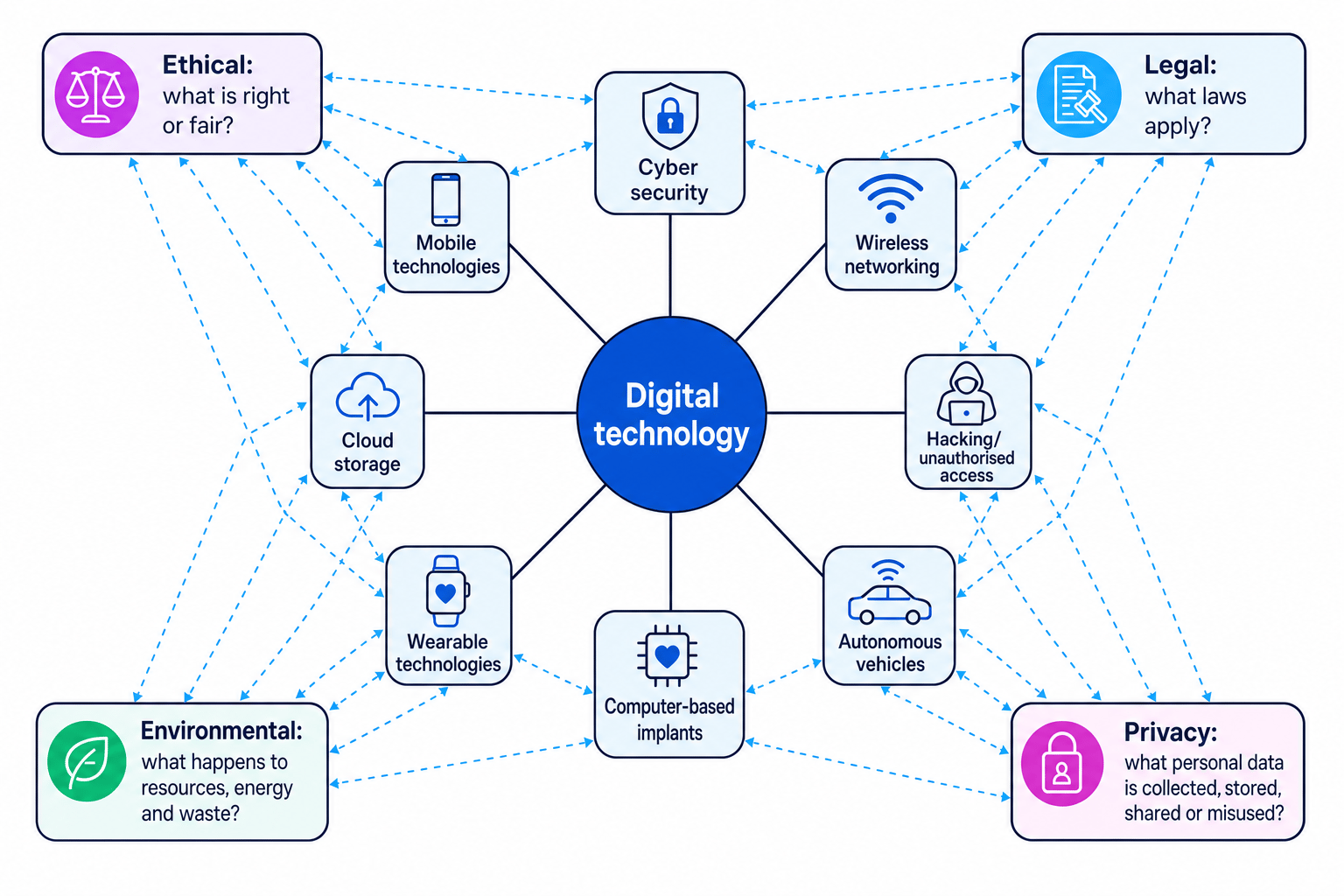
The four lenses
Ethical issues
An ethical issue is about what is morally right or wrong. Something can be legal but still feel unfair, harmful or intrusive.
Definition
Ethical issue
An ethical issue is a question about what people or organisations should do, especially when their actions affect others.
Examples include:
- Should an app track your location all the time?
- Should a company use customer data to target adverts?
- Should an autonomous vehicle prioritise passenger safety over pedestrian safety?
- Should employers monitor workers using wearable devices?
Ethical answers often involve a trade-off, where one benefit comes with a cost.
Key Idea
Ethics is about judgement
In exam answers, do not just say “it is unethical”. Explain why: for example, it may be unfair, unsafe, discriminatory, manipulative or an invasion of privacy.
Example
Judging whether location tracking is ethical
A mobile app tracks users’ locations so it can suggest nearby shops and restaurants.
- The benefit is that users receive useful, personalised recommendations based on where they are.
- The risk is that the app collects sensitive information, such as where users live, work, worship or spend their free time.
- A balanced judgement is that location tracking may be acceptable if users give informed consent, can turn it off, and the data is not shared unnecessarily.
Legal issues
A legal issue is about whether actions follow the law. In this topic, you are not expected to know every detail of every law, but you should understand the principles.
Definition
Legal issue
A legal issue is about whether a person or organisation is obeying rules set by law, such as rules about personal data, copyright or unauthorised access.
Important legal principles include:
- personal data should be collected and used fairly
- organisations should protect data from unauthorised access
- hacking into systems without permission is illegal
- software, music, images and other digital content may be protected by copyright
- companies may be responsible if unsafe systems cause harm
For example, if a hacker breaks into a company database, this is not just “bad behaviour”. It is a legal issue because it involves unauthorised access and possible misuse of personal data.
Common Mistake
Confusing ethical and legal
“Legal” means about the law. “Ethical” means about right and wrong. An action can be legal but still unethical, or illegal and also unethical.
Environmental issues
An environmental issue is about the effect technology has on the natural world.
Definition
Environmental issue
An environmental issue is an impact on resources, energy use, pollution, waste or the climate.
Digital technology can help the environment, but it can also damage it.
Positive impacts include:
- video calls reducing travel
- smart heating systems reducing wasted energy
- sensors helping farms use water more efficiently
- route-planning software reducing fuel use
Negative impacts include:
- electricity used by data centres and networks
- mining raw materials for devices and batteries
- electronic waste when devices are replaced frequently
- pollution caused by manufacturing and disposal
Definition
E-waste
E-waste means discarded electronic devices or components, such as old phones, laptops, batteries and circuit boards.
Key Idea
Environmental answers need both sides
A good answer might say that cloud storage reduces the need for some local hardware, but large data centres still use lots of electricity and need cooling.
Privacy issues
Privacy means being able to control information about yourself. Digital systems often collect, store, process and share personal data.
Definition
Personal data
Personal data is information that can identify a living person, either directly or indirectly. Examples include names, addresses, photos, location data, health data and login details.
Privacy issues arise when:
- too much data is collected
- users do not understand what is being collected
- data is shared with third parties
- data is stolen in a cyber attack
- governments or security services access private communications
- data is kept for longer than needed
Ordinary citizens usually value their privacy. They may not like governments, companies or security services having too much access to their personal information.
However, governments and security services often argue that access to private data may help prevent terrorism, organised crime or other serious attacks.
Example
Balancing privacy and public safety
A government wants messaging apps to provide access to encrypted messages during serious criminal investigations.
- The public safety argument is that investigators may need access to messages to prevent terrorism, protect victims or gather evidence.
- The privacy risk is that weakening private messaging could allow misuse by governments, criminals or hackers.
- A balanced answer should recognise both sides: safety may require targeted access in serious cases, but broad access to everyone’s private data could be excessive and dangerous.
Key technology areas you need to discuss
Cyber security
Cyber security means protecting computer systems, networks and data from attack, damage or unauthorised access.
Cyber security has positive impacts because it protects people from fraud, identity theft, data loss and disruption. For example, strong passwords, encryption and security updates help keep data safe.
But cyber security can also raise privacy issues. Monitoring network traffic may help detect attacks, but it might also mean collecting information about users’ behaviour.
Hacking and unauthorised access
In GCSE Computer Science, hacking usually means gaining unauthorised access to a computer system.
Definition
Hacking
Hacking is unauthorised access to a computer system. It may involve viewing, changing, stealing or deleting data without permission.
Impacts can include:
- stolen personal data
- financial loss
- disruption to hospitals, schools or businesses
- loss of trust in an organisation
- legal consequences for the attacker
Tip
Use precise language
Instead of saying “hackers get into stuff”, write “an attacker gains unauthorised access to a system and may steal, alter or delete data”.
Mobile technologies and wireless networking
Mobile technologies include smartphones, tablets and mobile apps. Wireless networking allows devices to communicate without cables, using technologies such as Wi-Fi or mobile networks.
Benefits include:
- communication anywhere
- navigation and emergency calls
- online banking, learning and shopping
- flexible working
Risks include:
- location tracking
- insecure public Wi-Fi
- stolen devices exposing data
- addictive app design
- unequal access for people who cannot afford devices or data
Wireless networks can also be attacked if they are poorly secured. This can lead to stolen data or unauthorised use of the network.
Cloud storage
Cloud storage means storing data on remote servers accessed over the internet, rather than only on a local device.
Definition
Cloud storage
Cloud storage is storage provided over a network, usually the internet, where data is kept on remote servers managed by another organisation.
Benefits include:
- access from different devices
- easier sharing and collaboration
- automatic backup
- less risk of losing data if one device breaks
Risks include:
- reliance on an internet connection
- data being stored in another country with different laws
- unauthorised access if accounts are compromised
- large data centres using significant energy
Example
Analysing cloud storage for a school
A school stores students’ work and personal records in a cloud system.
- The benefit is that teachers and students can access files from home and school, and backups reduce the chance of data loss.
- The privacy risk is that student records may contain personal data, so the school must control access carefully.
- The environmental issue is that cloud servers need electricity and cooling, although shared cloud systems may reduce the need for each school to run its own servers.
- The legal issue is that the school must ensure personal data is stored securely and used only for appropriate purposes.
Wearable technologies
Wearable technologies are digital devices worn on the body, such as smart watches, fitness trackers and smart glasses.
They can collect useful data, such as heart rate, steps, sleep patterns and location. This can help people monitor health and fitness.
However, wearables raise privacy and ethical issues because the data can be very personal. If an employer, insurance company or app provider uses this data unfairly, it could lead to discrimination or pressure on users.
For example, an insurance company might offer lower prices to people with certain fitness data. That may reward healthy behaviour, but it may also be unfair to people with disabilities or medical conditions.
Computer-based implants
A computer-based implant is a digital device placed inside the human body, often for medical reasons. Examples include pacemakers, cochlear implants or implanted sensors.
Benefits include:
- improved health
- increased independence
- better monitoring of medical conditions
- faster alerts when something is wrong
Risks include:
- hacking or interference with medical devices
- very sensitive health data being collected
- cost creating inequality between people who can and cannot access treatment
- responsibility if the device fails
Common Mistake
Implants involve high stakes
When technology is inside the body, failure is not just inconvenient. It may affect someone’s health, safety or life.
Autonomous vehicles
An autonomous vehicle is a vehicle that can make some or all driving decisions without direct human control.
Potential benefits include:
- fewer accidents caused by human error
- improved mobility for people who cannot drive
- smoother traffic flow
- reduced emissions if journeys are planned efficiently
Risks include:
- accidents caused by software or sensor failure
- unclear responsibility when something goes wrong
- job losses for drivers
- collection of location and journey data
- ethical decisions in unavoidable collision situations
A good GCSE answer does not need to solve every problem. It needs to show that you understand the competing benefits and risks.
How to structure a strong answer
When a question asks you to “discuss” or “explain impacts”, use a simple structure:
- Identify the technology.
- Give a clear benefit.
- Give a clear risk or concern.
- Link the concern to ethical, legal, environmental or privacy issues.
- Add a balanced judgement if asked.
Tip
Use named stakeholders
Mention who is affected: users, companies, governments, schools, patients, drivers, pedestrians, employees or the wider public. This makes your answer more specific.
Useful comparison table
| Area | Possible benefit | Possible risk |
|---|---|---|
| Cyber security | Protects systems and data | Monitoring may reduce privacy |
| Mobile technologies | Convenient access anywhere | Location tracking and device theft |
| Wireless networking | Easy connection without cables | Insecure networks can expose data |
| Cloud storage | Backup and access from many devices | Data may be hacked or stored under different laws |
| Hacking | Security testing can reveal weaknesses if authorised | Unauthorised access is illegal and harmful |
| Wearables | Health and fitness monitoring | Sensitive data may be misused |
| Computer-based implants | Improved health and independence | Device failure or hacking could be dangerous |
| Autonomous vehicles | May reduce human error | Responsibility and safety issues if accidents occur |
Exam technique
In the exam
- Be balanced: give both a benefit and a risk when the question asks you to discuss impacts.
- Be specific: link your point to data privacy, safety, fairness, law, energy use or waste.
- Use the scenario: if the question mentions patients, drivers, students or customers, make your answer about them rather than giving a generic point.
Self review
Check yourself
- Why might a government argue that it needs access to some private data?
- Give one ethical issue and one privacy issue linked to wearable technology.
- How could cloud storage have both positive and negative environmental impacts?

Recap questions
Test yourself with 5 quick questions on this guide. Answer them all correctly to complete it.
You've reached the end
Test yourself on this topic, or move on to the next guide.
How was this guide?