An industrial safety system monitors three sensors: XXX (temperature), YYY (pressure), and ZZZ (vibration). The system triggers an alarm state (T=1T = 1T=1) according to the Boolean expression:
T=(NOT X AND Y AND Z) OR (X AND Y AND Z) OR (X AND NOT Y AND Z) T = (\text{NOT } X \text{ AND } Y \text{ AND } Z) \text{ OR } (X \text{ AND } Y \text{ AND } Z) \text{ OR } (X \text{ AND } \text{NOT } Y \text{ AND } Z) T=(NOT X AND Y AND Z) OR (X AND Y AND Z) OR (X AND NOT Y AND Z)The truth table for this expression is shown in Table 1.
Table 1
| X | Y | Z | T |
|---|---|---|---|
| 0 | 0 | 0 | 0 |
| 0 | 0 | 1 | 0 |
| 0 | 1 | 0 | 0 |
| 0 | 1 | 1 | 1 |
| 1 | 0 | 0 | 0 |
| 1 | 0 | 1 | 1 |
| 1 | 1 | 0 | 0 |
| 1 | 1 | 1 | 1 |
Select the one option which represents a simpler equivalent expression that is implemented by the logic gate circuit shown below:
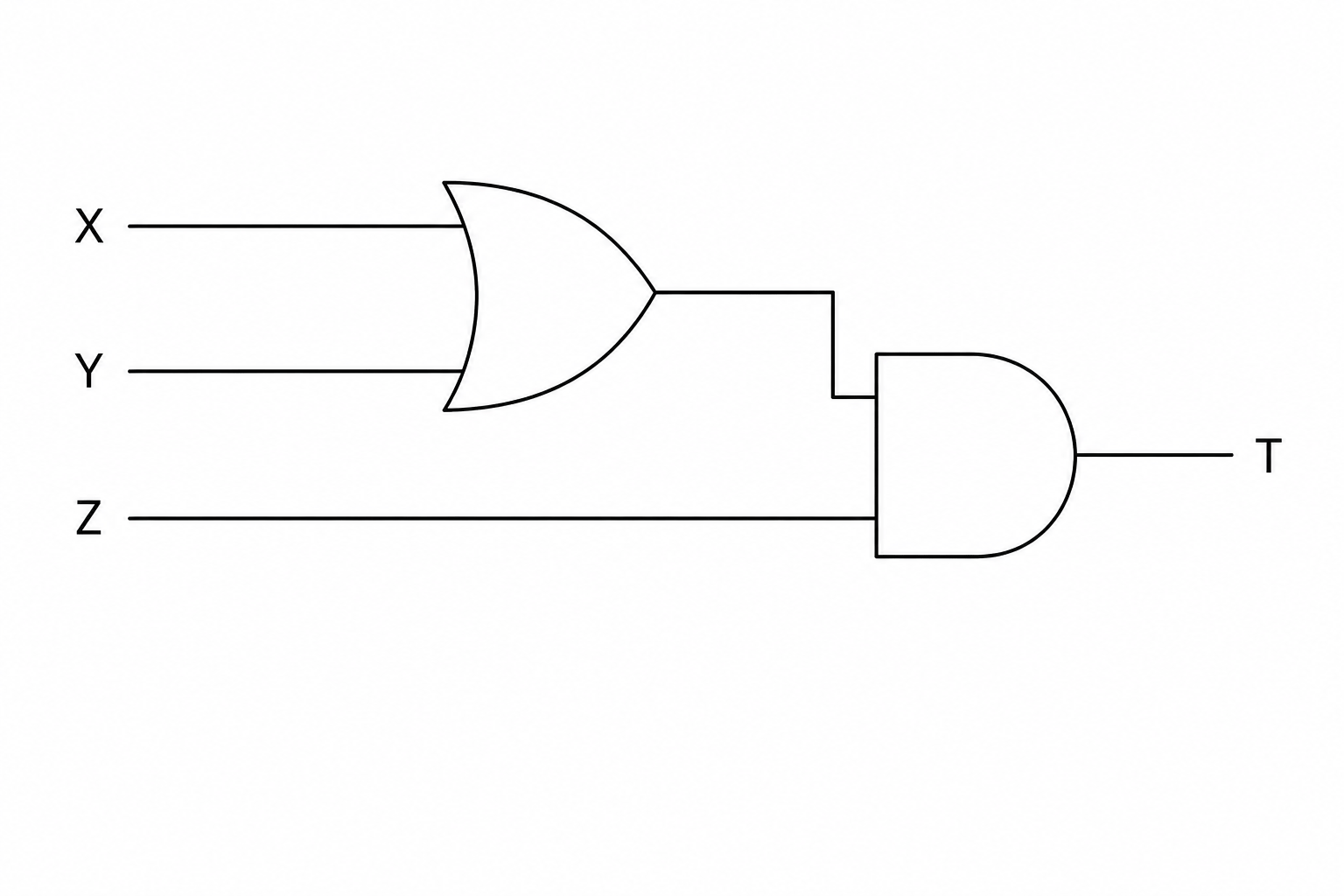
X AND ZX \text{ AND } ZX AND Z
Z AND (X OR Y)Z \text{ AND } (X \text{ OR } Y)Z AND (X OR Y)
Y OR (X AND Z)Y \text{ OR } (X \text{ AND } Z)Y OR (X AND Z)
X AND Y AND ZX \text{ AND } Y \text{ AND } ZX AND Y AND Z
Boolean logic Questions
Practise AQA GCSE Computer Science Boolean logic with exam-style questions for GCSE Computer Science. 83 questions, matched to the AQA GCSE Computer Science (8525) specification and written in Paper 1 and Paper 2 style. Every question includes a full worked solution and mark scheme, so you can see where marks are awarded rather than just whether you got the answer right.