Chemical bonds form by transferring or sharing electrons
Chemical bond
A strong attraction that holds atoms or ions together in a substance.
- Atoms bond in ways that give them a full outer shell, like the outer shell of a noble gas.
- A metal bonding with a non-metal transfers electrons, forming ionic bonds.
- Non-metals bonding with each other share electrons, forming covalent bonds.
- Metal atoms bonding together release their outer electrons into a shared pool, forming metallic bonds.
- In every case the bond is an electrostatic attraction between opposite charges.
Whether the elements are metals or non-metals tells you which type of bonding to expect.
Ionic bonds hold oppositely charged ions together
Ionic bond
The electrostatic attraction between oppositely charged ions.
Ionic lattice
A regular, repeating three-dimensional arrangement of oppositely charged ions.
- When sodium reacts with chlorine, each sodium atom transfers its one outer electron to a chlorine atom.
- Sodium becomes Na+\text{Na}^{+}Na+, with the arrangement [2.8]+[2.8]^{+}[2.8]+, and chlorine becomes Cl−\text{Cl}^{-}Cl−, with the arrangement [2.8.8]−[2.8.8]^{-}[2.8.8]−.
- The ions attract each other in all directions, so they build a giant structure.
- A grain of salt contains millions of ions, so the formula NaCl gives the ratio of ions rather than a molecule.
- In magnesium oxide, magnesium transfers two electrons to oxygen, forming Mg2+\text{Mg}^{2+}Mg2+ and O2−\text{O}^{2-}O2− ions.
- Do not call the particles in sodium chloride atoms or molecules, because the lattice is made of ions.
- Do not describe ionic bonding as an attraction between a nucleus and electrons, because it is the attraction between oppositely charged ions.
Covalent bonds form molecules, giant structures and polymers
Covalent bond
A shared pair of electrons between two atoms.
Molecule
A particle made from two or more atoms joined by covalent bonds.
- A covalent bond forms when two non-metal atoms each put one electron into a shared pair.
- The shared pair is attracted to both nuclei, which holds the two atoms together.
- In simple molecules such as H2\text{H}_2H2, Cl2\text{Cl}_2Cl2, H2O\text{H}_2\text{O}H2O and CH4\text{CH}_4CH4, a small, fixed number of atoms are joined by covalent bonds.
- Separate molecules are held to one another only by weak intermolecular forces, which are much weaker than the covalent bonds inside them.
- In giant covalent structures such as diamond and silicon dioxide, huge numbers of atoms are joined by covalent bonds in a continuous network.
- Polymers such as poly(ethene) are very long molecules in which thousands of atoms are joined in chains by covalent bonds.
- Neighbouring polymer chains are held together by intermolecular forces, which are stronger than between small molecules because the chains are so long.
Do not describe the forces between simple molecules as weak covalent bonds, because the covalent bonds inside the molecules are strong and the forces between them are separate, weaker attractions.
Metallic bonding involves a sea of delocalised electrons
Delocalised electron
An electron that is not attached to one particular atom or ion and can move through a structure.
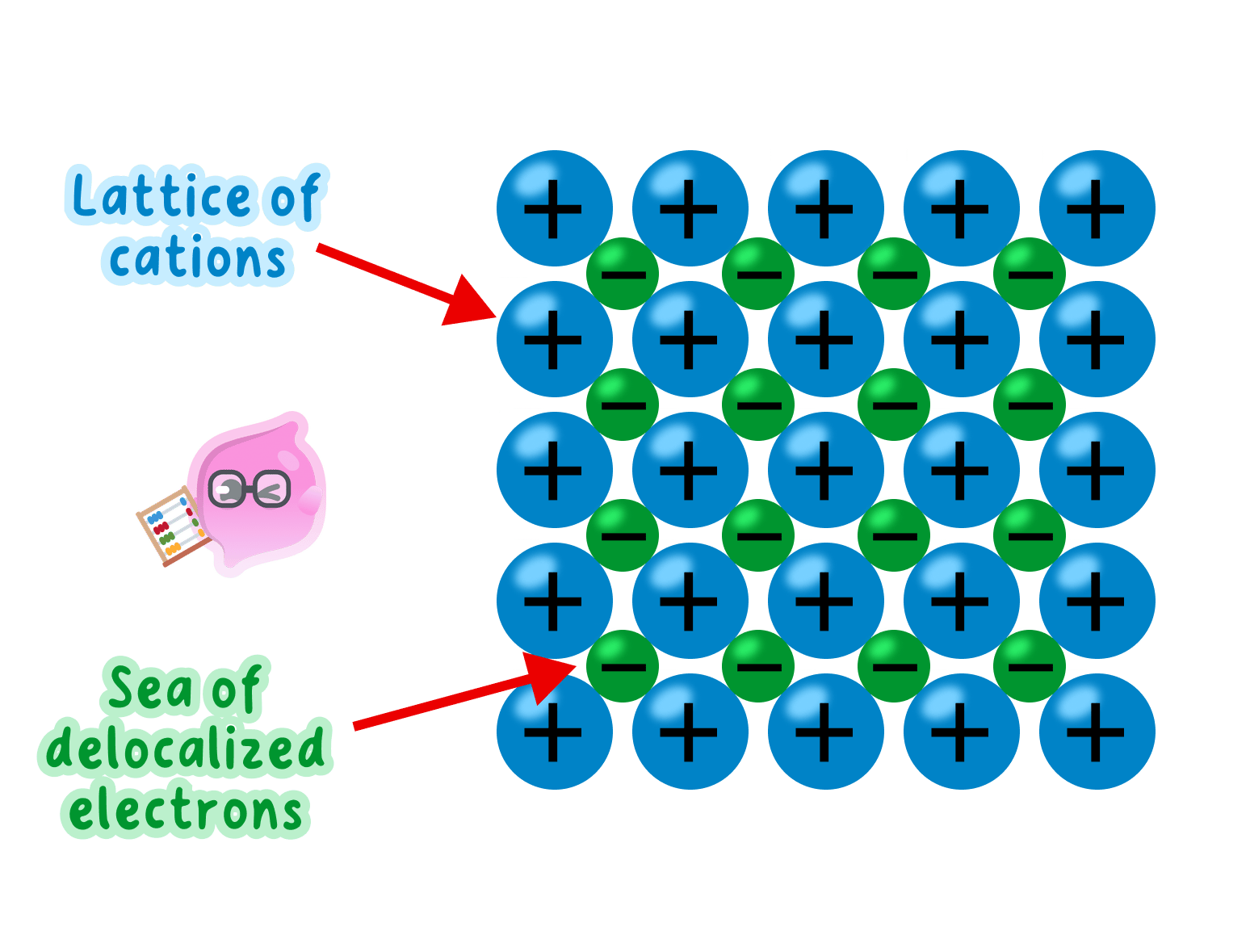
- In a metal, the atoms are packed closely in a regular arrangement.
- Each atom gives up its outer electrons, leaving positive metal ions.
- The released electrons spread through the whole metal as a sea of electrons.
- This strong electrostatic attraction between positive ions and delocalised electrons is called metallic bonding.
- Ionic, giant covalent and metallic substances are giant structures, while simple molecules and polymers are made of separate molecules.
- Sodium chloride is made of ions held by ionic bonds in a giant lattice.
- Water is made of small molecules with covalent bonds inside them and weak intermolecular forces between them.
- Copper is made of positive ions in a sea of delocalised electrons.
Dot and cross diagrams show outer electrons
Dot-and-cross diagram
A diagram showing how the outer-shell electrons of atoms are transferred or shared when they bond.
- Electrons from one atom are drawn as dots and electrons from the other atom as crosses, so it is clear where each came from.
- For a binary ionic compound, draw the outer shell of each ion inside square brackets, with the charge written outside at the top right.
- In MgO\text{MgO}MgO, magnesium's two outer electrons appear as crosses in the outer shell of oxygen, giving [Mg]2+[\text{Mg}]^{2+}[Mg]2+ and [O]2−[\text{O}]^{2-}[O]2− with eight outer electrons.
- For a simple covalent molecule, draw the outer shells overlapping, with each shared pair of one dot and one cross inside the overlap.
- In H2O\text{H}_2\text{O}H2O, oxygen shares one pair with each hydrogen atom, leaving oxygen with two pairs of outer electrons that are not shared.
- Finish by counting the outer electrons around each atom to check that every outer shell is full.
- Draw a dot and cross diagram for methane, CH4\text{CH}_4CH4.
- Carbon, 2.42.42.4, has four outer electrons, drawn as dots, and each hydrogen atom has one electron, drawn as a cross.
- Draw the outer shell of carbon overlapping the shell of each of the four hydrogen atoms.
- Place one dot and one cross in each overlap, giving four shared pairs around the carbon atom.
- What is transferred in ionic bonding, and what is shared in covalent bonding?
- What holds the ions together in a sodium chloride lattice?
- How do the bonds within a water molecule compare with the forces between water molecules?
- What is a metallic bond?
- Where is the charge written on the dot and cross diagram of an ion?
