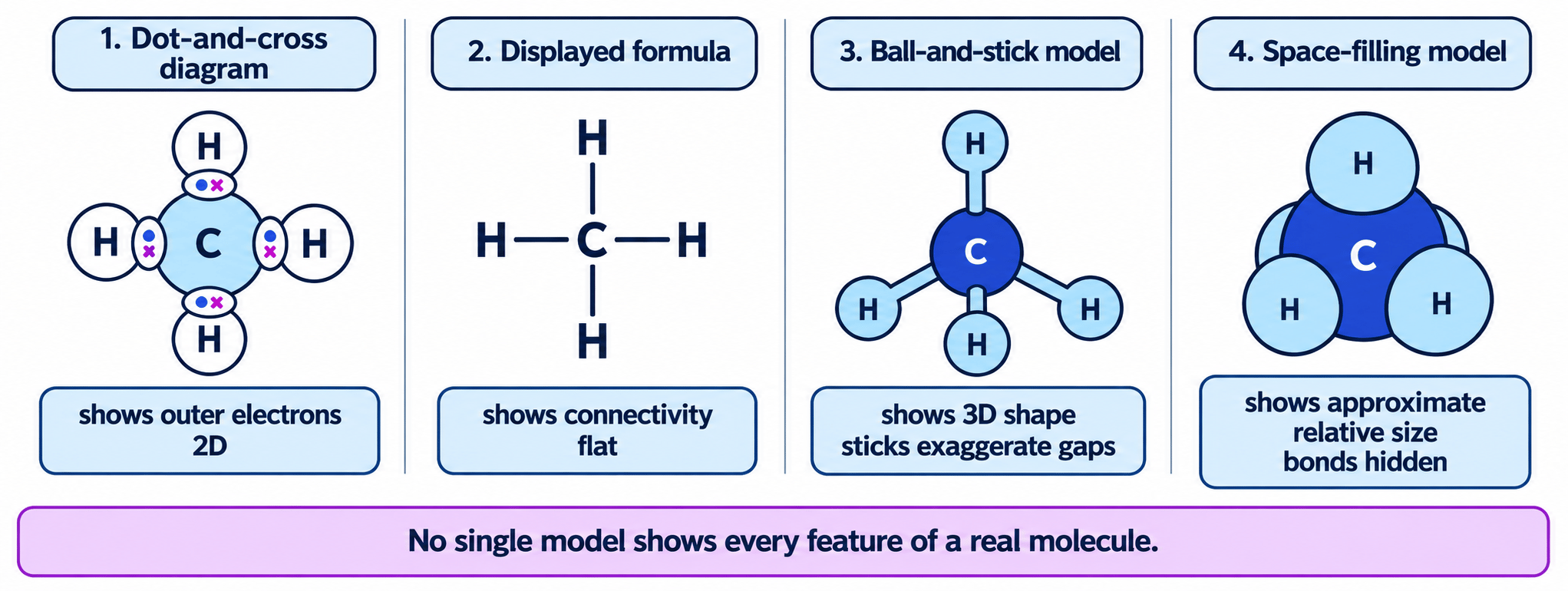
Every representation of a substance is a model
Scientific model
A simplified representation used to show or explain selected features of something real.
- Chemists represent substances with dot and cross diagrams, displayed formulae, ball and stick models and space-filling models.
- Each representation is chosen to show one feature clearly, such as which electrons form a bond or how the atoms are arranged.
- No single model shows everything, because real particles are not balls, sticks or lines on paper.
- Knowing what a model leaves out helps you choose the right one and avoid false conclusions.
A limitation is anything real that a model cannot show, or shows wrongly.
Dot and cross diagrams show electrons, not shape
Dot-and-cross diagram
A diagram showing how the outer-shell electrons of atoms are transferred or shared when they bond.
- A dot and cross diagram shows which electrons are transferred or shared and which atom they came from.
- It is two-dimensional, so it cannot show the three-dimensional shape of a molecule.
- Methane is drawn flat, but its four hydrogen atoms really point away from the carbon atom in three dimensions.
- It does not show the relative sizes of atoms or ions.
- Electrons from different atoms are drawn differently, although all electrons are identical.
- For an ionic compound it shows one pair of ions rather than the giant lattice.
Do not read the dots and crosses as different kinds of electron, because the symbols only record which atom each electron came from.
Displayed formulae and ball and stick models show bonds
Displayed formula
A two-dimensional formula that shows every atom in a molecule and each bond between the atoms.
Ball-and-stick model
A three-dimensional representation in which spheres represent atoms and sticks represent bonds.
- A displayed formula makes it easy to see which atoms are bonded to which.
- It is flat, so the bonds appear at right angles even though real molecules are three-dimensional.
- It does not show the electrons in each bond or the outer electrons that are not shared.
- A ball and stick model shows the 3D shape of a molecule much better.
- Its sticks suggest large gaps between atoms and make bonds look like solid rods, whereas bonded atoms are really very close together.
- The balls are often the wrong relative sizes, and the electrons are not shown at all.
In a ball and stick model of sodium chloride, the sticks wrongly suggest bonds between fixed pairs of ions, when each ion is really attracted to all six ions around it.
Space-filling and lattice diagrams hide the bonding
- A space-filling model shows the atoms touching at roughly their correct relative sizes.
- It shows the overall shape of a molecule well, but the bonds and bond angles are hard to see.
- A lattice diagram of sodium chloride shows how the ions repeat in three directions.
- It shows only a tiny part of the lattice, which really continues in every direction for millions of ions.
- A diagram of a metal shows positive ions in a sea of electrons, but it cannot show the electrons moving.
- When a question asks for a limitation of a model, say what the model shows wrongly or leaves out and then what the real substance is like.
- Choose a limitation that fits the model in the question, such as the flat shape of a displayed formula or the gaps between atoms in a ball and stick model.
- What does a dot and cross diagram show well?
- Give two limitations of a dot and cross diagram of methane.
- Why does a displayed formula give a misleading picture of bond angles?
- What false impression do the sticks in a ball and stick model give?
- Why does a diagram of a sodium chloride lattice show only part of the structure?