Question 3
HScientists can predict the reactions of elements from their positions in the Periodic Table.
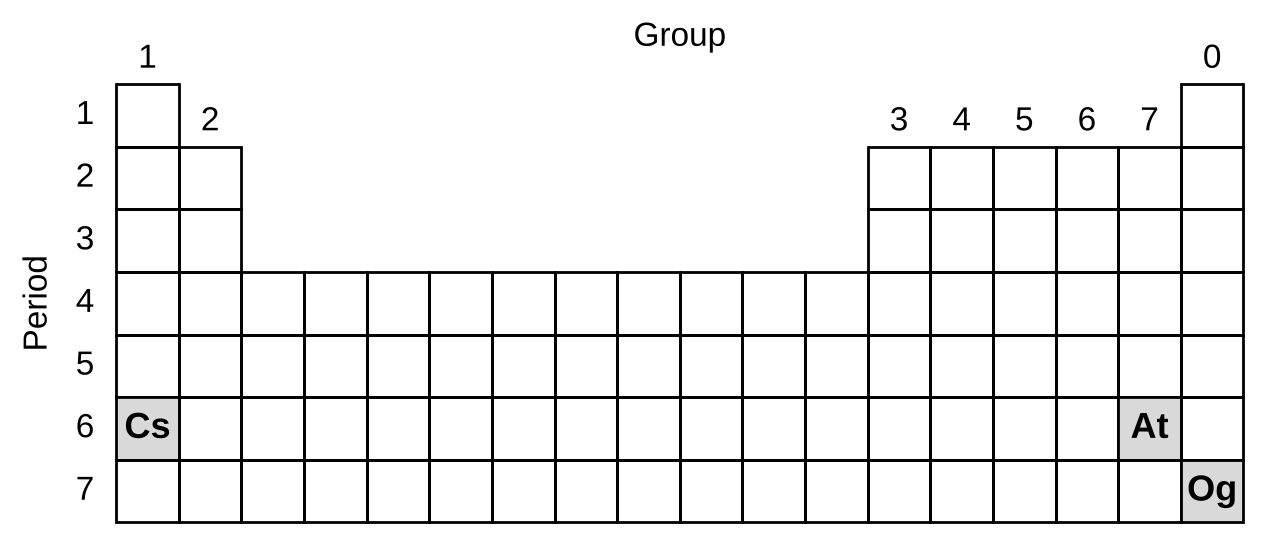
The diagram shows the positions of three elements in the Periodic Table: caesium, Cs, astatine, At, and oganesson, Og.
a.i.[2]
Caesium reacts with water.
Write the balanced symbol equation for the reaction of caesium with water.
a.ii.[3]
Predict how the reaction of caesium with water compares with the reaction of potassium with water.
Explain your prediction in terms of the electronic structure of the atoms.
b.i.[1]
Astatine is a halogen.
Predict the formula of the compound formed when caesium reacts with astatine.
b.ii.[2]
A student predicts:
"Astatine will displace iodine from sodium iodide solution."
Evaluate the student's prediction.
b.iii.[2]
Chlorine reacts with sodium astatide solution, NaAt.
Write the ionic equation for this reaction.
c.[2]
Only a few atoms of oganesson have ever been made.
A student says: "Oganesson will be a gas at room temperature, like all the other Group 0 elements."
Scientists predict that oganesson may be a solid at room temperature.
Use your knowledge of trends in Group 0 to explain the scientists' prediction.
4.1 Predicting chemical reactions Questions
60 exam-style questions on OCR GCSE Chemistry 4.1 Predicting chemical reactions, covering 4.1.1 Properties and trends in Groups 1, 7 and 0, 4.1.2 Properties of the transition metals, 4.1.3 Reactivity predicted from position in the Periodic Table, and 4.1.4 Reactivity of metals and the reactivity series. Each one has a worked solution and a mark scheme showing where the marks go.