Equal moles of any gas occupy equal volumes
Molar gas volume
The volume occupied by one mole of any gas at a stated temperature and pressure, which is 24 dm³ at room temperature and pressure.
- Gas particles are very far apart, so the volume of a gas depends on the number of particles and not on the size of each particle.
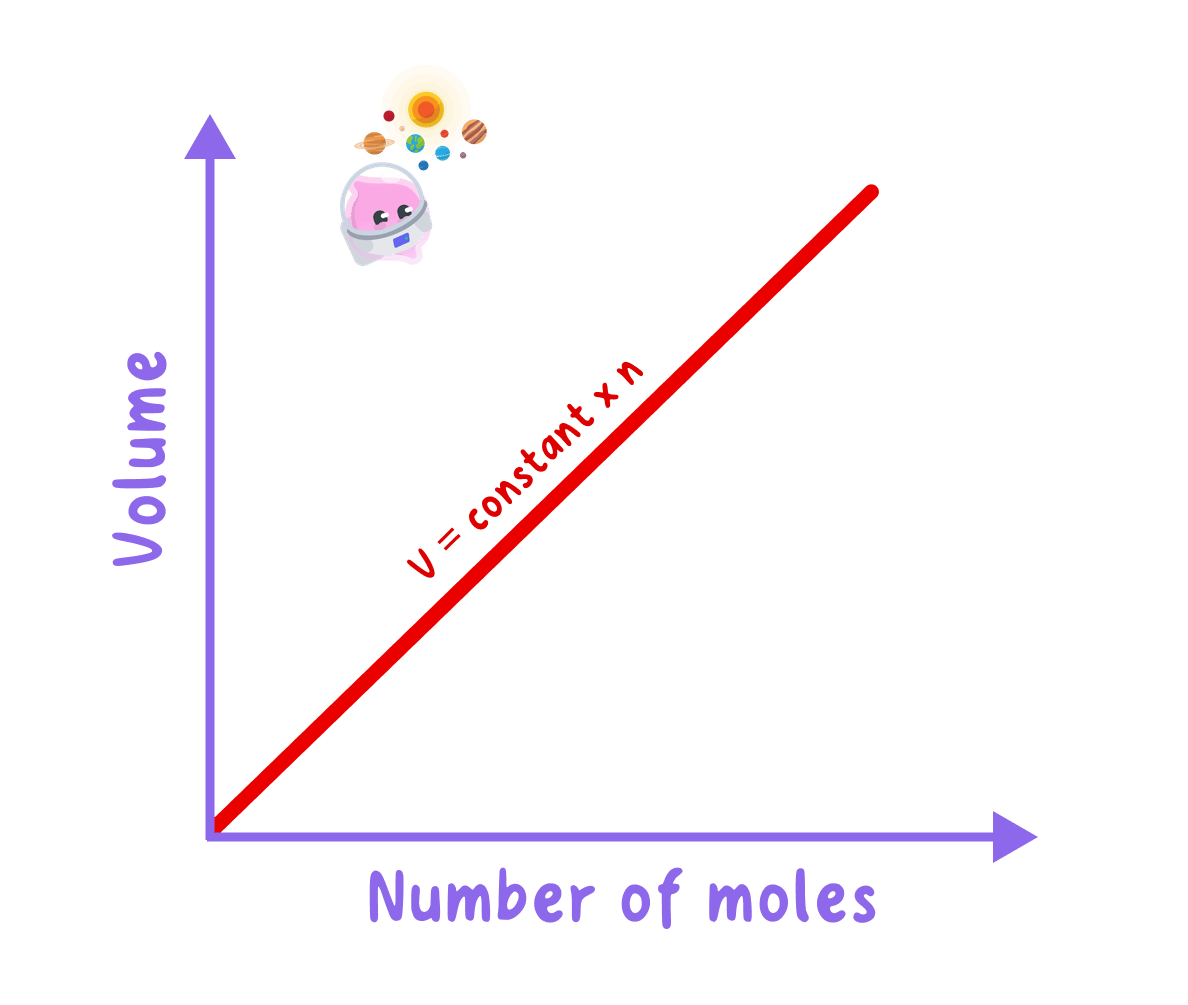
- At the same temperature and pressure, the volume of a gas is directly proportional to its amount in moles.
- Doubling the amount of gas doubles its volume, and halving it halves the volume.
- At room temperature and pressure, about 20 ∘C20\ ^{\circ}\text{C}20 ∘C and 1 atmosphere, one mole of any gas occupies 24 dm324\,\text{dm}^324dm3.
- This is the same as 24 000 cm324\,000\,\text{cm}^324000cm3, whether the gas is hydrogen, oxygen or carbon dioxide.
One mole of hydrogen weighs 2.0 g2.0\,\text{g}2.0g and one mole of carbon dioxide weighs 44.0 g44.0\,\text{g}44.0g, yet at room temperature and pressure each fills the same 24 dm324\,\text{dm}^324dm3.
Converting gas volume and moles using 24 dm³
- To find a gas volume, multiply the amount in moles by 242424: volume (dm3)=amount (mol)×24\text{volume (dm}^3\text{)} = \text{amount (mol)} \times 24volume (dm3)=amount (mol)×24
- To find an amount in moles, divide the gas volume in dm3\text{dm}^3dm3 by 242424.
- For a volume in cm3\text{cm}^3cm3, divide by 24 00024\,00024000 instead, or convert it into dm3\text{dm}^3dm3 first.
- So 0.25 mol0.25\,\text{mol}0.25mol of carbon dioxide occupies 0.25×24=6.0 dm30.25 \times 24 = 6.0\,\text{dm}^30.25×24=6.0dm3 at room temperature and pressure.
- The value of 24 dm324\,\text{dm}^324dm3 applies only at room temperature and pressure, so a different temperature or pressure gives a different volume.
- Calculate the amount in moles of oxygen in 480 cm3480\,\text{cm}^3480cm3 of the gas at room temperature and pressure.
- Convert the volume: 480 cm3÷1000=0.480 dm3480\,\text{cm}^3 \div 1000 = 0.480\,\text{dm}^3480cm3÷1000=0.480dm3.
- Amount =0.48024=0.0200 mol= \dfrac{0.480}{24} = 0.0200\,\text{mol}=240.480=0.0200mol.
Balancing numbers give the ratio of gas volumes
Mole ratio
The ratio of the amounts in moles of substances that react or form, given by the balancing numbers in the equation.
- The balancing numbers give the mole ratio, and equal amounts of gases have equal volumes, so for gases they also give the volume ratio.
- In CH4(g)+2O2(g)→CO2(g)+2H2O(l)\text{CH}_4\text{(g)} + 2\text{O}_2\text{(g)} \rightarrow \text{CO}_2\text{(g)} + 2\text{H}_2\text{O(l)}CH4(g)+2O2(g)→CO2(g)+2H2O(l), the volumes of methane, oxygen and carbon dioxide are in the ratio 1:2:11 : 2 : 11:2:1.
- So 50 cm350\,\text{cm}^350cm3 of methane reacts with 100 cm3100\,\text{cm}^3100cm3 of oxygen and makes 50 cm350\,\text{cm}^350cm3 of carbon dioxide.
- Water is a liquid at room temperature, so it is left out of the gas volume ratio.
- In 2H2(g)+O2(g)→2H2O(l)2\text{H}_2\text{(g)} + \text{O}_2\text{(g)} \rightarrow 2\text{H}_2\text{O(l)}2H2(g)+O2(g)→2H2O(l), 40 cm340\,\text{cm}^340cm3 of hydrogen needs half its volume, 20 cm320\,\text{cm}^320cm3, of oxygen.
Do not use the balancing numbers as a volume ratio for solids, liquids or solutions, because the rule applies only to gases measured at the same temperature and pressure.
Finding gas volume from reactant mass via moles
- First convert the mass of reactant into moles by dividing by its MrM_rMr.
- Next use the mole ratio from the balanced equation to find the amount in moles of gas formed.
- Then multiply the amount of gas by 242424 to find its volume in dm3\text{dm}^3dm3 at room temperature and pressure.
- Give the answer to a sensible number of significant figures, usually matching the data in the question.
- Calculate the volume of carbon dioxide at room temperature and pressure when 5.00 g5.00\,\text{g}5.00g of calcium carbonate is heated: CaCO3(s)→CaO(s)+CO2(g)\text{CaCO}_3\text{(s)} \rightarrow \text{CaO(s)} + \text{CO}_2\text{(g)}CaCO3(s)→CaO(s)+CO2(g) (ArA_rAr: Ca = 40.1, C = 12.0, O = 16.0).
- Mr(CaCO3)=40.1+12.0+(3×16.0)=100.1M_r(\text{CaCO}_3) = 40.1 + 12.0 + (3 \times 16.0) = 100.1Mr(CaCO3)=40.1+12.0+(3×16.0)=100.1, so the amount =5.00100.1=0.04995 mol= \dfrac{5.00}{100.1} = 0.04995\,\text{mol}=100.15.00=0.04995mol.
- The ratio CaCO3:CO2\text{CaCO}_3 : \text{CO}_2CaCO3:CO2 is 1:11 : 11:1, so 0.04995 mol0.04995\,\text{mol}0.04995mol of carbon dioxide forms.
- Volume =0.04995×24=1.20 dm3= 0.04995 \times 24 = 1.20\,\text{dm}^3=0.04995×24=1.20dm3.
Working back from gas volume to reactant mass
- Divide the gas volume in dm3\text{dm}^3dm3 by 242424 to find the amount of gas in moles.
- Use the mole ratio to find the amount in moles of the reactant.
- Multiply by the reactant's ArA_rAr or MrM_rMr to find its mass in grams.
- In Mg(s)+2HCl(aq)→MgCl2(aq)+H2(g)\text{Mg(s)} + 2\text{HCl(aq)} \rightarrow \text{MgCl}_2\text{(aq)} + \text{H}_2\text{(g)}Mg(s)+2HCl(aq)→MgCl2(aq)+H2(g), 180 cm3180\,\text{cm}^3180cm3 of hydrogen is 0.18024=0.00750 mol\dfrac{0.180}{24} = 0.00750\,\text{mol}240.180=0.00750mol.
- The ratio Mg:H2\text{Mg} : \text{H}_2Mg:H2 is 1:11 : 11:1, so the mass of magnesium that reacted is 0.00750×24.3=0.182 g0.00750 \times 24.3 = 0.182\,\text{g}0.00750×24.3=0.182g.
When a question gives a gas volume in cm3\text{cm}^3cm3, convert it into dm3\text{dm}^3dm3 before dividing by 242424, and show that step, because it is the step most often missed.
- What volume does one mole of any gas occupy at room temperature and pressure?
- What is the volume of 0.150 mol0.150\,\text{mol}0.150mol of nitrogen at room temperature and pressure?
- How many moles of gas are in 1200 cm31200\,\text{cm}^31200cm3 at room temperature and pressure?
- In CH4(g)+2O2(g)→CO2(g)+2H2O(l)\text{CH}_4\text{(g)} + 2\text{O}_2\text{(g)} \rightarrow \text{CO}_2\text{(g)} + 2\text{H}_2\text{O(l)}CH4(g)+2O2(g)→CO2(g)+2H2O(l), what volume of oxygen reacts with 30 cm330\,\text{cm}^330cm3 of methane?
- Why is water left out of the volume ratio in this equation?
