One product can be made by different pathways
Reaction pathway
The route of one or more reactions, with its starting materials and conditions, used to make a particular product.
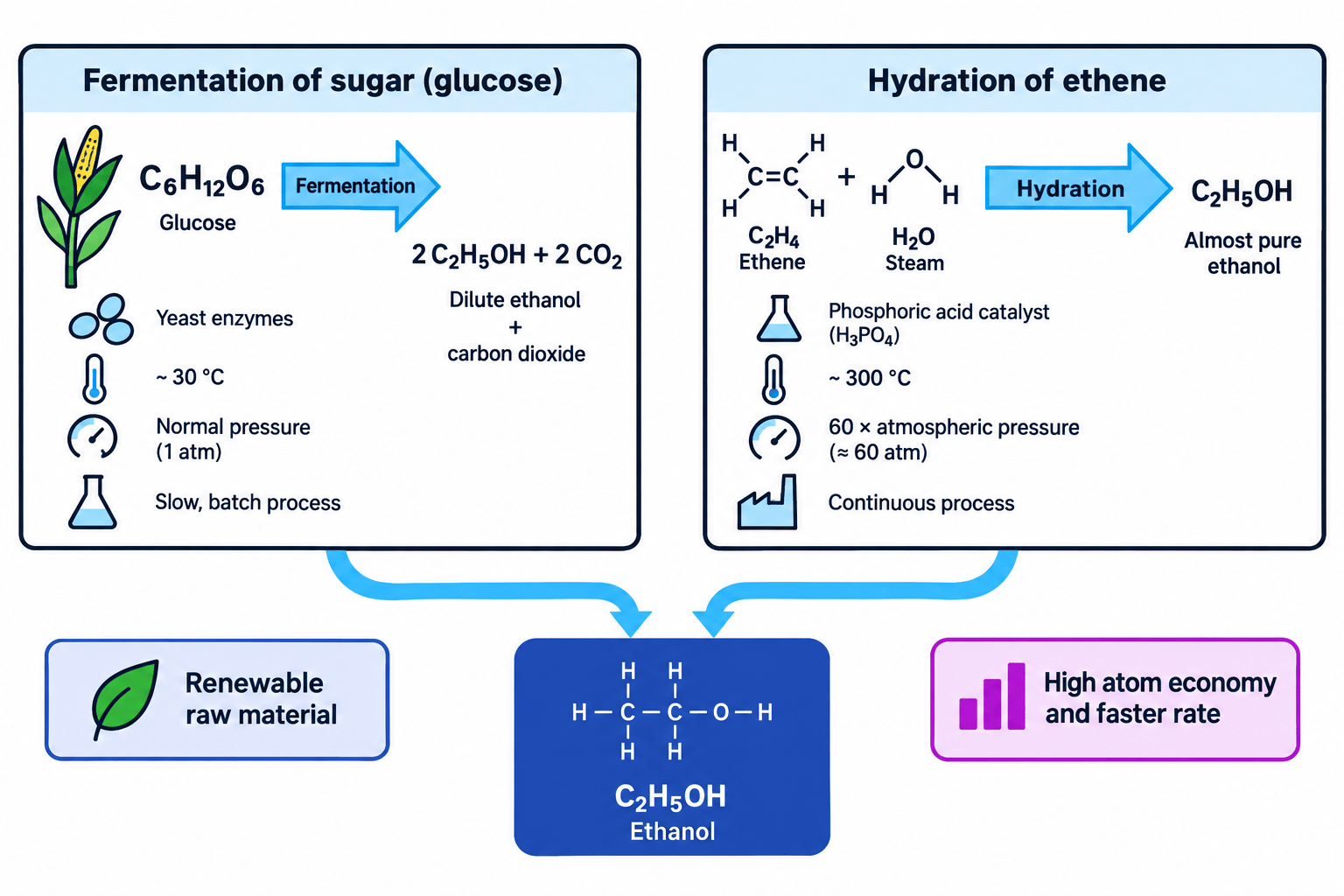
- Ethanol can be made by fermentation of sugars with yeast, or by reacting ethene with steam, which is called hydration.
- Each pathway uses different starting materials, conditions and numbers of steps.
- Chemists compare the pathways using data rather than choosing the one that seems simplest.
- The data usually cover yield and atom economy, rate, conditions and energy use, raw materials, by-products and how pure the product is.
The best pathway is the one that gives the most suitable overall balance of these factors for the product and its use, even if it is not the best on every one.
Yield and atom economy measure how much becomes product
By-product
A substance formed in a reaction alongside the desired product.
- A high percentage yield means that less of the reactant is lost or left unreacted.
- A high atom economy means that less of the reactant mass turns into by-products.
- A pathway with fewer steps usually loses less product overall, because some product is lost at every step.
- A low atom economy matters less if the by-product is useful or saleable, and more if it is harmful and must be treated.
- Unreacted starting materials can sometimes be recycled through the reactor, which improves the overall yield.
- Compare the atom economies of the two pathways to ethanol: C6H12O6→2C2H5OH+2CO2\text{C}_6\text{H}_{12}\text{O}_6 \rightarrow 2\text{C}_2\text{H}_5\text{OH} + 2\text{CO}_2C6H12O6→2C2H5OH+2CO2 and C2H4+H2O→C2H5OH\text{C}_2\text{H}_4 + \text{H}_2\text{O} \rightarrow \text{C}_2\text{H}_5\text{OH}C2H4+H2O→C2H5OH (MrM_rMr: glucose = 180.0, ethanol = 46.0).
- For fermentation, atom economy =2×46.0180.0×100=51.1%= \dfrac{2 \times 46.0}{180.0} \times 100 = 51.1\%=180.02×46.0×100=51.1%.
- For hydration, ethanol is the only product, so the atom economy is 100%100\%100%.
- Hydration wastes far less of the reactant mass, while almost half the mass in fermentation leaves as carbon dioxide.
Rate, conditions and energy decide a pathway's cost
- A fast reaction makes more product in a given time, so less equipment is needed for the same output.
- High temperatures and pressures need more energy and stronger, more expensive equipment.
- A catalyst can let a pathway run fast enough at a lower temperature, which saves energy.
- A continuous process, fed with reactants all the time, makes product faster than a batch that is started and stopped.
- Hydration of ethene runs continuously and quickly, while fermentation is a slow batch process that takes several days.
Hydration of ethene needs about 300 ∘C300\ ^{\circ}\text{C}300 ∘C, a pressure about 60 times atmospheric pressure and a phosphoric acid catalyst, whereas fermentation runs at about 30 ∘C30\ ^{\circ}\text{C}30 ∘C and normal pressure with enzymes in yeast.
Raw materials, purification and safety can outweigh yield
- A pathway is more sustainable if its raw materials are renewable, cheap and easy to obtain.
- Sugar for fermentation comes from crops such as sugar cane, which can be regrown, while ethene comes from crude oil, which is finite.
- A pathway that gives a purer product needs less separation afterwards.
- Fermentation gives a dilute solution of ethanol that must be separated by fractional distillation, while hydration gives almost pure ethanol.
- Hazardous substances, flammable gases and harmful waste add safety and disposal costs to a pathway.
Countries with large areas of farmland and little oil, such as Brazil, make much of their fuel ethanol by fermentation, while countries with a large petrochemical industry have used the hydration of ethene.
Justifying a pathway choice with data
- State which pathway you would choose for the specified product.
- Quote at least two pieces of data that support the choice.
- Explain what each value means in practice, such as less waste, lower energy costs or more product per hour.
- Say why the other pathway is less suitable, even if it has one advantage.
- Finish with a judgement linked to the stated priority, such as low cost, speed or sustainability.
When a question asks you to choose a pathway from data, compare the pathways factor by factor using the numbers given, then say which factor matters most for this product and why it decides your choice.
- What is meant by a reaction pathway?
- Why does fermentation have a lower atom economy than the hydration of ethene?
- Why can a pathway with fewer steps give a greater overall yield?
- Give one advantage of fermentation over the hydration of ethene.
- Why might a pathway with a lower percentage yield still be chosen?