5.3.1 Reversible reactions and dynamic equilibrium
Reversible reaction products can turn back into reactants
Reversible reaction
A reaction in which the products can react to form the original reactants again.
- The change from reactants to products is the forward reaction, and the change from products back to reactants is the reverse reaction.
- A reversible reaction is shown with the equilibrium sign, ⇌\rightleftharpoons⇌, instead of a single arrow.
- Heating ammonium chloride decomposes it into ammonia and hydrogen chloride:
NH4Cl(s)⇌NH3(g)+HCl(g)\text{NH}_4\text{Cl(s)} \rightleftharpoons \text{NH}_3\text{(g)} + \text{HCl(g)}NH4Cl(s)⇌NH3(g)+HCl(g)
- Near the cool top of the test tube, the two gases react again to form a white solid of ammonium chloride.
- Heating blue hydrated copper(II) sulfate drives off water and leaves white anhydrous copper(II) sulfate.
- Adding water to the white solid turns it blue again.
The copper(II) sulfate reaction is used as a test for water, because a liquid that turns white anhydrous copper(II) sulfate blue must contain water.
Changing conditions can reverse a reaction's direction
- Which direction a reversible reaction goes depends on the conditions, such as temperature, pressure and the amounts of substances present.
- For ammonium chloride, heating favours the forward reaction and cooling favours the reverse reaction.
- For copper(II) sulfate, heating removes water, while adding water reverses the change.
- When anhydrous copper(II) sulfate turns blue, the mixture gets hot, because the reverse reaction gives out the energy that heating put in.
- Most reactions, such as burning a fuel, cannot be reversed by changing the conditions.
A reversible reaction can go either way, and the conditions decide which direction happens.
Reversible reactions reach dynamic equilibrium in closed systems
Closed system
A container or apparatus from which no substances can escape and into which none can enter.
Dynamic equilibrium
The state of a reversible reaction in a closed system when the forward and reverse reactions happen at the same rate, so the amounts of all substances stay constant.
- At the start, only reactants are present, so the forward reaction is fast and the reverse reaction has not begun.
- As products build up, the reverse reaction speeds up, while the forward reaction slows as reactants are used up.
- Eventually the forward and reverse reactions happen at the same rate.
- From then on, the amounts of reactants and products stay constant.
- Equilibrium can be reached only in a closed system, because an escaping product could never react back.
- Heating calcium carbonate in an open container lets the carbon dioxide escape, so the reaction goes to completion instead.
- Do not say that the amounts of reactants and products are equal at equilibrium, because they stay constant but can be very different from each other.
- Do not say that the reactions stop at equilibrium, because both continue at the same rate.
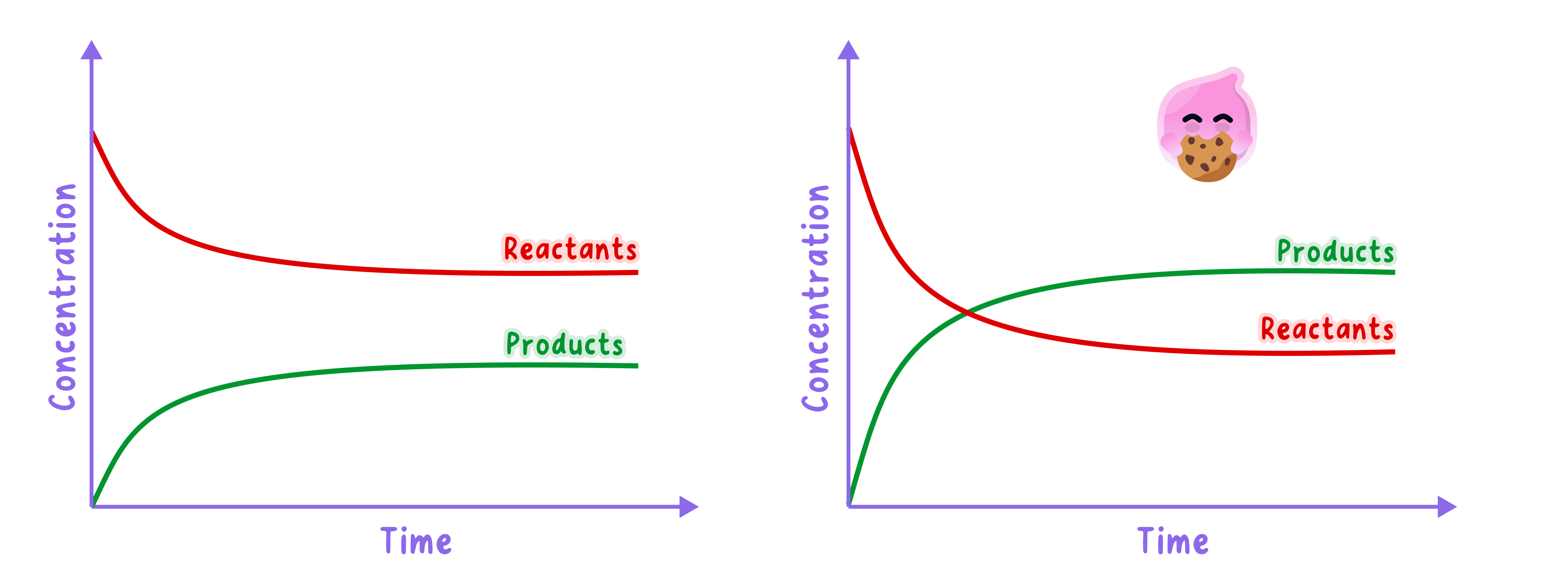
Both reactions continue at dynamic equilibrium
- The equilibrium is dynamic because particles keep reacting in both directions.
- No change can be seen, because each product particle formed is balanced by one reacting back.
- An equilibrium mixture can contain mostly products, mostly reactants or similar amounts of both.
- How far an equilibrium lies towards the products, and how that can be changed, is covered in the next topic.
When a question asks you to describe dynamic equilibrium, mention the closed system, the forward and reverse rates being equal and the amounts staying constant.
- What does the symbol ⇌\rightleftharpoons⇌ show in an equation?
- What happens when water is added to white anhydrous copper(II) sulfate?
- Why can dynamic equilibrium be reached only in a closed system?
- What is true about the rates of the forward and reverse reactions at dynamic equilibrium?
- Are the amounts of reactants and products equal at equilibrium?
5.3.2 Changing the position of equilibrium
Equilibrium shifts to oppose a change in conditions
Position of equilibrium
The relative amounts of reactants and products in a reaction mixture at equilibrium.
Le Chatelier's principle
When the conditions of a system at equilibrium are changed, the position of equilibrium shifts to oppose the change.
- When an equilibrium lies to the right, the mixture contains mostly products.
- When it lies to the left, the mixture contains mostly reactants.
- Changing the concentration, temperature or pressure disturbs the equilibrium.
- The system responds by shifting in the direction that opposes the change, until a new equilibrium is reached.
- At the new equilibrium, the forward and reverse rates are equal again, but the amounts of each substance are different.
To predict a shift, ask what the change did and which direction would undo some of it.
Adding or removing a substance shifts the equilibrium
- Adding more reactant shifts the equilibrium to the right, forming more product.
- Removing product as it forms also shifts the equilibrium to the right.
- Adding more product shifts the equilibrium to the left, forming more reactant.
- Removing a reactant shifts the equilibrium to the left, to replace some of it.
- In 2CrO42−(aq)+2H+(aq)⇌Cr2O72−(aq)+H2O(l)2\text{CrO}_4^{2-}\text{(aq)} + 2\text{H}^+\text{(aq)} \rightleftharpoons \text{Cr}_2\text{O}_7^{2-}\text{(aq)} + \text{H}_2\text{O(l)}2CrO42−(aq)+2H+(aq)⇌Cr2O72−(aq)+H2O(l), adding acid turns the yellow solution orange as the equilibrium shifts right.
- Adding alkali removes H+\text{H}^+H+ ions, so the equilibrium shifts left and the solution turns yellow again.
Raising temperature favours the endothermic direction
- If the forward reaction is exothermic, the reverse reaction is endothermic by the same amount.
- Raising the temperature shifts the equilibrium in the endothermic direction, which takes in energy and so opposes the rise.
- Lowering the temperature shifts the equilibrium in the exothermic direction, which releases energy.
- So for an exothermic forward reaction, a lower temperature gives more product at equilibrium.
- For an endothermic forward reaction, a higher temperature gives more product.
In 2NO2(g)⇌N2O4(g)2\text{NO}_2\text{(g)} \rightleftharpoons \text{N}_2\text{O}_4\text{(g)}2NO2(g)⇌N2O4(g) the forward reaction is exothermic, so warming the mixture shifts it left and the colour darkens as more brown NO2\text{NO}_2NO2 forms.
Raising pressure favours fewer gas molecules
- To compare the sides, add up the balancing numbers of the gases on each side of the equation.
- Raising the pressure shifts the equilibrium to the side with fewer gas molecules, which reduces the pressure.
- Lowering the pressure shifts it to the side with more gas molecules.
- In 2NO2(g)⇌N2O4(g)2\text{NO}_2\text{(g)} \rightleftharpoons \text{N}_2\text{O}_4\text{(g)}2NO2(g)⇌N2O4(g), there are 2 gas molecules on the left and 1 on the right, so high pressure shifts the equilibrium to the right.
- If both sides have the same number of gas molecules, as in H2(g)+I2(g)⇌2HI(g)\text{H}_2\text{(g)} + \text{I}_2\text{(g)} \rightleftharpoons 2\text{HI(g)}H2(g)+I2(g)⇌2HI(g), pressure does not change the position.
Do not count solids, liquids or dissolved substances when comparing the two sides, because pressure only affects the gases.
Choosing conditions to give the most product
- First find which side the desired product is on and whether its formation is exothermic or endothermic.
- Choose a low temperature if the forward reaction is exothermic, or a high temperature if it is endothermic.
- Choose a high pressure if the product side has fewer gas molecules, or a low pressure if it has more.
- Keep the reactant concentrations high and remove the product as it forms.
- A catalyst speeds up the forward and reverse reactions equally, so it does not change the position of equilibrium.
- Industry often uses compromise conditions that also give a fast enough rate at a sensible cost, and these are covered with industrial processes.
- Suggest conditions to make as much methanol as possible: CO(g)+2H2(g)⇌CH3OH(g)\text{CO(g)} + 2\text{H}_2\text{(g)} \rightleftharpoons \text{CH}_3\text{OH(g)}CO(g)+2H2(g)⇌CH3OH(g), where the forward reaction is exothermic.
- The forward reaction is exothermic, so a low temperature shifts the equilibrium to the right.
- There are 3 gas molecules on the left and 1 on the right, so a high pressure shifts the equilibrium to the right.
- Use a low temperature, a high pressure and plenty of carbon monoxide and hydrogen, and remove the methanol as it forms.
- What does it mean when an equilibrium lies to the left?
- What happens to the position of equilibrium when a product is removed?
- Which direction does a rise in temperature favour?
- In CH4(g)+H2O(g)⇌CO(g)+3H2(g)\text{CH}_4\text{(g)} + \text{H}_2\text{O(g)} \rightleftharpoons \text{CO(g)} + 3\text{H}_2\text{(g)}CH4(g)+H2O(g)⇌CO(g)+3H2(g), the forward reaction is endothermic; which temperature and pressure give the most hydrogen?
- Why does a catalyst not change the position of equilibrium?
