Question 2
FAmmonia is made by reacting nitrogen with hydrogen.
nitrogen + hydrogen ⇌ \rightleftharpoons\,⇌ ammonia
A scientist puts nitrogen and hydrogen into a sealed container with a catalyst. The temperature and pressure are kept the same.
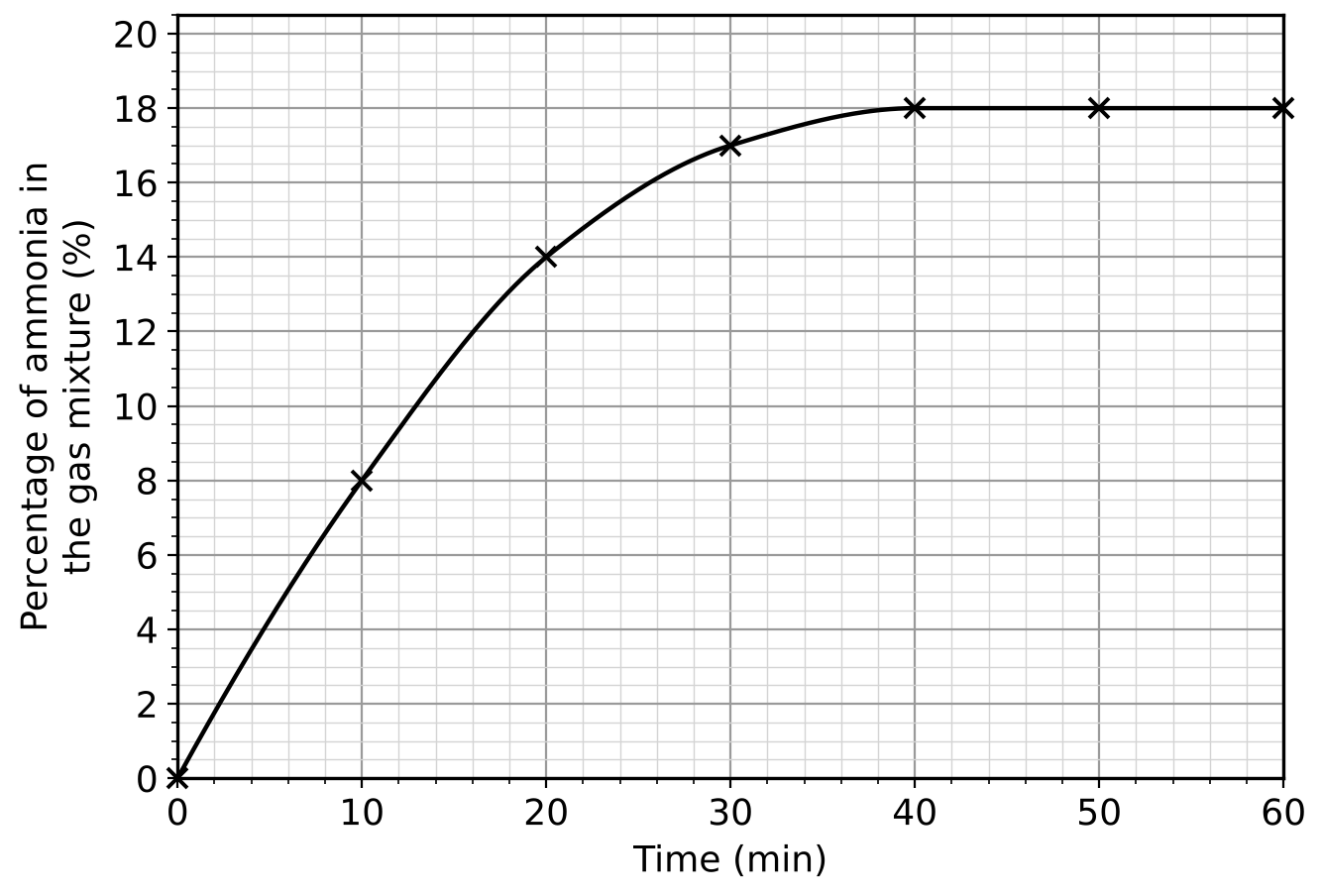
The scientist measures the percentage of ammonia in the gas mixture every 10 minutes.
The graph shows the results.
a.[2]
Describe how the percentage of ammonia in the gas mixture changes between 0 and 60 minutes.
b.[2]
The scientist says:
"After 40 minutes, the reaction has stopped, because the percentage of ammonia does not change."
Explain why the scientist is not correct.
c.[1]
Explain why the container must be sealed for the mixture to reach dynamic equilibrium.
d.[2]
A factory makes ammonia using the same reaction.
The factory could make 1250 tonnes of ammonia each day if all of the nitrogen and hydrogen reacted.
The factory actually makes 200 tonnes of ammonia each day.
Calculate the percentage yield of ammonia.
Use the equation: percentage yield = (actual yield ÷ theoretical yield) × 100
Percentage yield = ...... %
e.[1]
Suggest why the percentage yield of ammonia is much less than 100%.
5.3 Equilibria Questions
47 exam-style questions on OCR GCSE Chemistry 5.3 Equilibria, covering 5.3.1 Reversible reactions and dynamic equilibrium and 5.3.2 Changing the position of equilibrium. Each one has a worked solution and a mark scheme showing where the marks go.