Question 11
FA reversible reaction, A⇌B\mathrm{A \rightleftharpoons B}A⇌B, takes place in a sealed flask at constant temperature. Only A is present at the start.
The graph shows how the concentrations of A and B change with time.
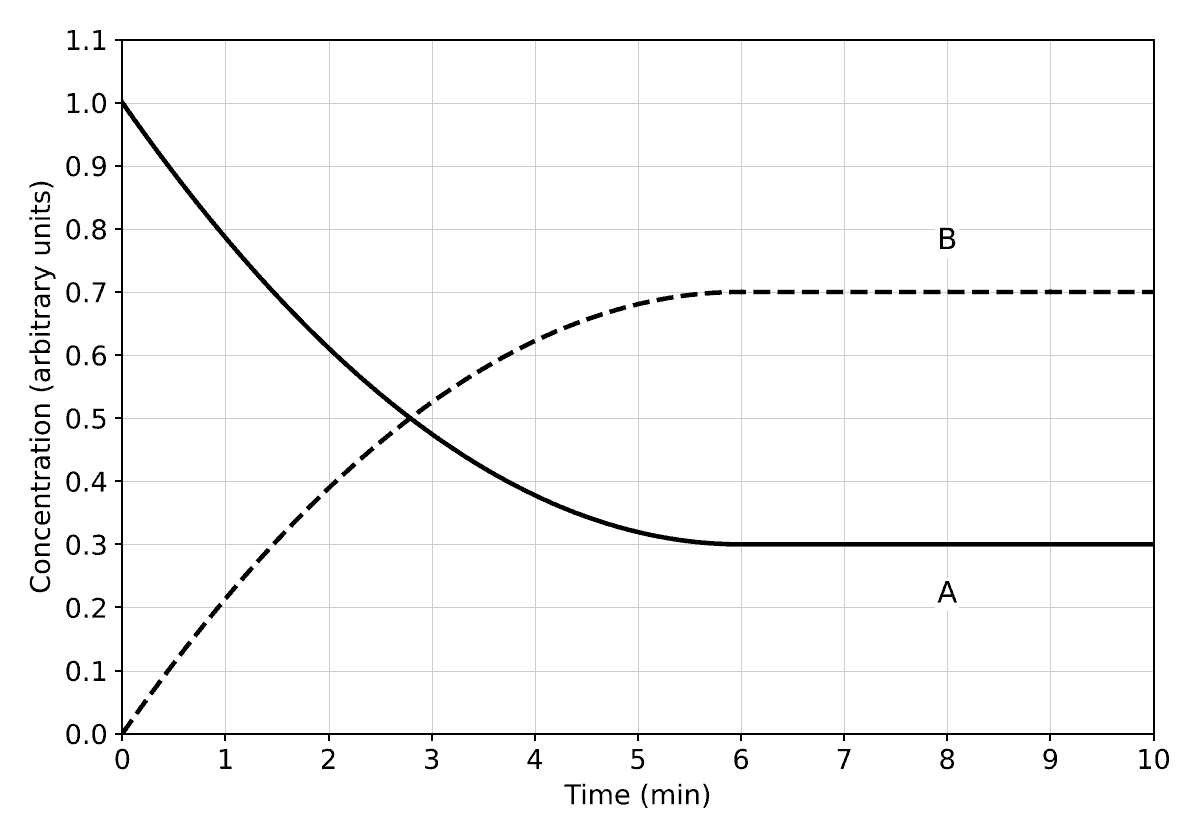
Which statement is correct?
Equilibrium is reached at about 3 min, because the concentrations of A and B are equal at this time.
After 6 min, the forward and reverse reactions have both stopped.
After 6 min, A changes into B at the same rate as B changes into A.
After 6 min, the reaction has finished because all of A has been used up.
5.3 Equilibria Questions
47 exam-style questions on OCR GCSE Chemistry 5.3 Equilibria, covering 5.3.1 Reversible reactions and dynamic equilibrium and 5.3.2 Changing the position of equilibrium. Each one has a worked solution and a mark scheme showing where the marks go.