2.5.1 Classifying substances by structure and bonding
Structure and bonding decide every physical property
- Structure describes how the particles are arranged, and bonding describes what holds them together.
- Four classes cover the substances in this topic: ionic, simple molecular, giant covalent and metallic.
- Each class has its own pattern of melting point, solubility and electrical conductivity.
- Those patterns come from two questions: how strong are the attractions, and can a charged particle move?
- Classifying an unfamiliar substance therefore starts with its particles, then the attraction between them.
- The noble gases sit outside the four classes, because they exist as single unbonded atoms.
- Strength of attraction sets the melting and boiling points.
- Mobility of charge sets the electrical conductivity.
Ionic and metallic: charged particles in a giant structure
Metallic bond
The strong electrostatic attraction between positive metal ions and the delocalised electrons that surround them.
Delocalised electron
An electron that is free to move through a structure instead of being held between two particular atoms.
- An ionic substance is a giant lattice of positive and negative ions held by strong electrostatic attraction.
- Melting one means overcoming very many of those attractions, so ionic melting and boiling points are high.
- A solid ionic substance does not conduct, because its ions are locked in position.
- Melting it or dissolving it frees the ions, so the liquid and the solution both conduct.
- A metal is a giant lattice of positive metal ions surrounded by a sea of delocalised electrons.
- Metallic melting points are high as well, because the ions and the electrons attract strongly throughout the lattice.
- A metal conducts as a solid and as a liquid, because those electrons move while the ions stay in place.
- Metals do not dissolve in water, although some of them react with it.
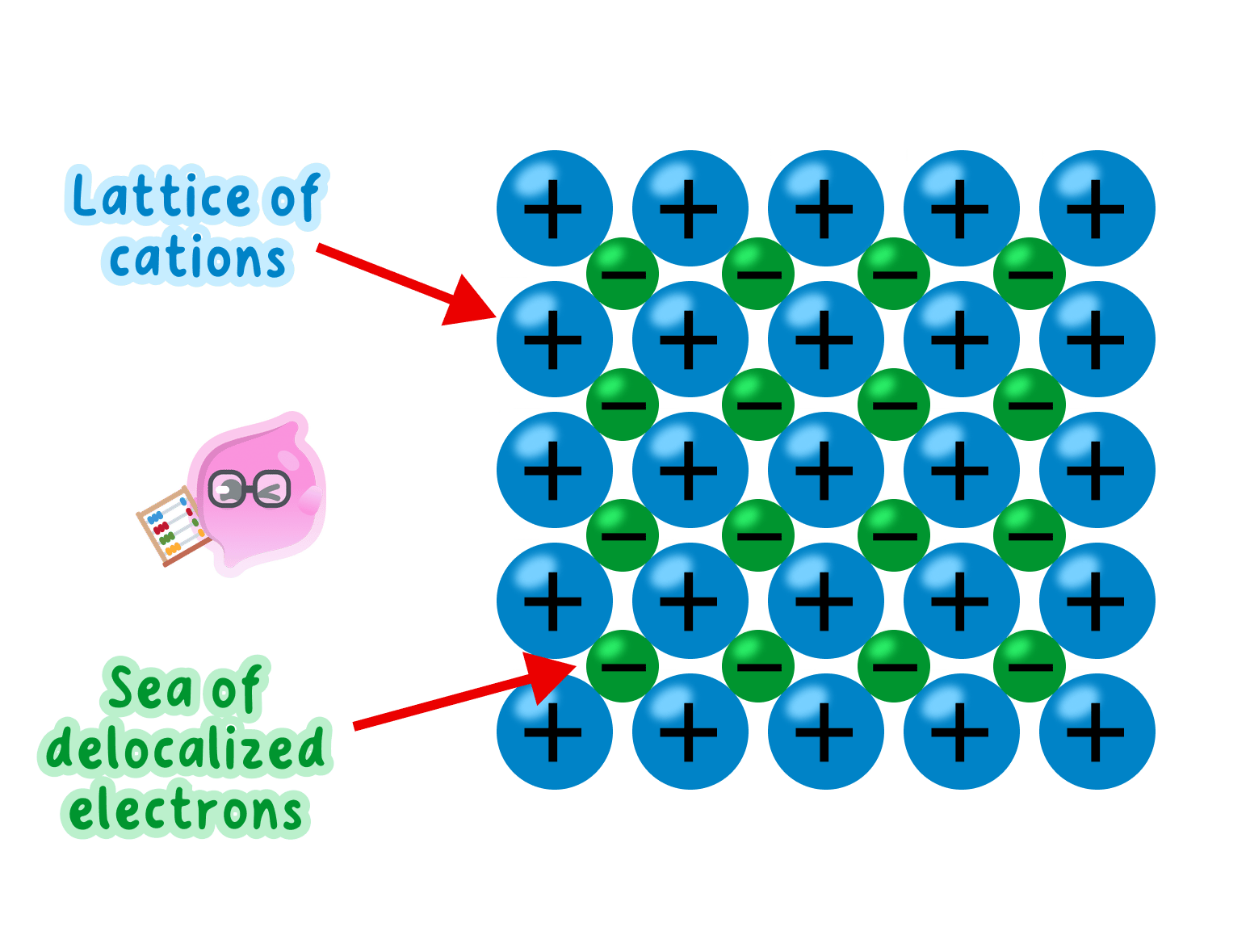
- Sodium chloride: a giant ionic lattice that conducts when molten or dissolved, but not as a solid.
- Copper: a giant metallic lattice that conducts as a solid and does not dissolve.
Simple molecular and giant covalent: same bond, opposite behaviour
Simple molecular substance
A substance made of small separate molecules, with strong covalent bonds inside each molecule and weak intermolecular forces between them.
Giant covalent structure
A structure in which a very large number of atoms are joined to their neighbours by strong covalent bonds in a continuous network.
Intermolecular force
A force of attraction between neighbouring molecules, much weaker than the covalent bonds inside a molecule.
- Both classes are built from atoms joined by strong covalent bonds, so the bond is not what separates them.
- A simple molecular substance melts and boils when the weak forces between its molecules give way.
- The covalent bonds inside those molecules survive melting and boiling untouched.
- Simple molecular substances therefore have low melting and boiling points.
- A giant covalent structure contains no separate molecules, so melting it means breaking covalent bonds throughout.
- Giant covalent substances therefore have very high melting and boiling points.
- Neither class normally conducts, because neither has mobile ions and the electrons are held inside bonds.
- Graphite and graphene are the exceptions, because each carbon atom there leaves one electron delocalised.
- Melting a simple molecular substance overcomes intermolecular forces, and saying that covalent bonds break is the commonest error here.
- Not every form of carbon conducts, because diamond uses all four outer electrons in bonds.
Solubility in water follows the particles too
- Water molecules carry slightly charged regions, which let them pull ions away from a lattice.
- Many ionic compounds dissolve for that reason, although plenty of others do not.
- A simple molecular substance dissolves if its molecules attract water molecules well enough.
- Sugar dissolves but stays as neutral molecules, so the solution does not conduct.
- Hydrogen chloride dissolves and forms ions, so that solution does conduct.
- Giant covalent structures do not dissolve, because water cannot pull atoms out of a covalent network.
- Dissolving and conducting are separate questions, and a substance can do one without the other.
- Dissolving does not imply conducting, because a sugar solution carries no charge.
- The state changes the answer, since one ionic compound behaves differently as a solid, a liquid and a solution.
Working from an unfamiliar substance to its properties
- Decide first which particles the substance contains: ions, small molecules, a covalent network, or metal ions with delocalised electrons.
- Name the attraction that holds those particles together.
- Predict the melting and boiling points from how strong and how numerous those attractions are.
- Predict the conductivity by asking whether a charged particle can move, and in which state.
- Predict the solubility by asking whether water can separate the particles from the structure.
- State the structure and the bonding in the answer, because the property on its own is only half an explanation.
- A property answer names the structure and the bonding, because the property on its own is only half of it.
- A conductivity answer names the particle that moves: ions in a molten or dissolved ionic compound, delocalised electrons in a metal.
- A melting point answer names what is overcome: intermolecular forces for a simple molecular substance, covalent bonds for a giant covalent one.
- Which two things have to be identified before a substance's properties can be predicted?
- Why does a solid ionic compound not conduct while its solution does?
- Why do simple molecular substances melt at low temperatures despite their strong covalent bonds?
- Why does graphite conduct electricity when diamond does not?
- Why does a sugar solution not conduct even though the sugar has dissolved?
2.5.2 Properties of ionic and simple molecular substances
Ionic compounds melt and boil at high temperatures
Giant ionic lattice
A regular, repeating three-dimensional arrangement of very large numbers of oppositely charged ions held together by ionic bonds.
Ionic bond
The strong electrostatic attraction between oppositely charged ions.
- The ions in an ionic solid sit in a giant lattice, each surrounded by ions of the opposite charge.
- Every one of those attractions is strong, and there are very many of them.
- Melting takes enough energy to loosen the lattice so that the ions can move past one another.
- Boiling takes enough energy to separate the ions from one another completely.
- Sodium chloride melts at 801 ∘C801\ ^{\circ}\text{C}801 ∘C and boils at 1413 ∘C1413\ ^{\circ}\text{C}1413 ∘C.
- Magnesium oxide melts at 2852 ∘C2852\ ^{\circ}\text{C}2852 ∘C, because Mg2+\text{Mg}^{2+}Mg2+ and O2−\text{O}^{2-}O2− attract far more strongly than singly charged ions.
- Larger charges attract more strongly, which is why MgO\text{MgO}MgO melts far above NaCl\text{NaCl}NaCl.
- The ions stay ions through melting and boiling, because no electrons are transferred back.
Ionic compounds conduct only when their ions can move
- In the solid, each ion is fixed in its lattice position and cannot travel.
- No moving charge means no current, even though every particle present is charged.
- Melting frees the ions, so a molten ionic compound conducts.
- Dissolving in water separates the ions, so an aqueous solution conducts.
- The charge is carried by the ions themselves, which is what separates this from conduction in a metal.
- Charged is not the same as mobile, so a solid ionic compound does not conduct despite being built from ions.
- Electrons do not carry the current here, because it is the ions that move.
Simple molecular substances melt and boil at low temperatures
Simple molecular substance
A substance made of small separate molecules, with strong covalent bonds inside each molecule and weak intermolecular forces between them.
Intermolecular force
A force of attraction between neighbouring molecules, much weaker than the covalent bonds inside a molecule.
- Each molecule is held together internally by strong covalent bonds.
- Neighbouring molecules attract one another only weakly.
- Melting and boiling separate whole molecules, so only those weak forces have to be overcome.
- The covalent bonds inside the molecules are untouched, which is why the gas is still the same substance.
- Methane boils at −161 ∘C-161\ ^{\circ}\text{C}−161 ∘C and water at 100 ∘C100\ ^{\circ}\text{C}100 ∘C, both far below any ionic compound.
- Larger molecules attract one another more strongly, so their melting and boiling points are higher.
- Boiling methane: the forces between CH4\text{CH}_4CH4 molecules are overcome, while every C−H\text{C}-\text{H}C−H bond stays intact.
- What comes off: whole CH4\text{CH}_4CH4 molecules enter the gas, not separate carbon and hydrogen atoms.
Simple molecular substances are poor conductors
- A molecule carries no overall charge, so it cannot carry current from one place to another.
- The electrons in each covalent bond are held between two particular atoms and cannot travel through the substance.
- There are no ions to move either, in the solid or the liquid.
- Simple molecular substances are poor conductors in every state as a result.
- A few of them, such as hydrogen chloride, form ions on dissolving, and those solutions do conduct.
- A low melting point is about the intermolecular forces, since saying the bonds are weak reads as the covalent bonds breaking.
- A value anchors the comparison, such as the 801 ∘C801\ ^{\circ}\text{C}801 ∘C at which sodium chloride melts.
The two classes side by side
- Both classes contain strong bonds, but only one of them has to break those bonds to melt.
- An ionic compound melts high because ionic bonds run through the whole lattice.
- A simple molecular substance melts low because only the forces between molecules give way.
- An ionic compound conducts once its ions can move, while a simple molecular one has no mobile charge at all.
- Naming the particle that moves, or the force that is overcome, is what turns a property into an explanation.
- Why do ionic compounds have high melting and boiling points?
- Why does a solid ionic compound not conduct electricity?
- Why does a molten ionic compound conduct?
- Which forces are overcome when methane boils?
- Why are simple molecular substances poor conductors of electricity?
2.5.3 Giant covalent structures: diamond and graphite
Diamond and graphite are both giant covalent forms of carbon
Giant covalent structure
A structure in which a very large number of atoms are joined to their neighbours by strong covalent bonds in a continuous network.
- Both are made only of carbon atoms joined to their neighbours by strong covalent bonds.
- Neither contains separate molecules, so the bonding runs continuously through the whole solid.
- Melting either one means breaking covalent bonds, so both have very high melting points.
- They are the same element, so every difference between them comes from how the atoms are joined.
- Each carbon atom has four outer electrons, and the two structures use them differently.
- Same element, different structure, which is why one is the hardest substance known and the other is soft enough to write with.
- The bonding decides the property, not the identity of the atoms.
Diamond: four bonds pointing in three dimensions
- Each carbon atom in diamond is covalently bonded to four others.
- Those bonds point outwards in three dimensions, giving a rigid network with no layers and no weak direction.
- Moving one atom would mean breaking several strong covalent bonds at once, which is why diamond is so hard.
- All four outer electrons on every carbon atom are used in bonding.
- With no delocalised electrons, diamond does not conduct electricity.
- Diamond is used in cutting tools, because it is hard enough to cut other materials and keeps its shape while doing so.
- Cutting tools: a diamond tip grinds through harder materials without wearing to a different shape.
- No conduction: every outer electron sits in a covalent bond, so none is free to carry charge.
Graphite: three bonds, layers, and one spare electron
Delocalised electron
An electron that is free to move through a structure instead of being held between two particular atoms.
- Each carbon atom in graphite is covalently bonded to three others.
- Those bonds form flat layers built from hexagonal rings.
- Only weak forces act between one layer and the next.
- The fourth outer electron on each carbon atom is not used in a covalent bond and becomes delocalised.
- Those electrons move along the layers and carry charge, so graphite conducts electricity.
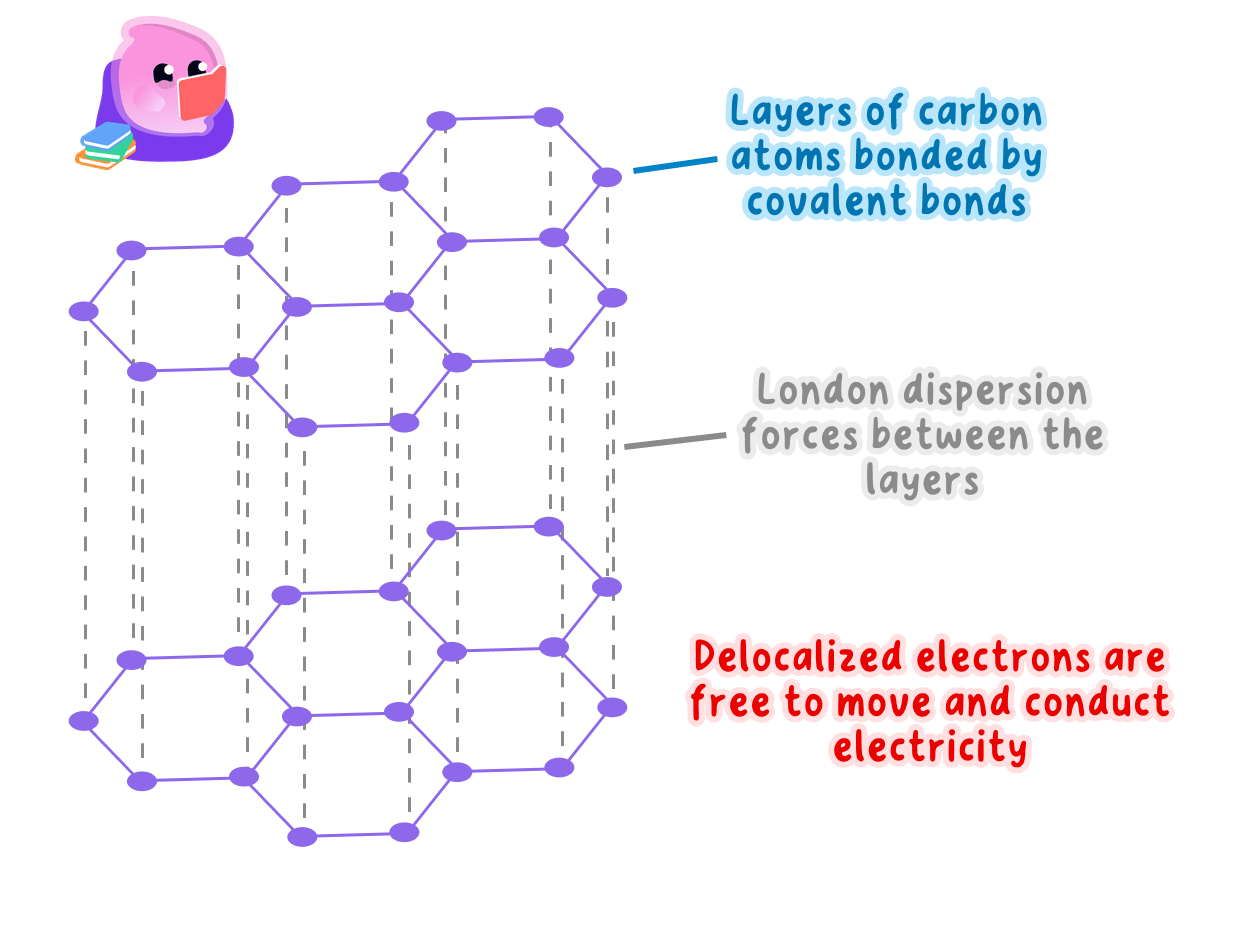
- The weak forces between layers let one layer slide over another, so graphite is soft and slippery.
- The layers slide, the covalent bonds do not break, so graphite is still graphite after it has lubricated something.
- Electrons move along a layer, not between layers, because nothing bonds one layer to the next.
Diamond and graphite side by side
- Both are giant covalent, so both need an enormous amount of energy to melt.
- Diamond bonds each carbon atom to four others, and graphite bonds each to three.
- Diamond uses all four outer electrons in bonds, and graphite leaves one delocalised per atom.
- Diamond has no layers, and graphite is built from layers held by weak forces.
- Diamond is hard and does not conduct, and graphite is slippery and does conduct.
- Every one of those differences follows from the number of bonds each carbon atom forms.
- Three bonds against four is the single fact that separates the two structures.
- Everything else follows from it, including the spare electron, the layers and the hardness.
From structure to use
- Electrodes: delocalised electrons move along graphite's layers, so graphite carries current into the cell.
- Lubricant: weak forces between graphite's layers let them slide, so friction between surfaces falls.
- Cutting tools: diamond's rigid three-dimensional network of covalent bonds makes it hard enough to cut other materials.
- Graphite also survives high temperatures, because the covalent bonds within each layer are strong.
- Stating only the property leaves out the part of the answer the question is really asking about.
- Why are diamond and graphite both described as giant covalent?
- How many other carbon atoms is each carbon atom bonded to in diamond, and how many in graphite?
- Why does graphite conduct electricity when diamond does not?
- Why can graphite act as a lubricant?
- Why is diamond used in cutting tools?
2.5.4 Fullerenes, graphene and simple polymers
Buckminsterfullerene: a hollow cage of sixty carbon atoms
Fullerene
A molecule made only of carbon atoms joined in rings to form a hollow cage or tube.
- Buckminsterfullerene, C60\text{C}_{60}C60, is a ball-shaped molecule built from 606060 carbon atoms.
- The cage is made from 121212 pentagonal rings and 202020 hexagonal rings.
- Each carbon atom is joined to three neighbours by strong covalent bonds within the cage.
- C60\text{C}_{60}C60 is a simple molecular substance, because each cage is a separate molecule.
- Only weak intermolecular forces hold neighbouring cages together.
- Solid C60\text{C}_{60}C60 is therefore soft and melts far below diamond or graphite.
- Strong bonds inside each cage, weak forces between cages, which is the simple molecular pattern.
- A fullerene is a molecule, so it has a fixed formula, unlike a giant structure.
Graphene: a single layer of graphite on its own
- Graphene is a sheet of carbon atoms one atom thick.
- The atoms are arranged in hexagonal rings, exactly as in one layer of graphite.
- Each carbon atom forms three strong covalent bonds within the sheet.
- The fourth outer electron on each atom is delocalised and moves through the sheet.
- Those delocalised electrons make graphene an excellent conductor of electricity.
- The continuous network of strong covalent bonds makes graphene very strong for its mass.
- A sheet one atom thick is also extremely light and can be bent.
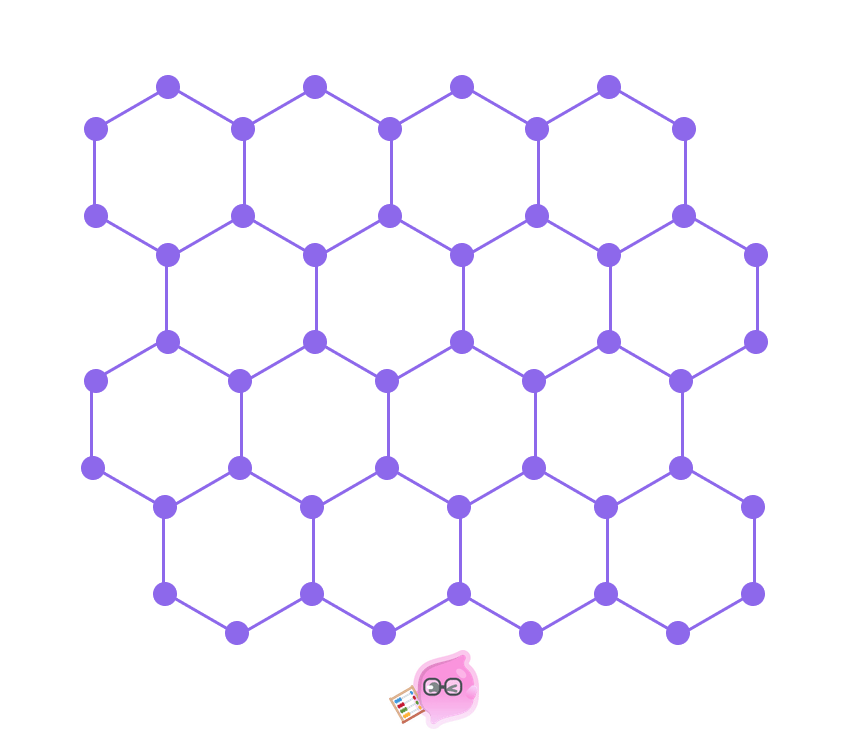
- Conducting: one delocalised electron per carbon atom travels across the sheet and carries charge.
- Strong and light: a continuous sheet of covalent bonds gives high strength with almost no mass for its area.
Poly(ethene): many small molecules joined into long chains
Polymer
A very large molecule formed when many small molecules join together in a repeating pattern.
- Ethene, CH2=CH2\text{CH}_2\text{=}\text{CH}_2CH2=CH2, is a small molecule with a double bond between its two carbon atoms.
- During polymerisation the double bond in each ethene molecule opens, leaving each molecule able to join to two others.
- Thousands of ethene molecules join end to end into one long chain of carbon atoms.
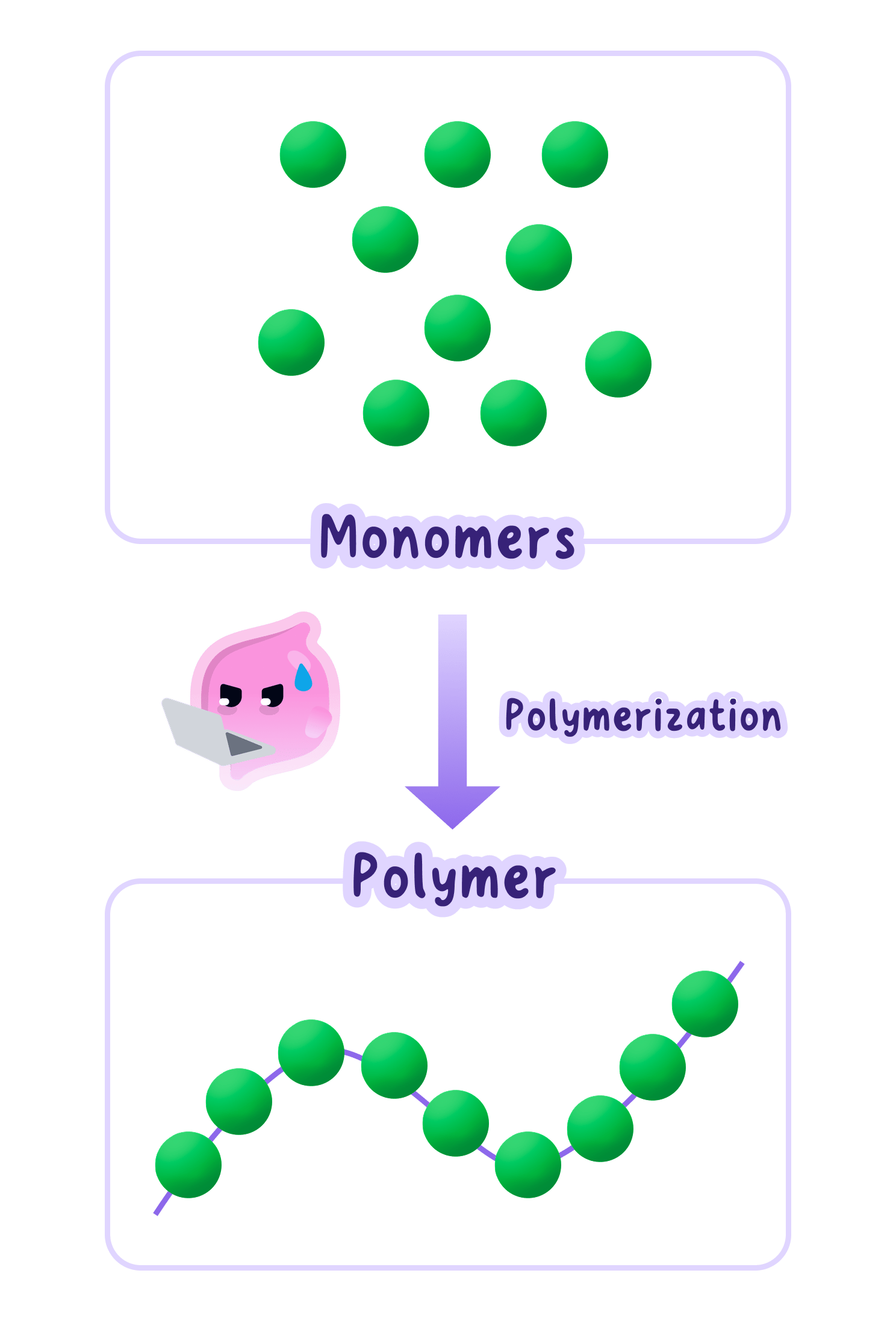
- The product is poly(ethene), whose repeating unit is written [−CH2−CH2−]n\left[-\text{CH}_2-\text{CH}_2-\right]_n[−CH2−CH2−]n.
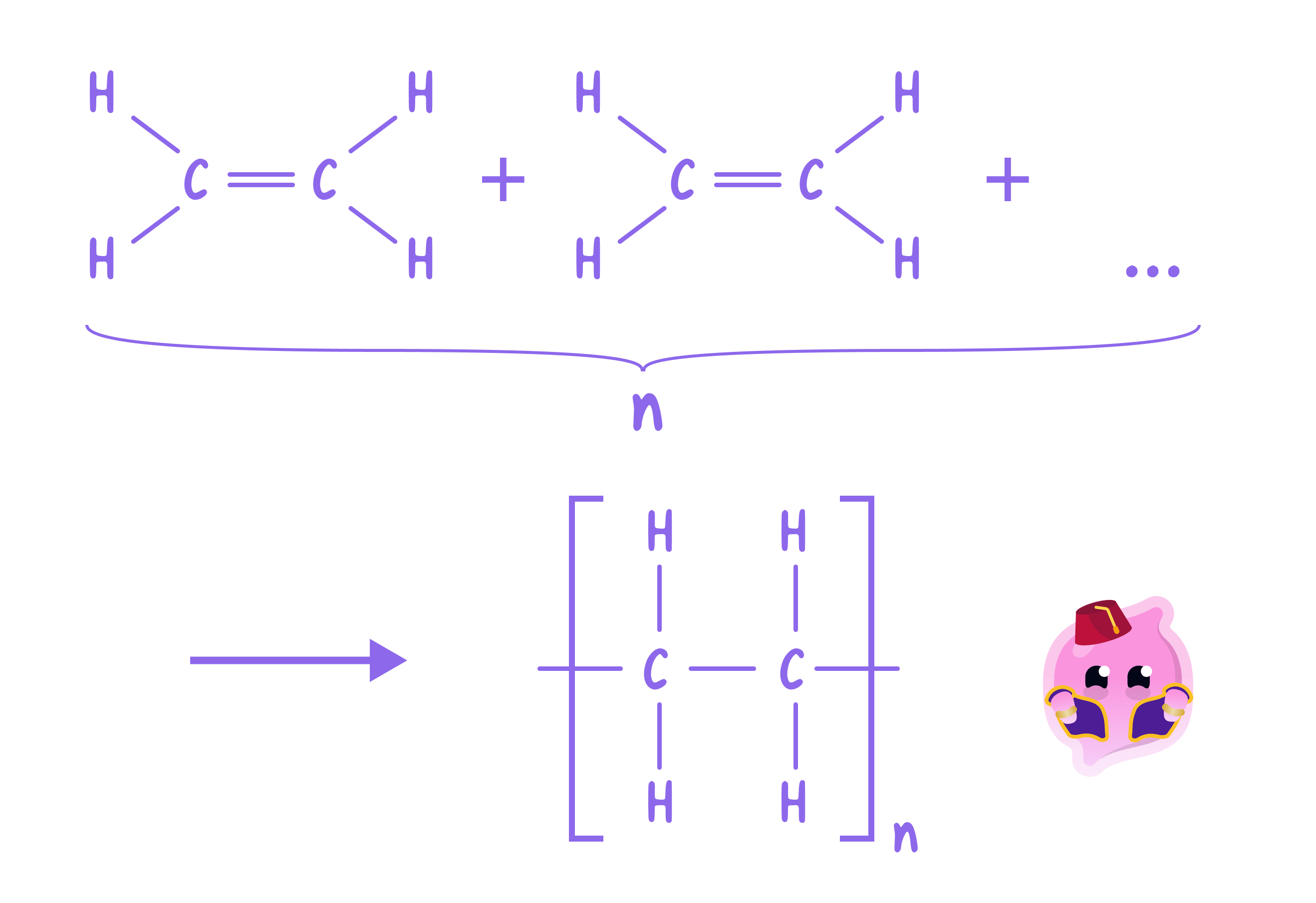
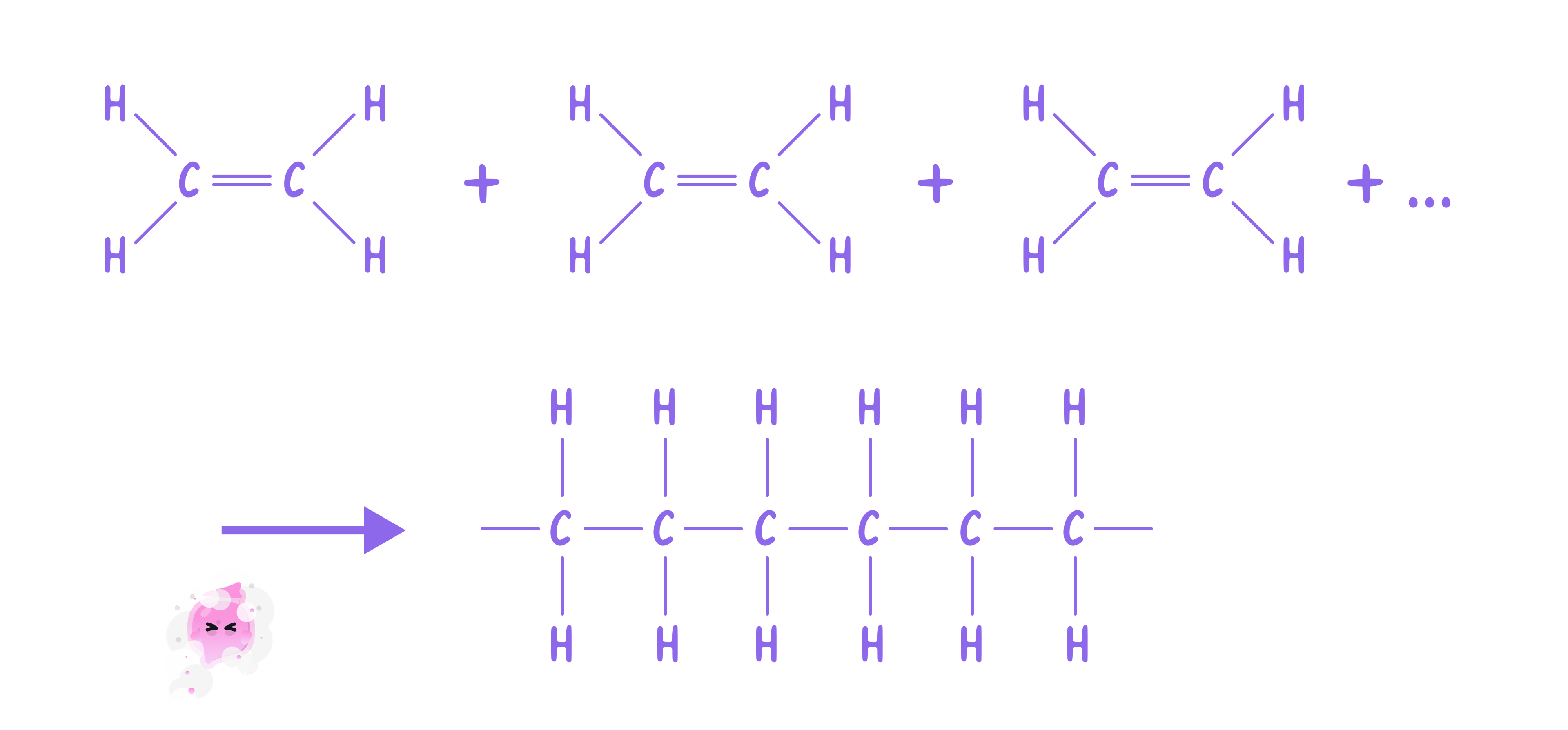
- The subscript nnn stands for a large, unspecified number of repeats, so a polymer has no single fixed formula.
- Strong covalent bonds run the whole length of each chain.
- Each poly(ethene) molecule is very large, which is what makes the material tough and flexible.
- The class comes first, simple molecular for C60\text{C}_{60}C60 and a giant sheet for graphene, and the rest follows from it.
- The brackets and the nnn make it a polymer, because the unit written on its own is one small molecule.
Explaining a carbon structure
- Start by saying whether the substance is made of separate molecules or is one continuous network.
- C60\text{C}_{60}C60 is separate molecules, so the weak forces between them explain its low melting point.
- Graphene is a continuous sheet, so its strong covalent bonds explain its strength.
- Graphene's one spare delocalised electron per carbon atom explains its conductivity.
- Poly(ethene) is separate very large molecules, each a long covalently bonded chain.
- The property always follows from the structure, so the structure is the part worth naming first.
- How many carbon atoms are in a molecule of C60\text{C}_{60}C60, and how are they arranged?
- Why does solid C60\text{C}_{60}C60 melt at a much lower temperature than graphite?
- Why does graphene conduct electricity?
- What happens to the double bond in ethene during polymerisation?
- What does the subscript nnn represent in the formula of poly(ethene)?
2.5.5 Properties of metals and non-metals
A metal is positive ions in a sea of delocalised electrons
Metallic bond
The strong electrostatic attraction between positive metal ions and the delocalised electrons that surround them.
Delocalised electron
An electron that is free to move through a structure instead of being held between two particular atoms.
- A metal is a giant lattice of positive metal ions, with the electrons from their outer shells free to move among them.
- Every ion is attracted to that electron sea, in every direction through the lattice.
- The attraction is strong and there is a great deal of it, so most metals melt and boil at high temperatures.
- The free electrons also make metals good conductors of electricity and of heat.
- They reflect light at the surface as well, which is what gives a metal its shine.
- Mercury is liquid at room temperature, so most metals is the accurate phrasing rather than all metals.
- The electrons are shared by the whole lattice, not by any single pair of ions.
- Almost every metallic property traces back to those mobile electrons, from conduction to shine.
Malleability comes from layers of ions that slide
Malleability
The ability of a material to be hammered or rolled into a new shape without breaking.
- The metal ions in the lattice are arranged in layers.
- A hammer blow pushes one layer past the next.
- The electron sea moves with them, so the attraction between the ions and the electrons is never lost.
- The metal changes shape instead of cracking, which is what makes it malleable.
- The same sliding lets a metal be drawn out into wire, a property called ductility.
- A brittle solid cannot do this, because its particles cannot move past one another without the structure failing.
- Copper wiring: copper is drawn into thin wire, and its delocalised electrons then carry the current.
- Aluminium drinks cans: aluminium is rolled into thin sheet without cracking, and has a low density for a metal.
Most metals: shiny, dense and high melting
- Most metals are shiny solids at room temperature, because the electrons at the surface reflect light.
- Most metals have high melting points, because the attraction between the ions and the electrons runs throughout the lattice.
- Most metals have high densities, because their ions pack closely together.
- Most metals are good conductors of electricity, as solids and when molten.
- Mercury, which is liquid at room temperature, and the group 111 metals, which are soft and low melting, are the usual exceptions.
- The word most is doing real work, because mercury and the group 111 metals are genuine exceptions.
- Conduction and melting point both trace to the same attraction, between the positive ions and the delocalised electrons.
Most non-metals: low melting and boiling points, poor conduction
- Most non-metals have low melting and boiling points.
- Many of them are simple molecular, so only weak intermolecular forces have to be overcome.
- Most non-metals are poor conductors of electricity, having neither mobile ions nor delocalised electrons.
- Most non-metals are dull rather than shiny, and are gases or brittle solids at room temperature.
- Most non-metals also have low densities compared with metals.
- Graphite conducts electricity although it is a non-metal, because each carbon atom there leaves one electron delocalised.
- Giant covalent non-metals melt very high, so the low melting point pattern holds for the simple molecular ones.
Writing a comparison
- A comparison reads more clearly when the same property is named on both sides.
- Melting point: most metals high, most simple molecular non-metals low.
- Electrical conductivity: most metals good, most non-metals poor.
- Appearance: most metals shiny, most non-metals dull.
- Density: most metals high, most non-metals low.
- Any of these traces back to the delocalised electrons in the metal and their absence in the non-metal.
- What holds a metallic lattice together?
- Why can a metal be hammered into a new shape without breaking?
- Which particles carry the current through a metal?
- Why do most non-metals conduct electricity poorly?
- Why is graphite an exception to that pattern?
2.5.6 Limitations of bonding models and representations
Every model shows some things and hides others
Model
A simplified representation of something that cannot be observed directly, built to show one kind of information about it.
- Chemists describe particles through models, because the particles themselves are far too small to observe directly.
- Each one is built to show a single kind of information clearly, and gives up others to do so.
- Judging a model means asking what it was designed to show, rather than whether it is a perfect picture.
- No single representation shows particles, electrons, forces, sizes and shapes all at once.
- Two models used together often cover each other's gaps.
- A model can be useful and limited at the same time.
- The right model depends on the question, whether that is about electrons, connections or shape.
Dot-and-cross diagrams: electrons yes, shape and scale no
- A dot-and-cross diagram shows the outer-shell electrons and which atom each one came from.
- For a covalent molecule it shows the shared pairs, so the number of bonds is clear.
- For an ionic compound it shows the electrons transferred and the charges that result.
- It leaves out the nucleus and the inner-shell electrons.
- It is flat, so it shows no three-dimensional shape and no bond angles.
- Symbol sizes and spacings are chosen for readability, so nothing in it is drawn to scale.
- For an ionic compound it shows one pair of ions rather than the repeating lattice.
- The dots and crosses stand for electrons, not for the atoms themselves.
- Electrons do not sit still in fixed spots, so the drawn positions record ownership rather than location.
Ball-and-stick models: shape yes, scale and electrons no
- A ball-and-stick model shows which atoms are joined and roughly how they sit in three dimensions.
- It gives a usable impression of the bond angles.
- The balls are drawn far apart relative to their size, so the spacing is wrong.
- Real atoms are not solid coloured spheres, and the colours are a labelling convention.
- The sticks show that a bond exists but say nothing about shared or transferred electrons.
- Atoms at the back can be hidden from any one viewing angle.
- For an ionic compound it can show the lattice arrangement but not the charges or the attractions.
- Water: a ball-and-stick model shows two hydrogen atoms joined to one oxygen atom at an angle.
- What it hides: the two lone pairs on oxygen, the true relative sizes of the atoms, and the real distance between the nuclei.
Two-dimensional and three-dimensional representations
- A two-dimensional drawing shows which atoms are joined and how many bonds each one has.
- It cannot show depth, so atoms nearer and further away look alike.
- A three-dimensional model or drawing shows the spatial arrangement and the approximate bond angles.
- It can still distort atom sizes, bond lengths and the spaces between particles.
- One viewing angle can hide atoms or make separate bonds appear to overlap.
- A flat drawing is not wrong merely for being flat, and its limitation is the missing depth.
- A flat drawing is not wrong for being flat, and its limitation is the missing depth.
- Scale is the safest limitation to reach for, since nothing in this topic is drawn to scale.
Choosing and combining models
- Use a dot-and-cross diagram when the question is about electrons, bonds or charges.
- Use a ball-and-stick model when the question is about shape or arrangement.
- Use a two-dimensional drawing when the question is only about which atoms are joined.
- Use two models together when the question needs both the electrons and the shape.
- Name the limitation that matters for the question rather than listing every limitation the model has.
- A limitation comes in two parts: what the representation does show, then the specific feature it leaves out.
- Calling a model inaccurate on its own leaves the answer unfinished, because the missing feature is the point.
- Naming the representation first keeps the limitation attached to the right model.
- What does a dot-and-cross diagram show that a ball-and-stick model does not?
- Why can a dot-and-cross diagram not show the shape of a molecule?
- Why are the balls and sticks in a ball-and-stick model not drawn to scale?
- What information does a two-dimensional drawing leave out?
- Why is it useful to have more than one representation of the same substance?
