6.1.1 Properties of transition metals
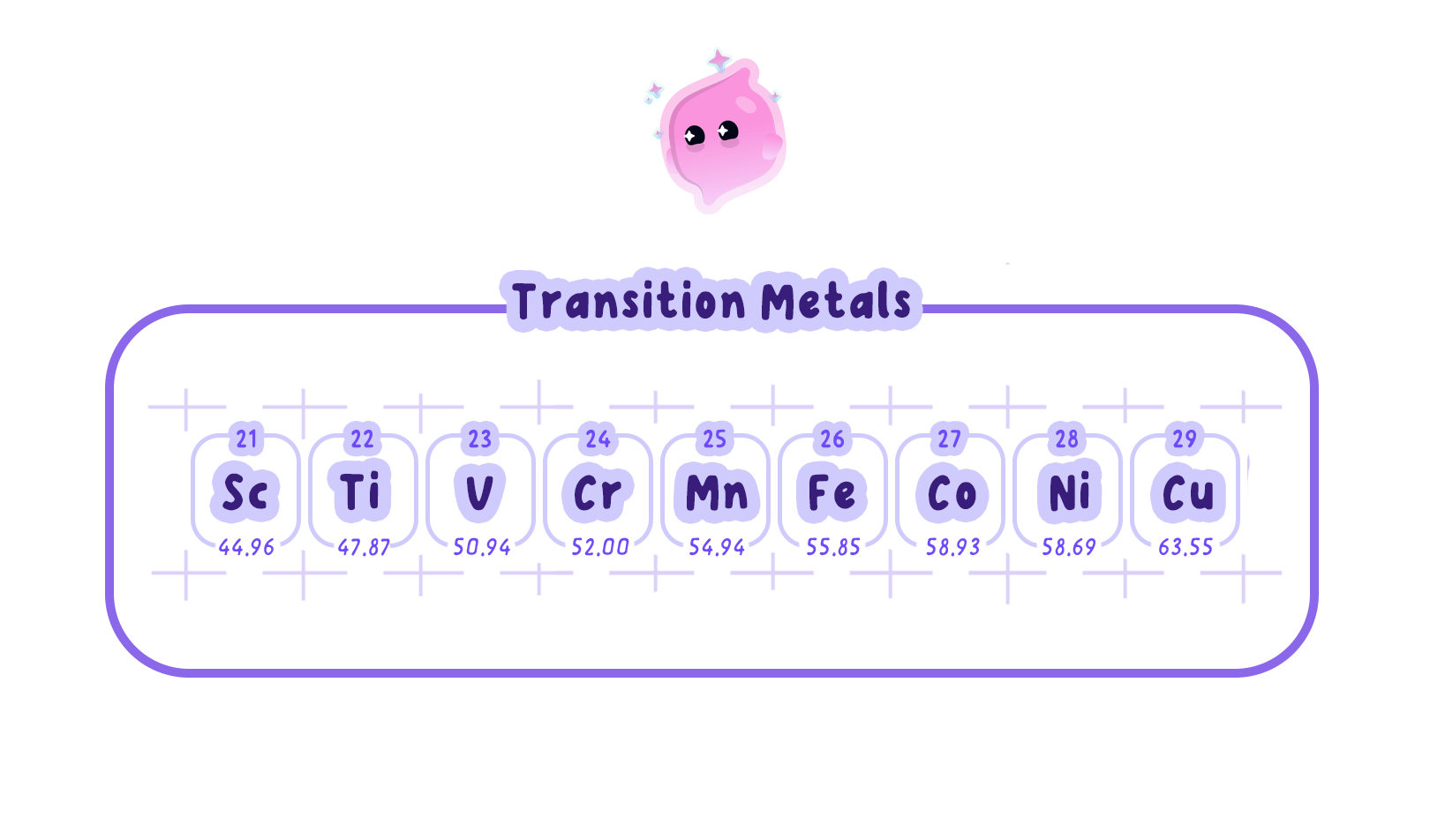
Transition metals fill the central block of the periodic table
Transition metal
A metal from the central block of the periodic table, between Group 2 and Group 3.
- The block between Group 2 and Group 3 holds the transition metals.
- It includes iron, copper, nickel, chromium, manganese, silver and gold.
- Most of the metals in the periodic table are transition metals, so they set the pattern of what a metal is like.
- Four properties are typical of the block: high melting point, high density, coloured compounds and catalytic activity.
- These are typical properties, so an individual metal may depart from one of them.
Group 1 metals are the untypical ones, which is why they are studied separately.
High melting points and high densities
Metallic bond
The strong electrostatic attraction between positive metal ions and the delocalised electrons that surround them.
- The metallic bonding in a transition metal is strong, so a large amount of energy is needed to melt it.
- Iron melts at about 1538 ∘C1538\ ^{\circ}\text{C}1538 ∘C and copper at about 1085 ∘C1085\ ^{\circ}\text{C}1085 ∘C.
- A high melting point is what allows these metals to be used in engines and in structures that get hot.
- Their atoms are also packed closely, which gives a high density.
- Iron has a density of about 7.9 g/cm37.9\ \text{g/cm}^37.9 g/cm3, against sodium's 0.97 g/cm30.97\ \text{g/cm}^30.97 g/cm3.
- Mercury is a transition metal that is liquid at room temperature, so the melting point rule has exceptions.
- Sodium floats on water, while every transition metal sinks in it.
Transition metals form coloured compounds
- The compounds of a transition metal are usually coloured, in the solid and in solution.
- Copper(II) compounds are typically blue or green, as in blue copper(II) sulfate solution.
- Iron(II) compounds are pale green, while iron(III) compounds are orange or red-brown.
- The colour depends on which metal is present and on its charge, so iron gives two different colours.
- Group 1 ions are colourless, so their compounds are white unless the negative ion supplies a colour.
- The colour of a solution is a first clue to which ion is present, though a chemical test confirms it.
- Zinc sits in the block but forms white compounds, so it is not counted as a typical transition metal.
Transition metals and their compounds act as catalysts
Catalyst
A substance that speeds up a reaction without being used up in the reaction.
- Catalytic activity means increasing the rate of a reaction without being used up by it.
- Iron is the catalyst used in the Haber process to make ammonia.
- Iron compounds are also used as catalysts in industry, so the activity is not limited to the metal itself.
- Nickel catalyses the addition of hydrogen to unsaturated oils.
- Recovering the catalyst at the end and using it again is why a small mass serves a large plant.
A catalyst changes only the rate, so it never alters how much product a reaction can give.
Comparing the block with the Group 1 metals
- Group 1 metals are soft enough to cut with a knife, while transition metals are hard.
- Group 1 metals melt at low temperatures, some below 100 ∘C100\ ^{\circ}\text{C}100 ∘C.
- Group 1 metals react vigorously with water, while iron and copper barely react with it.
- A Group 1 ion adds no colour of its own to a compound.
- Transition metals are therefore the metals chosen for construction and machinery, and Group 1 metals are not.
- Where in the periodic table are the transition metals found?
- Name four typical properties of a transition metal.
- Give the colour of an iron(II) compound and of an iron(III) compound.
- Which transition metal catalyses the Haber process?
- Give two ways in which sodium differs from a typical transition metal.
6.1.2 Corrosion and its prevention
Corrosion is the oxidation of a metal by its surroundings
Corrosion
The breaking down of a metal by reaction with substances in its surroundings.
Oxidation
The loss of electrons by a substance.
- A metal at the surface of an object reacts with substances in the air or water around it.
- The metal gains oxygen, so corrosion is an oxidation of the metal.
- The product is a compound, which has none of the strength or shine of the metal.
- A metal high in the reactivity series corrodes more readily than one low down.
- Gold does not corrode in air at all, which is why gold objects survive unchanged for centuries.
Corrosion eats into the object itself, so a corroded component is weaker as well as duller.
Rusting needs both water and oxygen
Rusting
The corrosion of iron, which needs both water and oxygen and forms hydrated iron(III) oxide.
- The corrosion of iron has its own name, and it happens only when both water and oxygen are present.
- The reaction that forms rust is: iron+oxygen+water→hydrated iron(III) oxide\text{iron} + \text{oxygen} + \text{water} \rightarrow \text{hydrated iron(III) oxide}iron+oxygen+water→hydrated iron(III) oxide
- Rust is hydrated iron(III) oxide, an orange-brown solid.
- Iron in dry air does not rust, and iron under boiled water with no dissolved air does not rust.
- Rust flakes off the surface, exposing fresh iron underneath, so the corrosion continues into the metal.
- Nail in damp air: rusts, because water and oxygen are both available.
- Nail in dry air with a drying agent: stays bright, because water is absent.
- Nail under boiled water with oil on top: stays bright, because the dissolved oxygen has been driven off.
Barriers keep water and oxygen away from the iron
- Coating the surface stops water and oxygen reaching the iron beneath.
- Painting is used on large structures such as bridges and ships.
- Oiling or greasing is used on moving parts, where a paint film would be worn away.
- A layer of plastic is used on garden furniture and on wire fencing.
- Every barrier fails once it is scratched, because water and oxygen reach the iron through the gap.
A barrier protects only while it is unbroken, so damaged paintwork rusts first.
Sacrificial protection uses a more reactive metal
Sacrificial protection
Protecting a metal from corrosion by attaching a more reactive metal that corrodes in its place.
Galvanising
Coating iron or steel with a layer of zinc to protect it from rusting.
- Attaching a more reactive metal to iron protects the iron even when the surface is damaged.
- The more reactive metal loses electrons in preference, so it corrodes instead of the iron.
- Zinc blocks are bolted to the hulls of ships and are replaced as they are eaten away.
- Galvanising coats iron or steel with zinc, which acts as a barrier and as a sacrificial metal at the same time.
- A galvanised bucket therefore keeps working after a scratch, which a painted one would not.
- The protecting metal is used up, which is why the blocks on a ship are replaced at each refit.
- A less reactive coating gives no sacrificial protection, so a scratch in it lets the iron rust.
Electroplating improves appearance and resistance to corrosion
Electroplating
Using electrolysis to coat an object with a thin layer of metal.
Electrolysis
The use of electrical energy from a direct current supply to break down an electrolyte into simpler substances.
- Electroplating uses electrolysis to lay a thin layer of one metal onto the surface of an object.
- The object to be plated is made the negative electrode, where metal ions gain electrons and deposit.
- The positive electrode is made of the plating metal, which dissolves to replace what is deposited.
- The electrolyte is a solution of a salt of the plating metal, such as copper sulfate for copper plating.
- A chromium or silver layer makes a cheap object look better and resist corrosion at the same time.
- Why is corrosion described as an oxidation?
- What two substances must be present for iron to rust, and what is rust?
- Why does a scratch in paintwork matter so much?
- How does zinc protect iron once the coating is scratched?
- Which electrode is the object being electroplated, and why?
6.1.3 Alloys and the uses of metals
A pure metal is soft because its layers can slide
Metallic bond
The strong electrostatic attraction between positive metal ions and the delocalised electrons that surround them.
- A pure metal is a regular arrangement of identical atoms, stacked in layers.
- A force applied to the metal makes one layer slide over the next.
- The atoms are all the same size, so nothing obstructs a layer as it moves.
- Sliding layers are what make a pure metal soft and easy to shape.
- The metallic bonding is not broken by the sliding, so the metal bends rather than shatters.
Softness comes from the regularity of the arrangement, not from weak bonding.
An alloy has atoms of different sizes that block the layers
Alloy
A mixture of a metal with one or more other elements.
- Mixing a metal with another element puts atoms of a different size into the structure.
- Those atoms distort the layers, so the regular stacking is broken up.
- A distorted layer cannot slide past its neighbour as easily as a regular one.
- More force is then needed to change the shape, so the alloy is harder and stronger.
- Hardness is resistance to being scratched or dented, and strength is resistance to breaking under load.
An alloy is a mixture, so its composition can be adjusted to suit the job.
Alloy steels are iron mixed for a purpose
- Pure iron is too soft for most structural uses on its own.
- Adding a small amount of carbon gives steel, which is far harder than iron.
- Adding chromium and nickel gives stainless steel, which resists corrosion.
- Different proportions give steels for girders, tools, cutlery and car bodies from one base metal.
- Iron is alloyed because the alloy can be matched to the job in a way the pure metal cannot.
- Low-carbon steel: easily shaped, used for car bodies.
- High-carbon steel: hard and brittle, used for cutting tools.
- Stainless steel: resists corrosion, used for cutlery and sinks.
The use of a metal follows from its properties
- Aluminium has a low density, so it is used where lightness matters, as in aircraft.
- Aluminium also resists corrosion, because a layer of aluminium oxide seals its surface.
- Copper conducts electricity well and is ductile, so it is drawn into wiring.
- Copper is also unreactive enough not to react with water, which suits it to pipework.
- Gold does not corrode and can be beaten very thin, so it is used in jewellery and in electrical contacts.
Aluminium's resistance comes from its oxide layer, not from the metal being unreactive.
Magnalium and brass are alloys with matched uses
- Magnalium is aluminium alloyed with magnesium.
- It keeps aluminium's low density while being stronger, which suits aircraft and racing car parts.
- Brass is copper alloyed with zinc.
- Brass is harder than copper and keeps a good appearance, which suits door fittings and musical instruments.
- In both cases the alloy keeps a useful property of the parent metal and improves on a weakness.
- Why can the layers in a pure metal slide over one another?
- Explain, in terms of layers, why an alloy is harder than the pure metal.
- Why is iron alloyed to make steels?
- Why does aluminium resist corrosion despite its position in the reactivity series?
- Name the two metals in brass and give a use for it.
