2.2.1 Mendeleev's periodic table
Mendeleev ordered the elements by mass but let chemical behaviour fix the columns
Periodic table
A chart of all the elements arranged in order of increasing atomic number, so that elements with similar properties fall in the same column.
- Dmitri Mendeleev arranged the elements known in the 1860s using their properties and the properties of their compounds.
- He worked mostly in order of increasing relative atomic mass, starting a new row whenever similar chemical behaviour appeared again.
- Elements that reacted in similar ways and formed compounds of similar formulae were placed in the same column.
- The columns showed that chemical properties repeat at regular intervals, which is what makes the arrangement periodic.
- Where an element did not fit, he trusted the chemical evidence rather than force it into the wrong column.
- He left a gap instead of filling a position with an element whose chemistry did not match its neighbours.
- Chemical evidence decided where an element belonged whenever mass order gave an awkward pattern.
- Gaps marked positions that Mendeleev expected a future element to fill.
Gaps in the table became testable predictions
- Properties change in a regular way across a row and then repeat when the next row begins.
- A gap therefore sits between elements whose properties bracket the missing one.
- Mendeleev estimated a missing element's relative atomic mass from the elements on either side of the gap.
- He predicted physical properties such as density and melting point from the same pattern.
- He predicted the formulae of the compounds that the missing element would form.
- He named two predicted elements eka-aluminium and eka-silicon, after the elements directly above them.
- Gallium and germanium were discovered later and fell into exactly those two positions.
- Eka-aluminium: predicted relative atomic mass near 686868 and density near 5.9 g cm−35.9\ \text{g cm}^{-3}5.9 g cm−3.
- Gallium, isolated in 1875, has a relative atomic mass of 69.769.769.7 and a density of 5.9 g cm−35.9\ \text{g cm}^{-3}5.9 g cm−3.
- Eka-silicon: predicted relative atomic mass near 727272 and density near 5.5 g cm−35.5\ \text{g cm}^{-3}5.5 g cm−3.
- Germanium, isolated in 1886, has a relative atomic mass of 72.672.672.6 and a density of 5.3 g cm−35.3\ \text{g cm}^{-3}5.3 g cm−3.
Isotope abundance explains the pairs that sit out of mass order
Isotope
Atoms of the same element with the same number of protons but different numbers of neutrons.
Relative atomic mass
The weighted mean mass of an element's atoms, taking the abundance of each isotope into account, compared with one-twelfth of the mass of a carbon-12 atom.
- A sample of an element contains its isotopes in fixed proportions, and those proportions set the value of ArA_rAr.
- A common isotope pulls the average towards its own mass far more strongly than a rare one does.
- For a few neighbouring pairs the averages come out in the opposite order to the one their chemistry demands.
- In today's table argon has Ar≈39.9A_r \approx 39.9Ar≈39.9 and potassium Ar≈39.1A_r \approx 39.1Ar≈39.1, yet argon is an unreactive gas and potassium a reactive metal.
- Argon was not isolated until 1894, so that pair belongs to the modern table rather than to Mendeleev's.
- Mendeleev himself reversed two such pairs, putting cobalt (58.958.958.9) before nickel (58.758.758.7) and tellurium (127.6127.6127.6) before iodine (126.9126.9126.9).
- Ordering by atomic number removes every one of these exceptions, but that idea arrived after Mendeleev's work.
- Mendeleev did not ignore relative atomic mass, because increasing mass is the order he used almost everywhere.
- Isotope abundance is the cause and chemical behaviour is the evidence, so the two do different jobs in an explanation.
Why the later discoveries counted as evidence
- The predictions were published before the elements were found, so they could not have been fitted to the results afterwards.
- Gallium and germanium matched the predicted masses and densities closely.
- A table that predicts unknown facts carries more weight than one that only organises known facts.
- The gaps closed one by one as more elements were isolated.
- The pairs still out of mass order were explained once atomic number replaced relative atomic mass as the ordering rule.
- An answer about an out-of-order pair is worth writing in two parts:
- the isotope abundances that make the relative atomic masses come out that way,
- the chemical properties that decided the final position.
- Naming the actual pair, such as tellurium before iodine, is stronger than describing the problem in general terms.
- What two kinds of evidence did Mendeleev use when he placed an element?
- Why did Mendeleev leave gaps rather than fill every position?
- Which measured properties of gallium supported his prediction for eka-aluminium?
- Why does isotope abundance put a few pairs out of relative atomic mass order?
- Why did the discovery of germanium strengthen the case for the table?
2.2.2 Periods, groups, metals and non-metals
Atomic number fixes both the element and its place in the table
Atomic number
The number of protons in the nucleus of an atom, which is unique to each element.
Periodic table
A chart of all the elements arranged in order of increasing atomic number, so that elements with similar properties fall in the same column.
- Every atom of an element carries the same number of protons, and no two elements share that number.
- The elements run left to right and then down, in order of increasing atomic number.
- An element's position therefore follows directly from its proton count.
- Carbon has atomic number 666, so it is the sixth element in that order.
- A neutral atom holds as many electrons as protons, so the same number gives the electron count.
- Reading a position off the table is enough to fix the number of protons in the nucleus of that element.
- Position gives the proton number, because atomic number is the ordering rule.
- Proton number gives the identity, because changing it changes the element.
Periods run across the table and groups run down it
Period
A horizontal row of the periodic table, along which the atomic number increases by one from each element to the next.
Group
A vertical column of the periodic table, whose elements have the same number of outer-shell electrons and so have similar chemical properties.
- Each horizontal row fills one more electron shell than the row above it.
- Each main-group column collects elements whose atoms have the same number of outer-shell electrons.
- Shared outer-shell arrangements are why elements in one column react in similar ways.
- Lithium and sodium sit in the same column, and both are reactive metals that form compounds of similar formulae.
- Magnesium and chlorine sit in the same row, and their properties are quite different.
- A position across a row says little on its own, while a position down a column predicts chemical behaviour.
- Lithium and sodium share a column, so both form chlorides of the same pattern, LiCl\text{LiCl}LiCl and NaCl\text{NaCl}NaCl.
- Magnesium and chlorine share a row, yet one is a reactive metal and the other a reactive non-metal.
Metals sit to the left and non-metals to the right
- Most elements on the left and in the centre of the table are metals.
- Most elements on the right are non-metals, separated from the metals by a staircase line running down from near boron.
- Metals are typically shiny solids that conduct electricity, while non-metals are typically dull and conduct poorly.
- Hydrogen is a non-metal despite being drawn above group 111.
- Position is therefore a reliable first sort, with hydrogen the exception worth remembering.
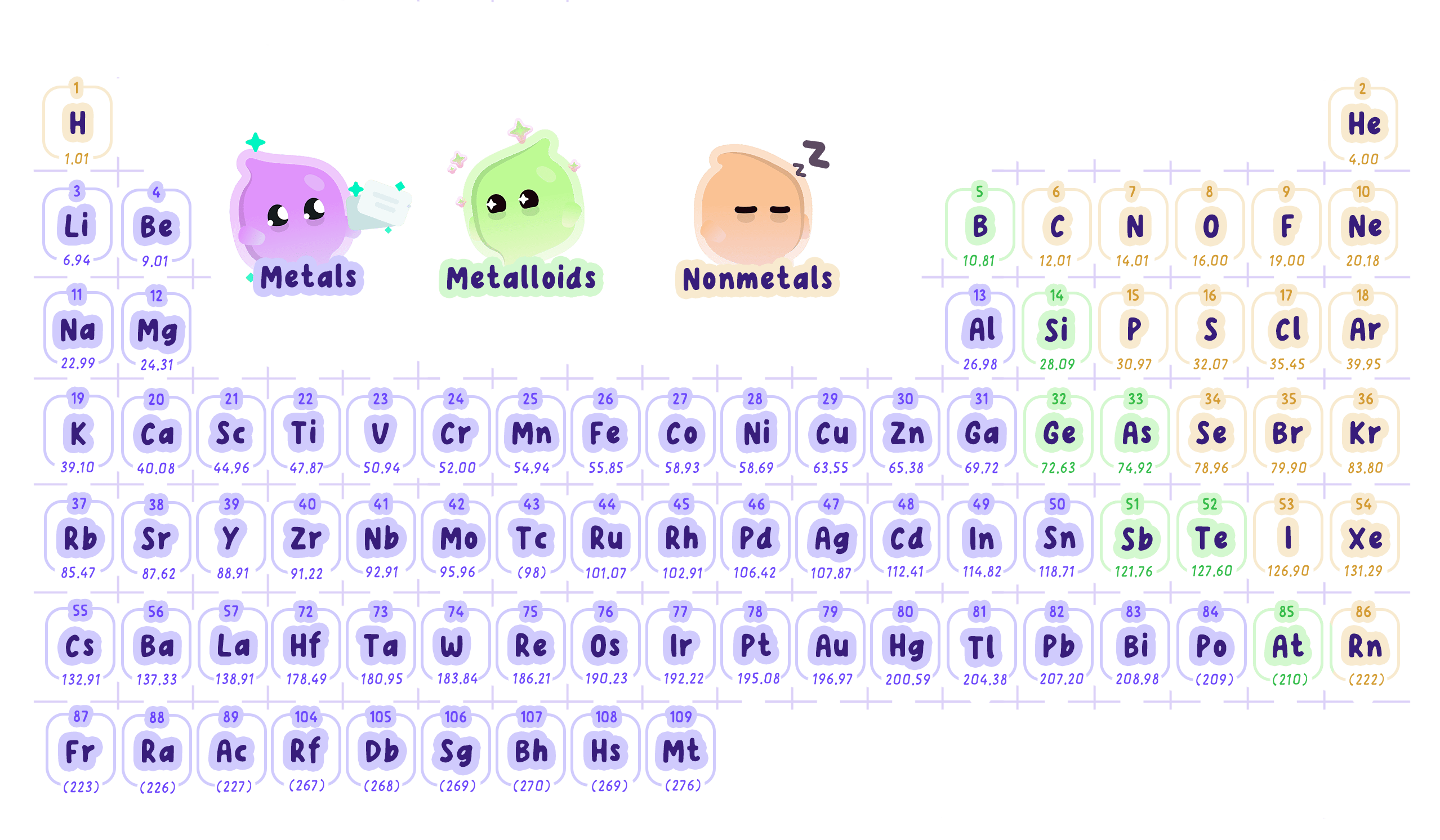
- Periods are rows and groups are columns, and swapping the two words changes the answer completely.
- Hydrogen is a non-metal, whatever its drawn position above group 111 suggests.
Outer-shell electrons explain the split
Electron shell
A fixed energy level around the nucleus in which electrons are found.
- Metal atoms usually hold one, two or three electrons in the outer shell.
- Losing those few electrons leaves a full shell beneath, so metal atoms form positive ions.
- Non-metal atoms usually hold four to seven outer-shell electrons.
- Gaining or sharing completes that shell more easily than losing does, and how many electrons are involved depends on the element, from one for chlorine to four for carbon.
- The group 000 elements already hold a full outer shell, which is why they react with almost nothing.
- The difference in outer-shell electrons is what turns a difference in position into a difference in chemistry.
- Position is the clue and atomic structure is the reason, so a classification is explained only once the outer-shell count is given.
- The electronic configuration makes that count explicit, as 2.8.12.8.12.8.1 does for sodium.
Reading an element's identity and type from its position
- Find the element and read its atomic number to get the proton count.
- Count the rows down from the top to name the period.
- Read the group number printed above the column, since the modern table has eighteen columns and the transition block sits between Groups 2 and 3.
- Judge metal or non-metal from which side of the staircase line the element sits on.
- Support that judgement by stating the outer-shell electron count and whether the atom tends to lose or gain electrons.
- What does an element's atomic number tell you about its atoms?
- How does a period differ from a group?
- Why do elements in the same group have similar chemical properties?
- Where in the table are most metals found, and where are most non-metals found?
- Why does a magnesium atom form a positive ion while a chlorine atom forms a negative one?
2.2.3 Electronic configuration and position in the periodic table
Electron shells fill from the inside out
Electron shell
A fixed energy level around the nucleus in which electrons are found.
- The electrons in an atom occupy shells at fixed distances from the nucleus.
- The first shell holds at most 222 electrons.
- The second and third shells each hold at most 888 electrons across the first 202020 elements.
- The fourth shell begins to fill once the third holds 888.
- A neutral atom has as many electrons as its atomic number.
- An electronic configuration lists those electrons shell by shell, separated by full stops, starting with the shell nearest the nucleus.
- Sodium's configuration 2.8.12.8.12.8.1 means 222 in the first shell, 888 in the second and 111 in the third.
- The numbers add up to the atomic number in a neutral atom, which is the quickest check on any configuration.
- A shell only starts filling once the one inside it is full, across the first 202020 elements.
The first twenty configurations, one electron at a time
- Period 1: hydrogen 111, helium 222.
- Period 2: lithium 2.12.12.1, beryllium 2.22.22.2, boron 2.32.32.3, carbon 2.42.42.4, nitrogen 2.52.52.5, oxygen 2.62.62.6, fluorine 2.72.72.7, neon 2.82.82.8.
- Period 3: sodium 2.8.12.8.12.8.1, magnesium 2.8.22.8.22.8.2, aluminium 2.8.32.8.32.8.3, silicon 2.8.42.8.42.8.4, phosphorus 2.8.52.8.52.8.5, sulfur 2.8.62.8.62.8.6, chlorine 2.8.72.8.72.8.7, argon 2.8.82.8.82.8.8.
- Period 4: potassium 2.8.8.12.8.8.12.8.8.1, calcium 2.8.8.22.8.8.22.8.8.2.
- Each element adds one electron to the one before it, so any configuration can be built from its neighbour.
- A shell diagram carries the same information: the nucleus at the centre, concentric circles around it, and the right number of electrons marked on each circle.
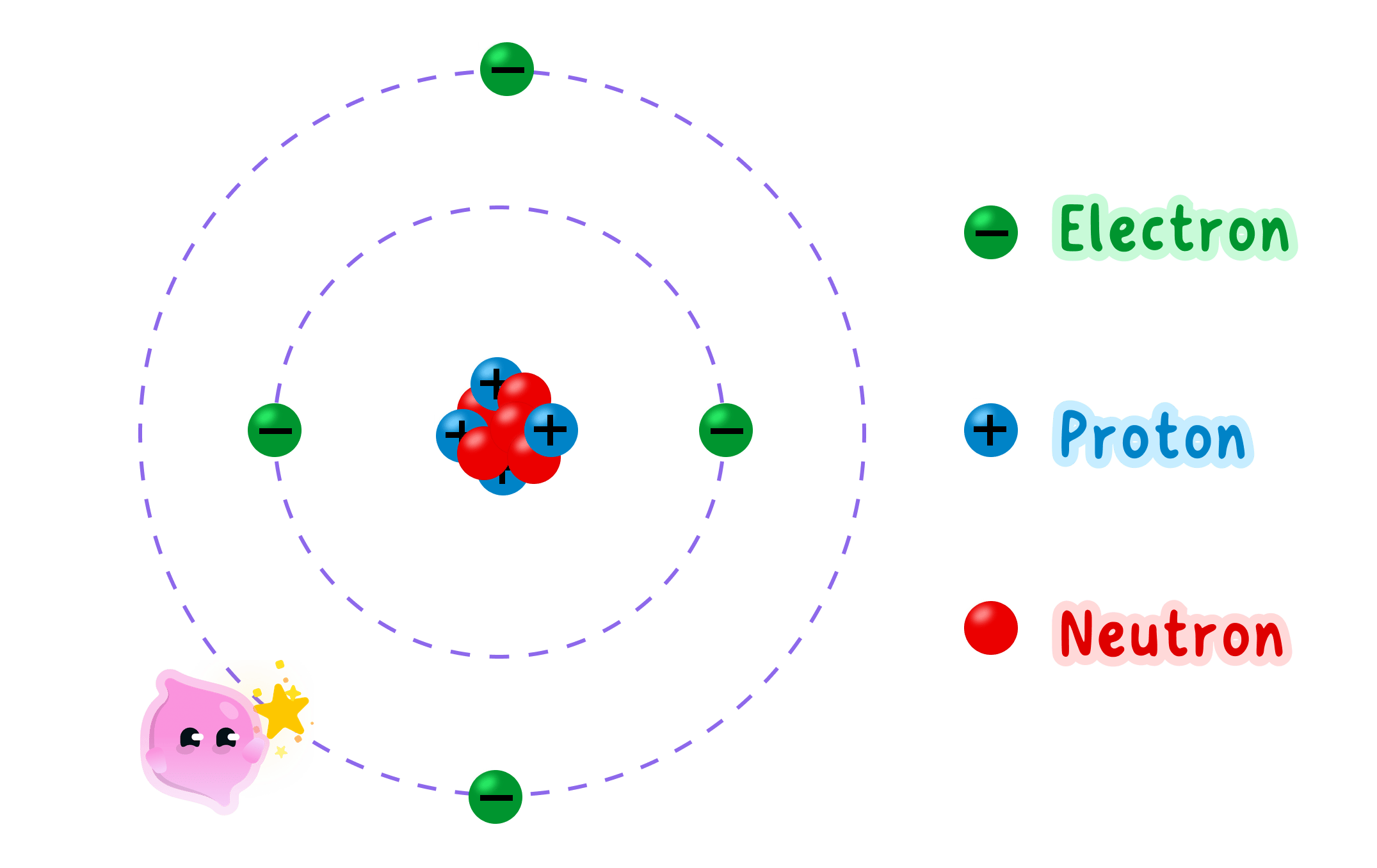
- Sodium has 111111 electrons, so 222 fill the first shell, 888 fill the second and the last 111 starts the third, giving 2.8.12.8.12.8.1.
- Potassium has 191919 electrons, so the first three shells take 222, 888 and 888, and the nineteenth electron starts the fourth, giving 2.8.8.12.8.8.12.8.8.1.
The period number counts the occupied shells
Period
A horizontal row of the periodic table, along which the atomic number increases by one from each element to the next.
- Count how many numbers appear in the configuration, because each one stands for an occupied shell.
- Hydrogen and helium have one number each, so they lie in period 111.
- Lithium to neon have two numbers, so they lie in period 222.
- Sodium to argon have three numbers, so they lie in period 333.
- Potassium and calcium have four numbers, so they lie in period 444.
- A number written as 111 still counts, because that shell does hold an electron.
- The period changes at the point where a new shell starts, such as between argon 2.8.82.8.82.8.8 and potassium 2.8.8.12.8.8.12.8.8.1.
- The numbers add to the atomic number, which catches most slips straight away.
- Full stops separate the shells, so 2.8.12.8.12.8.1 is right and 281281281 is not.
The group number comes from the outer-shell electrons
Group
A vertical column of the periodic table, whose elements have the same number of outer-shell electrons and so have similar chemical properties.
- Read the last number in the configuration to find the outer-shell electron count.
- One outer-shell electron places an element in group 111, and two place it in group 222.
- Counts of 333 to 777 place an element in groups 333 to 777 respectively.
- A full outer shell places an element in group 000, which holds the noble gases.
- Helium belongs to group 000 because its single shell is complete at 222 electrons.
- Chlorine 2.8.72.8.72.8.7 therefore lies in group 777, and magnesium 2.8.22.8.22.8.2 in group 222.
- Elements in one group behave similarly because the same outer-shell count takes part in their reactions.
- The total electron count does not give the group, because only the outer shell is counted.
- Helium is in group 000, not group 222, because its outer shell is complete.
Going both ways between configuration and position
- Write the configuration from the atomic number, filling each shell before starting the next.
- Count the numbers for the period and read the last number for the group.
- Calcium 2.8.8.22.8.8.22.8.8.2 sits in period 444, group 222.
- Argon 2.8.82.8.82.8.8 sits in period 333, group 000.
- The same two counts work from a shell diagram: occupied circles give the period, and electrons on the outer circle give the group.
- Working backwards, an element in period 333 and group 666 has three occupied shells and six outer-shell electrons, giving 2.8.62.8.62.8.6.
- How many electrons fill the first shell, and how many fill the second?
- What is the electronic configuration of sulfur?
- Which period and group hold an atom with the configuration 2.8.72.8.72.8.7?
- Why is helium placed in group 000 rather than group 222?
- Which configuration belongs to an element in period 444, group 111?
