One mole is both a count of particles and a mass
Definition
Mole
The amount of a substance that contains the Avogadro constant of particles, and which has a mass in grams equal to its relative particle mass.
Definition
Avogadro constant
The number of particles in one mole of a substance, 6.02 x 10^23 per mole.
- Counting atoms one at a time is impossible, so chemists count them in moles instead.
- One mole of any substance contains 6.02×10236.02 \times 10^{23}6.02×10²³ particles.
- The particles are whichever the formula represents: atoms for an element such as aluminium, molecules for O2\text{O}_2O2, formula units for NaCl\text{NaCl}NaCl, or ions when the question names an ion.
- One mole of a substance has a mass in grams equal to its relative particle mass.
- The relative particle mass is the ArA_rAr for an element made of single atoms, and the MrM_rMr for a compound.
- One mole of water therefore has a mass of 18 g18\ \text{g}18 g, and one mole of aluminium a mass of 27 g27\ \text{g}27 g.
Key Idea
- The particle count is always the same, whatever the substance is.
- The mass of one mole changes with the substance, because each has its own relative particle mass.
Converting between mass and amount
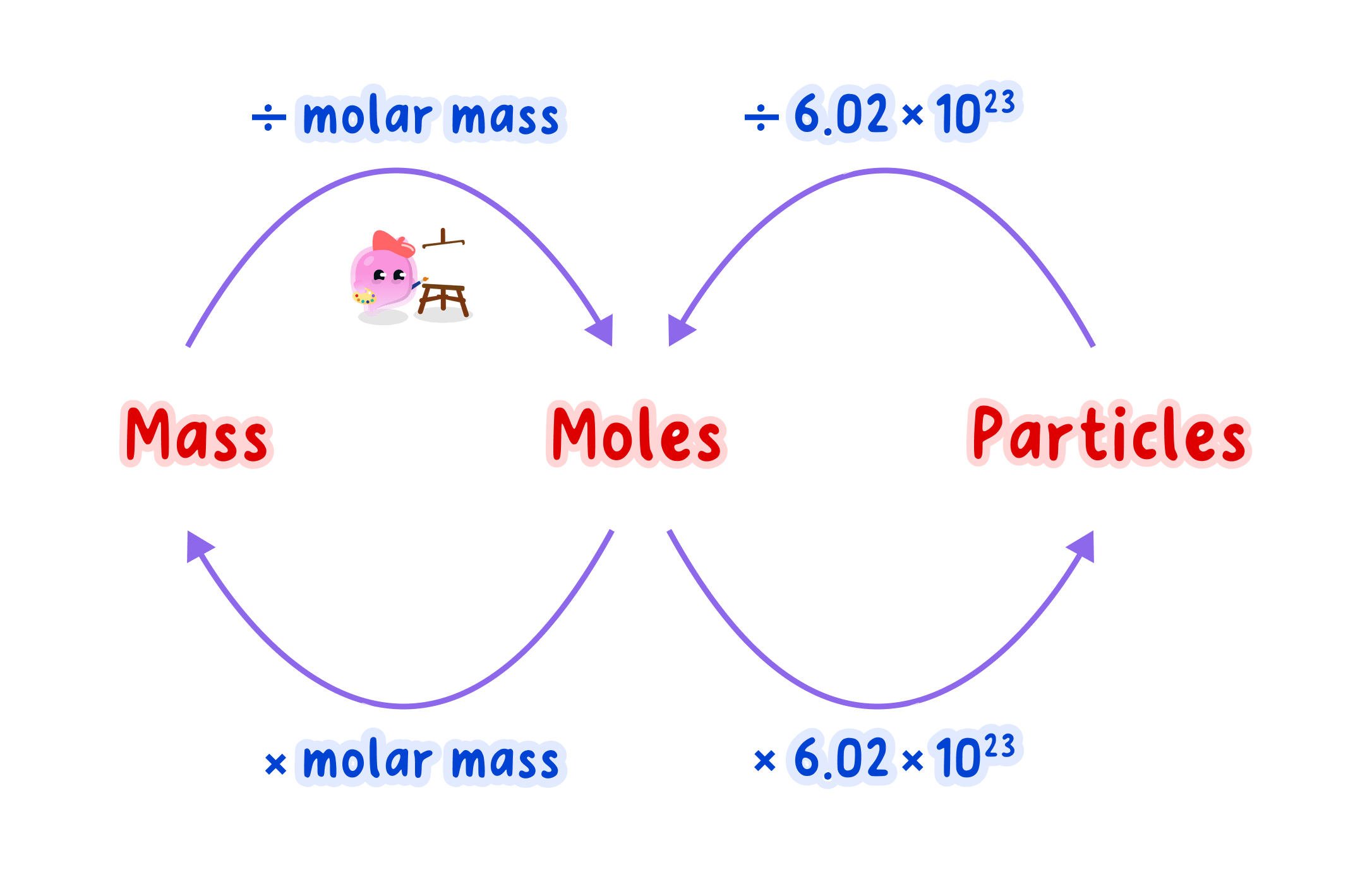
- Divide a mass by the relative particle mass to get the amount: n=mMrn = \frac{m}{M_r}n=Mrm
- Multiply an amount by the relative particle mass to get the mass: m=n×Mrm = n \times M_rm=n×Mr
- The mass is in g\text{g}g, the amount in mol\text{mol}mol, and the relative particle mass carries no unit.
- So 36 g36\ \text{g}36 g of water is 36÷18=2.0 mol36 \div 18 = 2.0\ \text{mol}36÷18=2.0 mol.
- And 0.25 mol0.25\ \text{mol}0.25 mol of carbon dioxide has a mass of 0.25×44=11 g0.25 \times 44 = 11\ \text{g}0.25×44=11 g.
Example
- Mass to amount: 36 g36\ \text{g}36 g of H2O\text{H}_2\text{O}H2O divided by 181818 gives 2.0 mol2.0\ \text{mol}2.0 mol.
- Amount to mass: 0.25 mol0.25\ \text{mol}0.25 mol of CO2\text{CO}_2CO2 multiplied by 444444 gives 11 g11\ \text{g}11 g.
Converting between amount and number of particles
- Multiply an amount by the Avogadro constant to get the number of particles: N=n×6.02×10²³N = n \times 6.02 \times 10^{23}N=n×6.02×10²³
- Divide a number of particles by the Avogadro constant to get the amount: n=N6.02×1023n = \frac{N}{6.02 \times 10^{23}}n=6.02×10²³N
- So 0.50 mol0.50\ \text{mol}0.50 mol of oxygen contains 0.50×6.02×1023=3.01×10230.50 \times 6.02 \times 10^{23} = 3.01 \times 10^{23}0.50×6.02×1023=3.01×10²³ molecules.
- And 1.204×10241.204 \times 10^{24}1.204×1024 chloride ions is 1.204×1024÷(6.02×10²³)=2.00 mol1.204 \times 10^{24} \div (6.02 \times 10^{23}) = 2.00\ \text{mol}1.204×1024÷(6.02×10²³)=2.00 mol.
- A number of particles carries no unit, although the particle itself has to be named.
Common Mistake
- Dividing a mass by MrM_rMr gives an amount, not a number of particles, so the Avogadro constant is still to come.
- Not every particle is a molecule, so an ionic compound is counted in formula units and an element such as aluminium in atoms.
Going from mass straight to particles
- Mass and particle number are linked through the amount in moles.
- From a mass, divide by the relative particle mass and then multiply by the Avogadro constant: N=mMr×6.02×10²³N = \frac{m}{M_r} \times 6.02 \times 10^{23}N=Mrm×6.02×10²³
- From a number of particles, divide by the Avogadro constant and then multiply by the relative particle mass: m=N6.02×1023×Mrm = \frac{N}{6.02 \times 10^{23}} \times M_rm=6.02×10²³N×Mr
- For 9.0 g9.0\ \text{g}9.0 g of aluminium, with Ar=27A_r = 27Ar=27, the amount is 0.3333 mol0.3333\ \text{mol}0.3333 mol and the count is 2.0×10232.0 \times 10^{23}2.0×10²³ atoms.
- For 3.01×10233.01 \times 10^{23}3.01×10²³ molecules of CO2\text{CO}_2CO2, the amount is 0.500 mol0.500\ \text{mol}0.500 mol and the mass is 0.500×44=22 g0.500 \times 44 = 22\ \text{g}0.500×44=22 g.
Note
- Extra figures survive the middle step, because rounding the amount early shifts the particle count.
- The two-step route and the single equation agree, since both pass through the amount in moles.
Choosing the right quantity
- A mass in the question and a mass in the answer means the relative particle mass is used twice.
- A particle count anywhere in the question means the Avogadro constant appears in the working.
- The amount in moles sits in the middle of every one of these conversions.
- Units settle most slips: g\text{g}g for a mass, mol\text{mol}mol for an amount, and no unit for a particle count.
- The relative particle mass always comes from the substance named, never from a neighbouring one.
Exam technique
- Reading which quantity the question gives, and which it asks for, settles which equation to use.
- A particle count is named, so the answer reads 2.0×10232.0 \times 10^{23}2.0×10²³ aluminium atoms rather than a bare number.
- The relative particle mass always comes from the substance the question names.
Self review
- What is the value of the Avogadro constant?
- What is the mass of one mole of a substance whose MrM_rMr is 444444?
- How many moles are there in 36 g36\ \text{g}36 g of water?
- How many molecules are there in 0.50 mol0.50\ \text{mol}0.50 mol of oxygen?
- What mass of carbon dioxide contains 3.01×10233.01 \times 10^{23}3.01×10²³ molecules?
