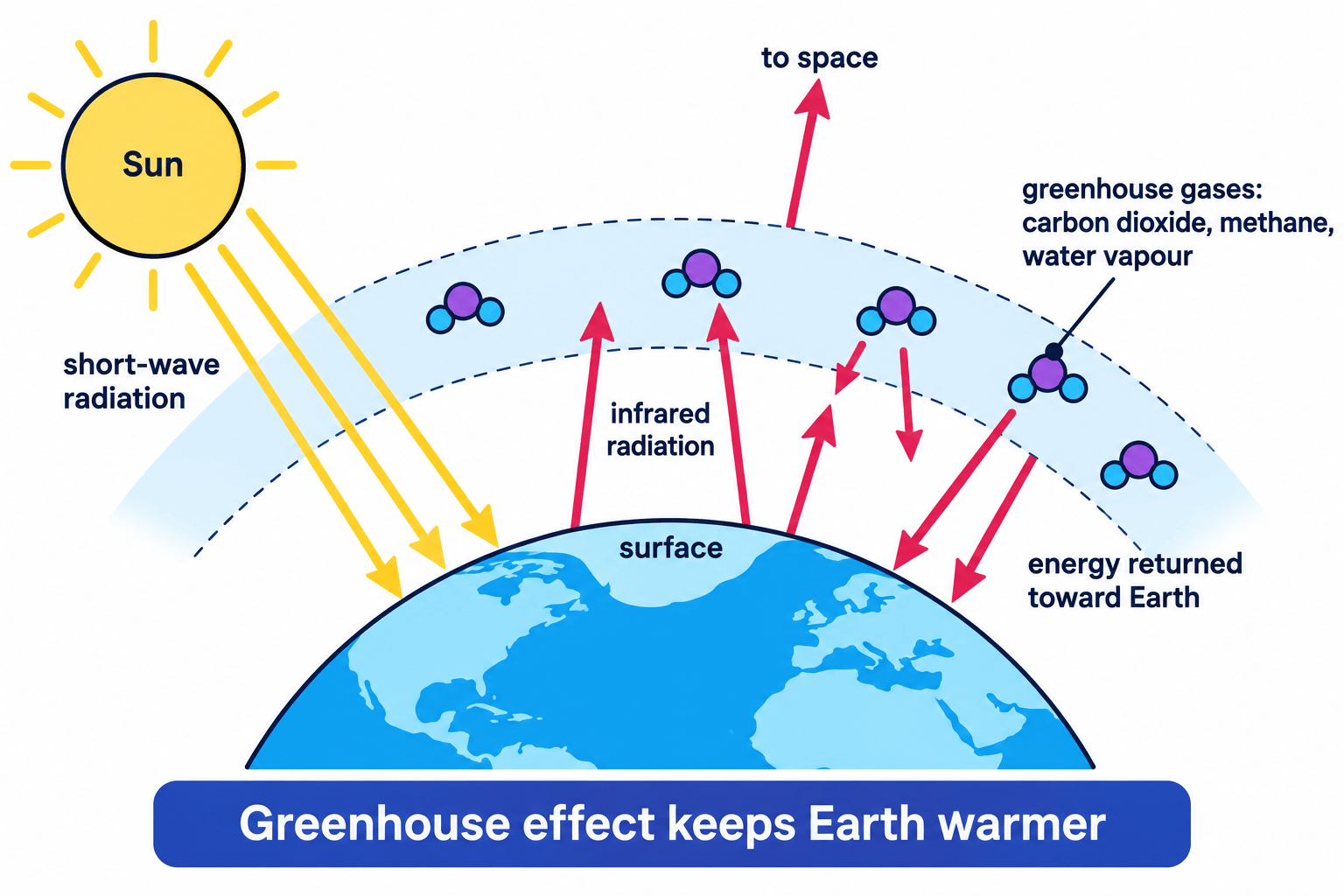
Greenhouse gases keep the Earth warm
Definition
Greenhouse effect
The warming of the Earth caused by gases in the atmosphere absorbing heat radiated from the surface and releasing energy that keeps the Earth warm.
- Energy arrives from the Sun and warms the Earth's surface.
- The warmed surface radiates heat back outwards.
- Some gases in the atmosphere absorb that radiated heat.
- Those gases then release energy, some of it back towards the Earth.
- The result is that the Earth stays warmer than it would otherwise be.
Key Idea
Without the greenhouse effect the Earth would be too cold to support life as it does.
Which gases are involved
- Carbon dioxide is the greenhouse gas discussed most often.
- Methane is another, and it absorbs heat strongly for the amount present.
- Water vapour is a greenhouse gas as well, and is the most abundant of them.
- These gases are present in small proportions apart from water vapour.
- Nitrogen and oxygen make up most of the air but are not greenhouse gases.
Note
Being abundant and being a greenhouse gas are different things, as nitrogen shows.
The composition of today's atmosphere
- Nitrogen makes up about 78%78\%78% of the air by volume.
- Oxygen makes up about 21%21\%21%.
- Together those two account for about 99%99\%99% of the atmosphere.
- The remainder is mostly argon, with carbon dioxide at a small fraction of a percent.
- Water vapour is also present, in an amount that varies with place and weather.
Example
Nitrogen 78%78\%78%, oxygen 21%21\%21%, argon about 0.9%0.9\%0.9%, carbon dioxide about 0.04%0.04\%0.04%.
The evidence linking human activity to climate change
- Atmospheric carbon dioxide has risen since large-scale burning of fossil fuels began.
- The consumption of fossil fuels has risen over the same period.
- Average global temperature has risen over that period too.
- Three quantities rising together is a correlation, and a strong one.
- A mechanism supports it, since carbon dioxide is known to absorb radiated heat.
Common Mistake
A correlation on its own does not prove cause, which is why the mechanism matters.
The uncertainties in that evidence
- Measurements taken at different places can give different readings.
- A reading taken near a city may be affected by local conditions rather than global ones.
- Historical records were made with less accurate instruments than today's.
- Records from long ago are estimated from ice cores and tree rings rather than measured directly.
- These uncertainties affect how precisely the trend is known, not whether it exists.
The potential effects of more carbon dioxide and methane
- Human activity raises both gases: burning fossil fuels releases carbon dioxide, and livestock farming releases methane.
- Rice paddies and landfill sites release methane as well.
- More greenhouse gas absorbs more of the heat radiated from the surface, so average global temperature is expected to rise.
- Warmer oceans expand and ice sheets melt, so sea levels rise and low-lying land is at risk of flooding.
- Shifts in rainfall change which crops grow where, and extreme weather is expected to become more frequent.
Note
These are stated as expected effects, because they are projections from models rather than measurements already made.
Whether those effects can be mitigated
- Mitigation means cutting the amount of greenhouse gas released, or removing it once it has been released.
- Generating electricity from renewable sources in place of fossil fuels cuts carbon dioxide at source.
- Carbon capture stores carbon dioxide underground instead of letting it reach the atmosphere.
- Changing diets and farming reduces the methane that livestock produce.
- Every measure is judged on its scale, risk and cost, since one that works in a trial may not work worldwide.
Exam technique
- An evaluation states the correlation, then the mechanism, then the uncertainties.
- Naming where and when a measurement was taken is what makes an uncertainty specific.
- A conclusion says how strong the evidence is rather than treating it as all or nothing.
Self review
- Explain how the greenhouse effect keeps the Earth warm.
- Name two human activities that increase the amount of greenhouse gas.
- Give two potential effects of a warmer climate.
- What correlation is offered as evidence for human activity causing climate change?
- Give one way these effects could be mitigated, and one thing that must be weighed against it.