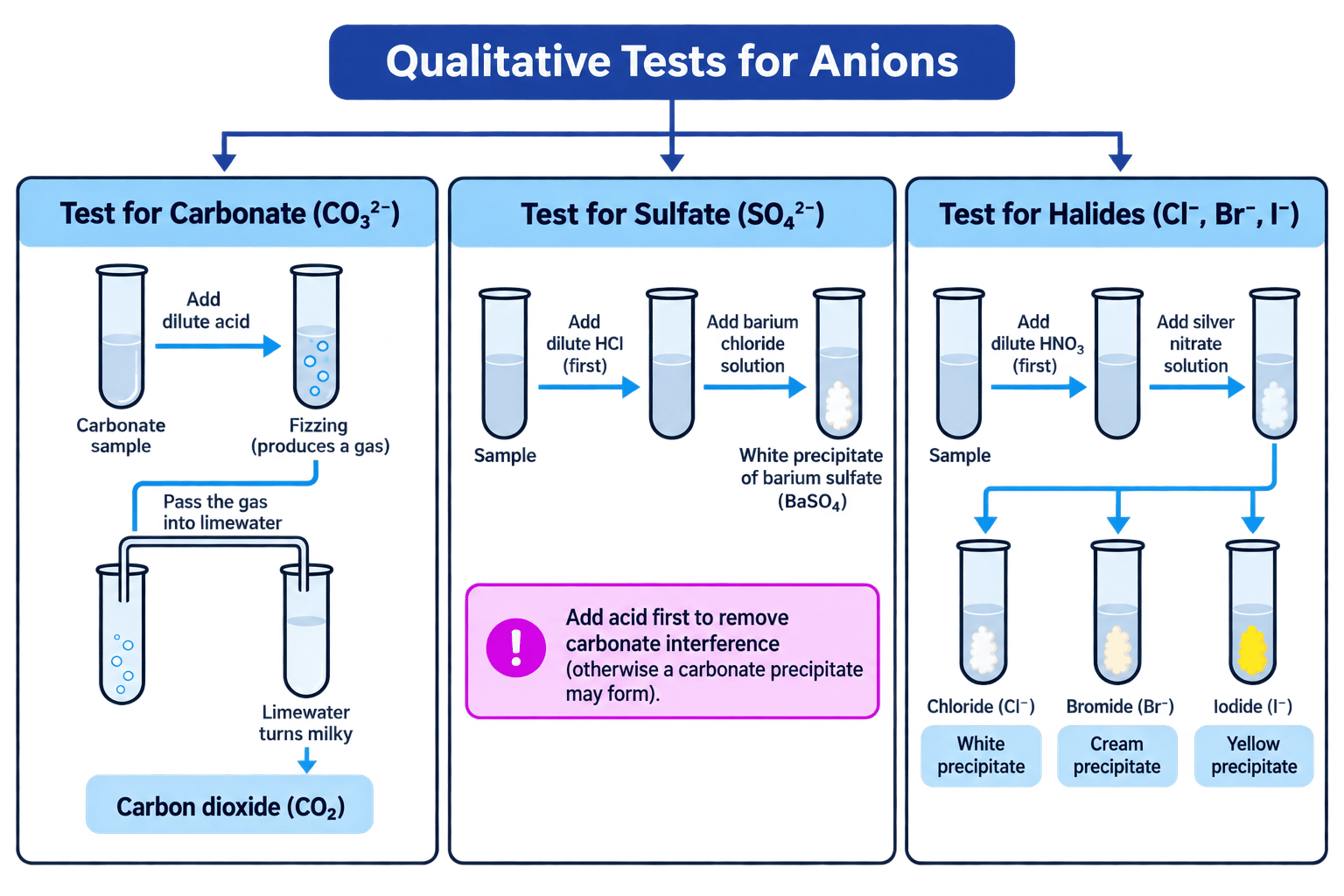
Carbonates give off carbon dioxide with dilute acid
- Dilute acid is added to the solid or to its solution.
- A carbonate fizzes, because a gas is being released.
- The reaction releases carbon dioxide: carbonate+acid→salt+water+carbon dioxide\text{carbonate} + \text{acid} \rightarrow \text{salt} + \text{water} + \text{carbon dioxide}carbonate+acid→salt+water+carbon dioxide
- The gas is passed through limewater, which turns milky.
- Fizzing alone is not enough, since the gas has to be identified as well.
Key Idea
Two steps make the test unique: the effervescence, then the limewater result.
Sulfates give a white precipitate with barium chloride
- Dilute hydrochloric acid is added to the solution first.
- Barium chloride solution is then added.
- A white precipitate of barium sulfate shows a sulfate ion is present.
- The precipitate forms as: Ba2+(aq)+SO42−(aq)→BaSO4(s)\text{Ba}^{2+}(aq) + \text{SO}_4^{2-}(aq) \rightarrow \text{BaSO}_4(s)Ba2+(aq)+SO42−(aq)→BaSO4(s)
- The acid is added first to remove any carbonate, which would also precipitate.
Common Mistake
Leaving out the acid risks a false positive, because barium carbonate is white too.
Halides give coloured precipitates with silver nitrate
Definition
Halide ion
The negative ion formed when a halogen atom gains one electron.
- Dilute nitric acid is added to the solution first.
- Silver nitrate solution is then added.
- A chloride gives a white precipitate.
- A bromide gives a cream precipitate.
- An iodide gives a yellow precipitate.
Example
- White: chloride. Cream: bromide. Yellow: iodide.
- The three colours run from white through cream to yellow, deepening down the group.
Why the acid comes first
- A carbonate in the sample would give a precipitate with silver or barium ions.
- That precipitate would be mistaken for a positive halide or sulfate result.
- Adding acid first destroys any carbonate, releasing it as carbon dioxide.
- Nitric acid is used before silver nitrate, so that no chloride is introduced.
- Hydrochloric acid is used before barium chloride, for the same kind of reason.
Note
Matching the acid to the reagent avoids adding the very ion being tested for.
Self review
- Describe the full test for a carbonate ion.
- Which two reagents identify a sulfate ion?
- Give the precipitate colours for chloride, bromide and iodide.
- Why is acid added before the silver nitrate?
- Why is nitric acid rather than hydrochloric acid used in the halide test?