Inside the atom: a nucleus of protons and neutrons, electrons in shells
Definition
Nucleus
The tiny, dense, positively charged centre of an atom, containing the protons and neutrons and almost all of the atom's mass.
Definition
Electron shell
A fixed energy level around the nucleus in which electrons are found.
- The nucleus sits at the centre of the atom and holds the protons and the neutrons.
- The electrons move around the nucleus, occupying shells at fixed distances from it.
- Protons, neutrons and electrons are the three subatomic particles that make up an atom.
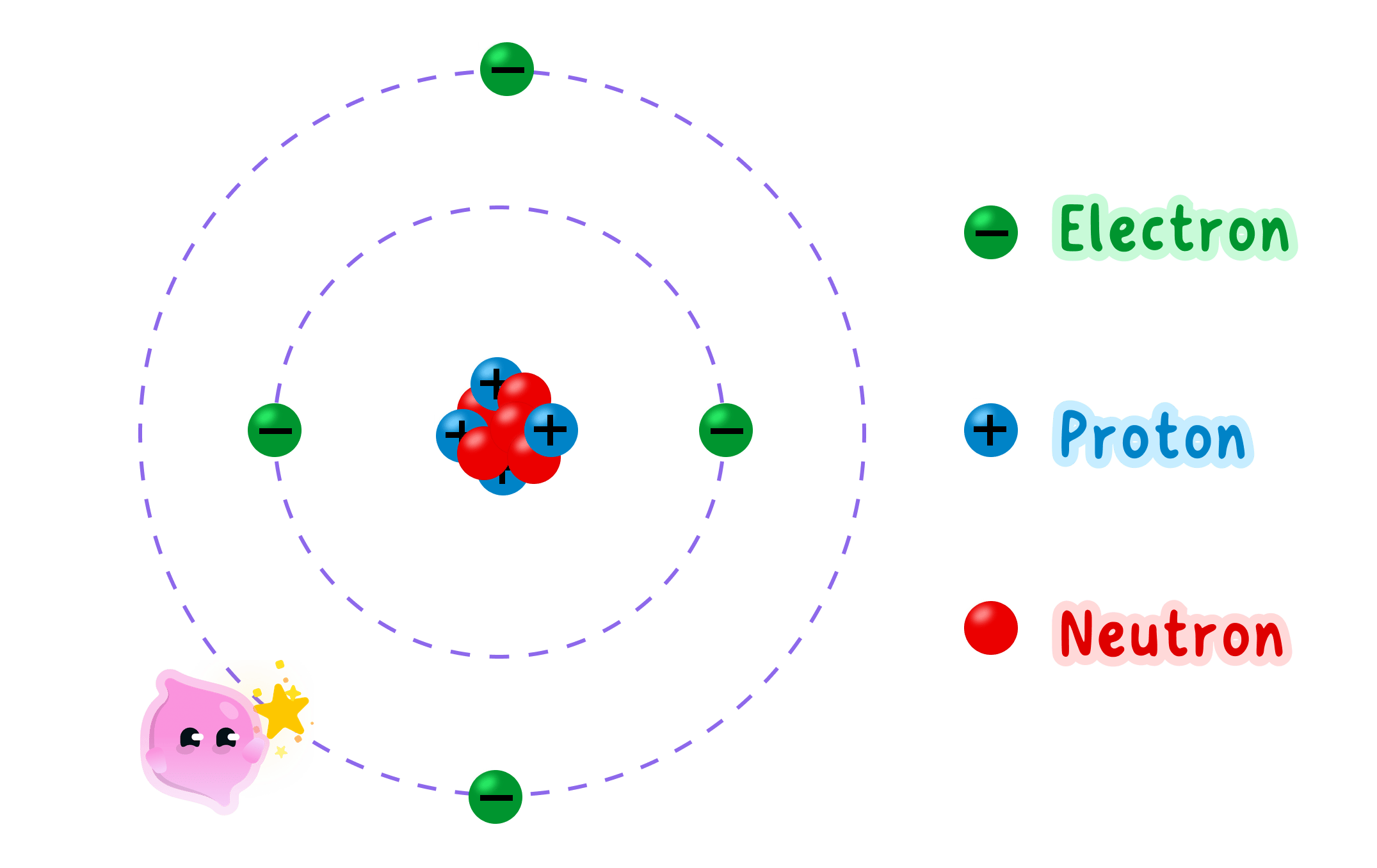
- An atom carries no overall charge, so it holds as many electrons as protons.
Key Idea
- All the positive charge and nearly all the mass sit in the nucleus.
- All the negative charge sits outside it, in the electron shells.
Relative charge and relative mass of each particle
- Relative charge compares a particle's charge with the charge on a proton, which is set at +1+1+1.
- Relative mass compares a particle's mass with the mass of a proton, which is set at 111.
- Proton: relative charge +1+1+1, relative mass 111, found in the nucleus.
- Neutron: relative charge 000, relative mass 111, found in the nucleus.
- Electron: relative charge −1-1−1, relative mass 11840\frac{1}{1840}18401, found in a shell around the nucleus.
- A proton and a neutron therefore contribute about the same mass, while an electron contributes almost none.
Note
- The neutron is the only one of the three with no charge, so it never affects the atom's overall charge.
- Relative charge and relative mass have no units, because each one compares a particle with a proton.
Why an atom is neutral: protons and electrons cancel exactly
- A proton carries +1+1+1 and an electron carries −1-1−1, so one of each cancels to zero.
- Equal numbers of protons and electrons give equal amounts of positive and negative charge.
- Those charges cancel, so the atom has an overall charge of zero.
- Neutrons carry no charge, so they take no part in this balance.
- A particle whose protons and electrons are unequal is an ion, not an atom.
Common Mistake
- Do not confuse equal protons and electrons with equal protons and neutrons, which is not generally true.
- Do not use neutrons to explain why an atom is neutral, because they have no charge to cancel.
Size and mass: a tiny nucleus that carries nearly all the mass
- The nucleus has a radius of roughly 110000\frac{1}{10000}100001 that of the whole atom.
- Almost all of the atom is therefore empty space through which the electrons move.
- Each proton and each neutron has relative mass 111, while each electron has relative mass 11840\frac{1}{1840}18401.
- Adding in the electrons changes the total mass by an amount too small to matter.
- Nearly all of the atom's mass therefore sits in the nucleus, even though the nucleus occupies almost none of its volume.
- The electrons fix the size of the atom while the nucleus fixes its mass.
Self review
- Which particles are found in the nucleus of an atom?
- Give the relative charge and relative mass of a proton, a neutron and an electron.
- Why must an atom contain equal numbers of protons and electrons?
- How does the radius of the nucleus compare with the radius of the atom?
- Why is nearly all of an atom's mass concentrated in the nucleus?
