5.2.1 Reversible reactions and dynamic equilibrium
Some reactions run in both directions
Reversible reaction
A reaction in which the products can react together to re-form the reactants, shown by the symbol ⇌.
- In many reactions the products can react together to re-form the reactants.
- Heating blue hydrated copper sulfate drives off water and leaves white anhydrous copper sulfate.
- Adding water to the white solid turns it blue again, which reverses the change.
- Heating white ammonium chloride breaks it into ammonia and hydrogen chloride, which recombine on cooling.
- The conditions decide which direction dominates, so changing them can reverse the change.
- Hydrated copper sulfate: blue solid, heated, gives a white solid and water vapour.
- Anhydrous copper sulfate: white solid, water added, turns blue and warms up.
The double arrow marks a reversible reaction
- A reversible reaction is written with the symbol ⇌\rightleftharpoons⇌ in place of a single arrow.
- The copper sulfate change is written this way: CuSO4⋅5H2O⇌CuSO4+5H2O\text{CuSO}_4{\cdot}5\text{H}_2\text{O} \rightleftharpoons \text{CuSO}_4 + 5\text{H}_2\text{O}CuSO4⋅5H2O⇌CuSO4+5H2O
- The left to right change is called the forward reaction and the right to left change the backward reaction.
- The two reactions are opposites, so one is exothermic by exactly as much as the other is endothermic.
- Both reactions are taking place at the same time whenever reactants and products are mixed together.
A single arrow is the convention for a reaction that goes essentially to completion, which a reversible one does not.
A closed system reaches dynamic equilibrium
Closed system
A system in which no reactants or products can enter or leave.
Dynamic equilibrium
The state of a reversible reaction in a closed system in which the forward and backward reactions happen at the same rate, so the amounts of reactants and products stay constant.
- Nothing can enter or leave a closed system, so every product stays in contact with the mixture.
- As the reactants are used up the forward reaction slows down.
- As the products build up the backward reaction speeds up.
- The two rates eventually become equal, and at that moment the amounts stop changing.
- The mixture has then reached equilibrium, and it stays there unless something is changed.
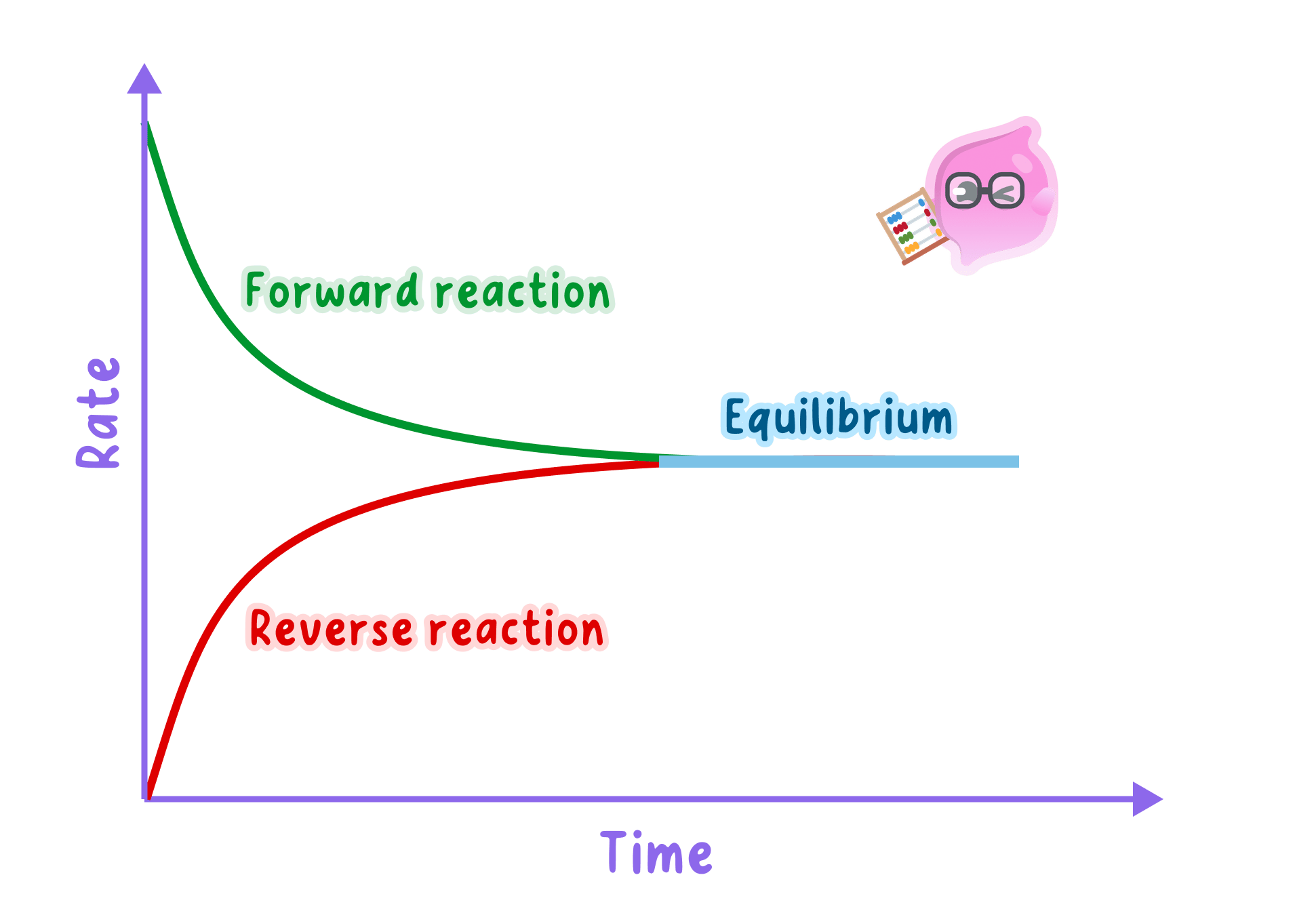
- Equilibrium is only possible in a closed system, because a product that escapes can never react back.
- Letting a gaseous product escape keeps shifting the reaction forwards, so it can run close to completion instead.
Equilibrium is dynamic, not still
- At equilibrium both reactions are still running, and running at the same rate.
- Particles are still being converted in both directions, which is what dynamic means.
- What stays constant is the amount of each substance present, not the activity in the mixture.
- The reactants and products are not present in equal amounts, only in unchanging ones.
- A mixture that has simply stopped reacting is not at equilibrium, because nothing is happening at all.
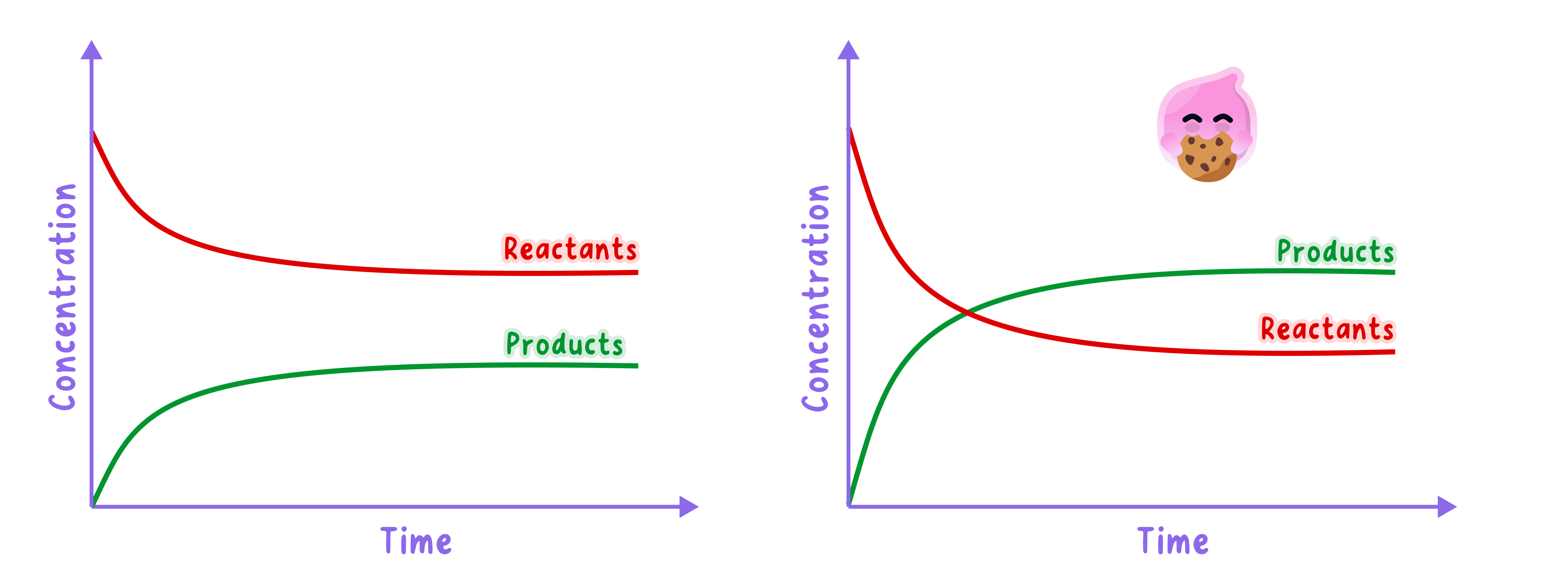
Equal rates, not equal amounts, is what defines a dynamic equilibrium.
Changing the conditions changes what the mixture holds
- Once a mixture is at equilibrium, its composition stays fixed until a condition is altered.
- Changing the temperature, the pressure or a concentration disturbs the balance of the two rates.
- The mixture then settles at a new equilibrium holding different amounts of reactants and products.
- This is why the direction of a reversible reaction can be controlled by choosing the conditions.
- Industry uses that control to push a reversible reaction towards the product that is wanted.
- What does the symbol ⇌\rightleftharpoons⇌ tell you about a reaction?
- Why can equilibrium only be reached in a closed system?
- What is happening to the forward and backward rates at equilibrium?
- Why is equilibrium described as dynamic?
- What happens to a mixture at equilibrium when a condition is changed?
5.2.2 The Haber process
Ammonia is made from nitrogen and hydrogen
- The Haber process combines nitrogen and hydrogen to make ammonia.
- The equation for the reaction is: N2(g)+3H2(g)⇌2NH3(g)\text{N}_2(\text{g}) + 3\text{H}_2(\text{g}) \rightleftharpoons 2\text{NH}_3(\text{g})N2(g)+3H2(g)⇌2NH3(g)
- The ratio is one nitrogen to three hydrogen, and the gases are supplied in that proportion.
- The forward reaction is exothermic, so it releases energy as ammonia forms.
- Ammonia is the raw material for fertilisers, which is why the process is run on such a scale.
Every molecule of ammonia is built from atmospheric nitrogen, which plants cannot use directly.
Where the two raw materials come from
- Nitrogen is extracted from the air, which is about 78%78\%78% nitrogen by volume.
- The air is cooled until it liquefies and is then separated by fractional distillation.
- Hydrogen is obtained from natural gas, which is mainly methane.
- Both raw materials are purified before they enter the reactor, because impurities spoil the catalyst.
- The nitrogen is effectively unlimited, while the hydrogen depends on a supply of natural gas.
Natural gas is a finite resource, so the hydrogen is the part of the process that cannot go on forever.
The reaction is reversible and reaches a dynamic equilibrium
Reversible reaction
A reaction in which the products can react together to re-form the reactants, shown by the symbol ⇌.
Dynamic equilibrium
The state of a reversible reaction in a closed system in which the forward and backward reactions happen at the same rate, so the amounts of reactants and products stay constant.
- Ammonia breaks back down into nitrogen and hydrogen under the same conditions that form it.
- The gases are held in the reactor long enough for the mixture to approach equilibrium.
- Where the forward and backward rates become equal, the mixture has reached a dynamic equilibrium.
- At that point the mixture holds ammonia together with unreacted nitrogen and hydrogen.
- The reaction can therefore never convert all of the nitrogen and hydrogen in a single pass.
Gas flows through the reactor continuously, so the mixture approaches equilibrium rather than sitting at it as a sealed flask would.
The conditions used in the Haber process
Catalyst
A substance that speeds up a reaction without being used up in the reaction.
- The temperature used is 450 ∘C450\ ^{\circ}\text{C}450 ∘C.
- The pressure used is 200200200 atmospheres.
- An iron catalyst is used.
- The catalyst brings the mixture to equilibrium sooner without being used up.
- These three conditions are the ones recalled for this process.
- Temperature: 450 ∘C450\ ^{\circ}\text{C}450 ∘C.
- Pressure: 200200200 atmospheres.
- Catalyst: iron.
The mixture is cooled and recycled
- The gases leaving the reactor are cooled until the ammonia condenses to a liquid.
- Nitrogen and hydrogen stay as gases at that temperature, so the ammonia separates out.
- Removing the ammonia means the liquid product is run off on its own.
- The unreacted nitrogen and hydrogen are pumped back into the reactor.
- Recycling means that very little of either raw material is wasted, even though each pass converts only some.
- Write the equation for the formation of ammonia from its elements.
- Where does the nitrogen used in the Haber process come from, and how is it obtained?
- Why does the reactor never convert all of the nitrogen and hydrogen?
- State the temperature, pressure and catalyst used.
- How is the ammonia separated from the unreacted gases?
5.2.3 Changing the position of a dynamic equilibrium
The position of equilibrium describes what the mixture holds
Position of equilibrium
Whether a dynamic equilibrium holds more products or more reactants, described as lying to the right or to the left.
- A mixture at equilibrium holds both reactants and products, in unchanging amounts.
- An equilibrium lying to the right holds mostly products.
- An equilibrium lying to the left holds mostly reactants.
- Changing a condition upsets the balance of the two rates, and the mixture settles at a new position.
- The general rule is that the system responds so as to oppose the change that was made.
Predicting a shift means asking which direction reduces the effect of the change imposed.
Temperature favours the endothermic or the exothermic direction
- One direction of a reversible reaction is exothermic and the other is endothermic.
- Raising the temperature shifts the position towards the endothermic direction, which takes energy in.
- Lowering the temperature shifts the position towards the exothermic direction, which gives energy out.
- In the Haber process the forward reaction is exothermic, so a lower temperature gives more ammonia at equilibrium.
- Temperature shifts the position of every equilibrium, while pressure does so only where the two sides differ in moles of gas.
Energy is a condition, not a substance, so it never appears as a species in the equation.
Pressure matters when the two sides hold different amounts of gas
- Only gases respond to a change in pressure, so solids and liquids can be ignored.
- Count the moles of gas shown on each side of the equation.
- Raising the pressure shifts the position towards the side with fewer moles of gas.
- Lowering the pressure shifts it towards the side with more moles of gas.
- Ammonia forms from four moles of gas and makes two, so high pressure favours ammonia.
Where both sides hold the same number of moles of gas, changing the pressure moves the position not at all.
Concentration shifts the equilibrium away from whatever is added
- Adding more of a reactant shifts the position to the right, making more product.
- Adding more of a product shifts the position to the left, making more reactant.
- Removing a product shifts the position to the right, as the system replaces what was taken.
- Removing a reactant shifts the position to the left for the same reason.
- Removing the product as it forms keeps shifting the position right, so the reaction can run close to completion.
- More nitrogen added: the position moves right and the amount of ammonia rises.
- Ammonia removed: the position moves right again, which is why the Haber plant condenses it out.
A catalyst changes the speed but not the position
Catalyst
A substance that speeds up a reaction without being used up in the reaction.
- A catalyst speeds up the forward and backward reactions by the same factor.
- Because both rates rise together, they still become equal at the same composition.
- Equilibrium is therefore reached sooner, holding exactly the amounts it would have held anyway.
- The yield at equilibrium is unchanged, however much catalyst is present.
- Industry pays for a catalyst because of the time it saves, not for extra product.
- A prediction is worth stating as a direction of shift plus the reason the system opposes the change.
- Counting the moles of gas on each side comes before any answer about pressure.
- An answer that credits a catalyst with a higher yield contradicts the equal factor point above.
- What does it mean to say an equilibrium lies to the left?
- Which direction does raising the temperature favour, and why?
- When does a change of pressure leave the position of equilibrium unchanged?
- What happens to the position when a product is removed?
- Why does a catalyst not change the yield at equilibrium?
