The chemical test for chlorine
- Damp blue litmus paper is held in the gas being tested.
- Chlorine turns the paper red and then bleaches it white.
- The bleaching is the part that identifies chlorine, since other acidic gases only turn it red.
- The paper must be damp, because the gas has to dissolve before it can act.
- The test is carried out in a fume cupboard, as chlorine is toxic.
Key Idea
Red then white is the full result: red alone does not identify chlorine.
Halogens react with metals to form metal halides
Definition
Metal halide
A compound formed when a metal reacts with a halogen.
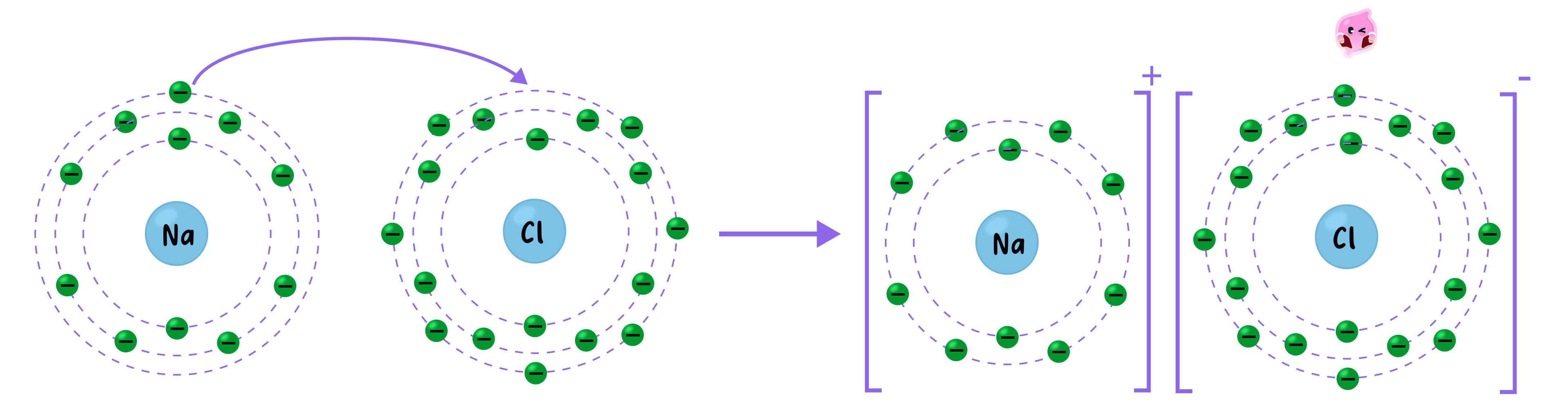
- A halogen reacts with a metal to give an ionic compound.
- The metal atoms lose electrons and the halogen atoms gain them.
- Sodium burns in chlorine with a bright yellow flame: 2Na+Cl2→2NaCl2\text{Na} + \text{Cl}_2 \rightarrow 2\text{NaCl}2Na+Cl2→2NaCl
- Hot iron wool reacts with chlorine to give a brown solid: 2Fe+3Cl2→2FeCl32\text{Fe} + 3\text{Cl}_2 \rightarrow 2\text{FeCl}_32Fe+3Cl2→2FeCl3
- The product is named from the halogen, giving a chloride, bromide or iodide.
Example
- Sodium and chlorine: sodium chloride, a white solid.
- Sodium and bromine: sodium bromide, by the same pattern.
- Iron and chlorine: iron(III) chloride, a brown solid.
Predicting the reaction of other halogens with metals
- Every halogen reacts with a metal in the same way, differing only in vigour.
- The reaction gets less vigorous down the group, so iodine reacts more slowly than chlorine.
- The general pattern lets any metal halide be predicted: metal+halogen→metal halide\text{metal} + \text{halogen} \rightarrow \text{metal halide}metal+halogen→metal halide
- The charge on the metal ion decides the formula, so magnesium gives MgCl2\text{MgCl}_2MgCl2.
- A halide ion always carries a charge of 1−1-1−, whichever halogen it came from.
Common Mistake
Predicting a formula means balancing the charges, not copying the pattern of sodium chloride.
Halogens form hydrogen halides
Definition
Hydrogen halide
A compound of hydrogen and a halogen, which dissolves in water to give an acidic solution.
- A halogen reacts with hydrogen to give a compound of the two.
- Hydrogen and chlorine give hydrogen chloride: H2+Cl2→2HCl\text{H}_2 + \text{Cl}_2 \rightarrow 2\text{HCl}H2+Cl2→2HCl
- The bonding here is covalent, because both elements are non-metals.
- Bromine gives hydrogen bromide and iodine gives hydrogen iodide, by the same pattern.
- All the hydrogen halides are gases at room temperature.
Note
The reaction with hydrogen is less vigorous down the group, as with the metals.
Hydrogen halides dissolve to give acidic solutions
Definition
Acid
A substance that is a source of hydrogen ions when it dissolves in water.
- A hydrogen halide is very soluble in water.
- On dissolving it splits into ions, releasing hydrogen ions into the solution.
- Hydrogen ions are what make a solution acidic, so the solution has a low pH.
- Hydrogen chloride dissolved in water is hydrochloric acid.
- Hydrogen bromide and hydrogen iodide give hydrobromic and hydroiodic acid in the same way.
Self review
- Describe the test for chlorine and its full result.
- Write the equation for sodium reacting with chlorine.
- Predict the product when magnesium reacts with bromine, and give its formula.
- What type of bonding holds a hydrogen halide together?
- Why is a solution of hydrogen chloride acidic?
