Question 5
HA trainee prepares the titration apparatus shown. The drawing deliberately includes problems with the preparation. The dark square beneath the flask is a dark mat.
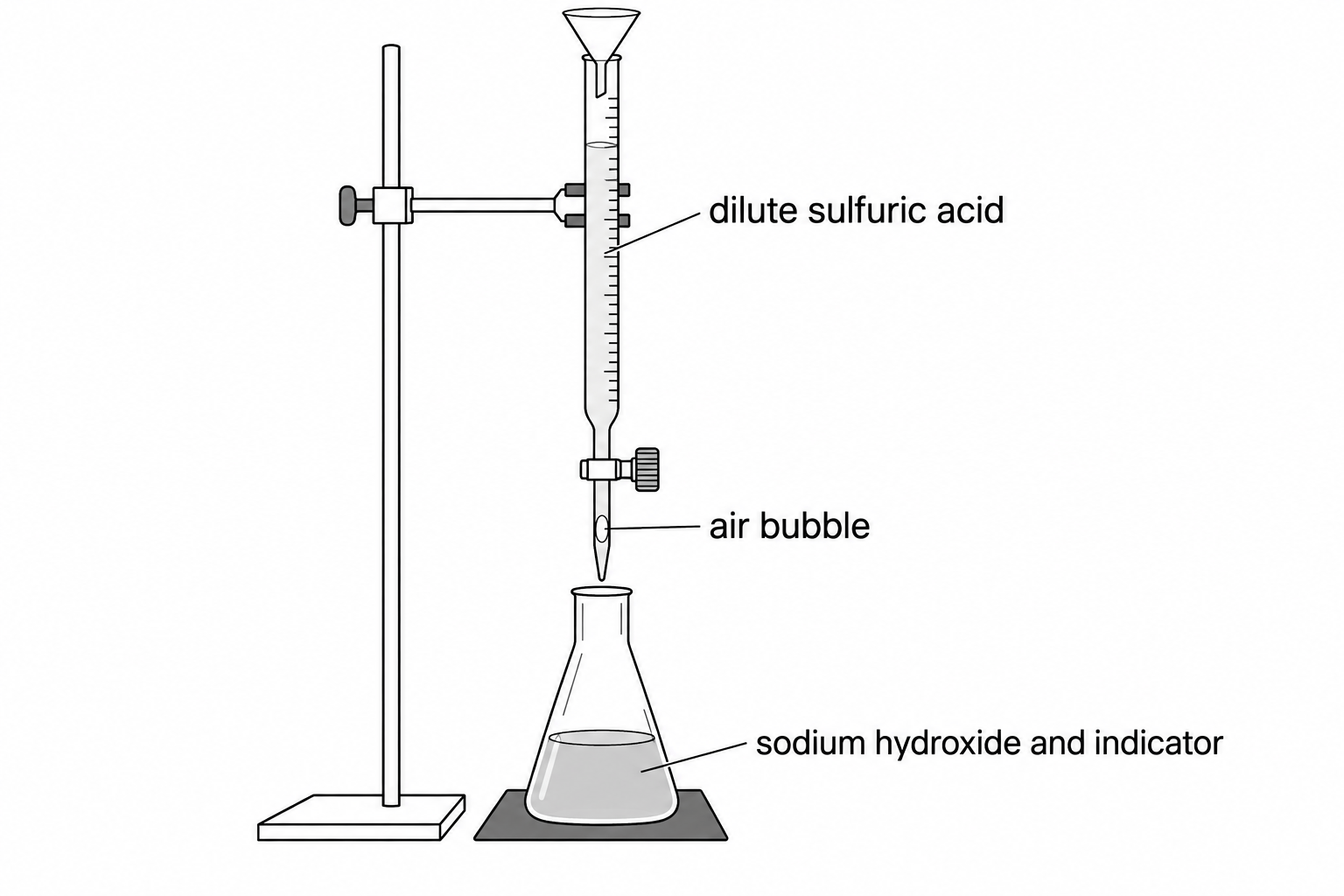
After correcting the setup, the trainee titrates 25.0 cm3 of sodium hydroxide with 0.0800 mol dm−30.0800\,\mathrm{mol\,dm^{-3}}0.0800moldm−3 sulfuric acid. Concordant titres are 18.60 cm3 and 18.70 cm3.
H2SO4+2NaOH→Na2SO4+2H2O\mathrm{H_2SO_4+2NaOH\rightarrow Na_2SO_4+2H_2O}H2SO4+2NaOH→Na2SO4+2H2O
a.[4]
Identify two visible preparation problems in the diagram. For each, state how to correct it and explain how the correction improves the titration.
b.[4]
Calculate the sodium hydroxide concentration in mol dm−3\mathrm{mol\,dm^{-3}}moldm−3. Give your answer to three significant figures.
c.[2]
Suppose the air bubble initially shown disappears during a titration, filling the outlet with acid. Explain whether the calculated sodium hydroxide concentration would be too high or too low if this reading were used without correction.
6.2 Quantitative analysis Questions
51 exam-style questions on Edexcel GCSE Chemistry 6.2 Quantitative analysis, covering 6.2.1 Concentration in mol dm⁻³ and titration calculations, 6.2.2 Percentage yield and why actual yield falls short, 6.2.3 Atom economy of a reaction, 6.2.4 Choosing a reaction pathway, and 6.2.5 Molar volume of gases and Avogadro's law. Each one has a worked solution and a mark scheme showing where the marks go.