10.1.1 Principles of ion tests and flame tests
A test is only useful if its result is unique
- A test identifies an ion by giving a result that no other ion gives.
- A result shared by two ions leaves the answer ambiguous.
- A white precipitate on its own identifies nothing, because several ions give one.
- What makes a test unique is the combination of reagent and observation.
- Where one test cannot separate two ions, a second test is used alongside it.
Uniqueness is the whole point of a test: a result that several ions share is no evidence at all.
A flame test identifies a metal ion by colour
Flame test
A test in which a sample is held in a flame and the colour produced identifies the metal ion present.
- A small sample of the solid is held in a flame and the colour is observed.
- The wire holding the sample is cleaned first, usually by dipping it in acid.
- A clean wire is checked by holding it in the flame until it gives no colour.
- The flame used is a blue Bunsen flame, since a yellow flame would hide the result.
- The colour comes from the metal ion, so the same ion gives the same colour in any compound.
An uncleaned wire carries the previous sample's ion, which gives a false result.
The five flame colours
- Lithium, Li+\text{Li}^{+}Li+, gives a red flame.
- Sodium, Na+\text{Na}^{+}Na+, gives a yellow flame.
- Potassium, K+\text{K}^{+}K+, gives a lilac flame.
- Calcium, Ca2+\text{Ca}^{2+}Ca2+, gives an orange-red flame.
- Copper, Cu2+\text{Cu}^{2+}Cu2+, gives a blue-green flame.
- Red: lithium. Yellow: sodium. Lilac: potassium.
- Orange-red: calcium. Blue-green: copper.
What a flame test cannot do
- Only one ion can be identified at a time, so a mixture gives a confused result.
- Sodium's strong yellow colour masks the paler colours of other ions in the same sample.
- Lithium's red and calcium's orange-red are similar, so they can be confused.
- A flame test says nothing about the negative ion in the compound.
- A full identification therefore needs a separate test for the negative ion.
- Why must the result of a test be unique?
- Why is the wire cleaned before a flame test?
- Give the flame colours for lithium, sodium and potassium.
- Which ion gives a blue-green flame?
- Give one limitation of a flame test.
10.1.2 Tests for cations and for ammonia
Sodium hydroxide solution precipitates metal hydroxides
Precipitate
An insoluble solid that forms when two solutions are mixed.
- Sodium hydroxide solution is added to a solution of the unknown salt.
- The hydroxide ions react with the metal ion to form an insoluble hydroxide.
- That insoluble solid appears as a precipitate.
- The colour of the precipitate is what identifies the metal ion.
- Adding sodium hydroxide in excess gives a second piece of evidence.
Two observations are available: the colour of the precipitate, and whether it dissolves in excess.
The coloured precipitates
- Copper, Cu2+\text{Cu}^{2+}Cu2+, gives a blue precipitate.
- Iron(II), Fe2+\text{Fe}^{2+}Fe2+, gives a green precipitate.
- Iron(III), Fe3+\text{Fe}^{3+}Fe3+, gives a brown precipitate.
- The reaction for copper is: Cu2+(aq)+2OH−(aq)→Cu(OH)2(s)\text{Cu}^{2+}(aq) + 2\text{OH}^{-}(aq) \rightarrow \text{Cu(OH)}_2(s)Cu2+(aq)+2OH−(aq)→Cu(OH)2(s)
- None of these three dissolves when more sodium hydroxide is added.
- Blue: copper. Green: iron(II). Brown: iron(III).
- Iron's two ions are told apart by colour alone, which is why the charge matters.
The two white precipitates are told apart by excess
- Aluminium, Al3+\text{Al}^{3+}Al3+, gives a white precipitate.
- Calcium, Ca2+\text{Ca}^{2+}Ca2+, also gives a white precipitate.
- Adding excess sodium hydroxide separates them.
- The aluminium precipitate dissolves in excess, giving a colourless solution.
- The calcium precipitate does not dissolve, however much is added.
Stopping at the first white precipitate leaves the two ions indistinguishable.
The ammonium ion gives off ammonia
- Sodium hydroxide solution is added to the sample and the mixture is warmed gently.
- The ammonium ion, NH4+\text{NH}_4^{+}NH4+, releases ammonia gas.
- The reaction is: NH4++OH−→NH3+H2O\text{NH}_4^{+} + \text{OH}^{-} \rightarrow \text{NH}_3 + \text{H}_2\text{O}NH4++OH−→NH3+H2O
- No precipitate forms, since the ammonium ion is not a metal ion.
- The gas is then identified by the test for ammonia.
Warming is needed to drive the gas off, so a cold mixture may give no result.
The chemical test for ammonia
- Damp red litmus paper is held at the mouth of the tube.
- Ammonia is alkaline in solution, so it turns the paper blue.
- The paper must be damp, because the gas has to dissolve before it can act.
- Ammonia also has a sharp, choking smell, though smell alone is not the test.
- A blue result confirms the ammonium ion was present in the original sample.
- What two observations does a sodium hydroxide test give?
- Give the precipitate colours for copper, iron(II) and iron(III).
- How are aluminium and calcium told apart?
- Why does the ammonium ion give no precipitate?
- Describe the chemical test for ammonia.
10.1.3 Tests for anions
Carbonates give off carbon dioxide with dilute acid
- Dilute acid is added to the solid or to its solution.
- A carbonate fizzes, because a gas is being released.
- The reaction releases carbon dioxide: carbonate+acid→salt+water+carbon dioxide\text{carbonate} + \text{acid} \rightarrow \text{salt} + \text{water} + \text{carbon dioxide}carbonate+acid→salt+water+carbon dioxide
- The gas is passed through limewater, which turns milky.
- Fizzing alone is not enough, since the gas has to be identified as well.
Two steps make the test unique: the effervescence, then the limewater result.
Sulfates give a white precipitate with barium chloride
- Dilute hydrochloric acid is added to the solution first.
- Barium chloride solution is then added.
- A white precipitate of barium sulfate shows a sulfate ion is present.
- The precipitate forms as: Ba2+(aq)+SO42−(aq)→BaSO4(s)\text{Ba}^{2+}(aq) + \text{SO}_4^{2-}(aq) \rightarrow \text{BaSO}_4(s)Ba2+(aq)+SO42−(aq)→BaSO4(s)
- The acid is added first to remove any carbonate, which would also precipitate.
Leaving out the acid risks a false positive, because barium carbonate is white too.
Halides give coloured precipitates with silver nitrate
Halide ion
The negative ion formed when a halogen atom gains one electron.
- Dilute nitric acid is added to the solution first.
- Silver nitrate solution is then added.
- A chloride gives a white precipitate.
- A bromide gives a cream precipitate.
- An iodide gives a yellow precipitate.
- White: chloride. Cream: bromide. Yellow: iodide.
- The three colours run from white through cream to yellow, deepening down the group.
Why the acid comes first
- A carbonate in the sample would give a precipitate with silver or barium ions.
- That precipitate would be mistaken for a positive halide or sulfate result.
- Adding acid first destroys any carbonate, releasing it as carbon dioxide.
- Nitric acid is used before silver nitrate, so that no chloride is introduced.
- Hydrochloric acid is used before barium chloride, for the same kind of reason.
Matching the acid to the reagent avoids adding the very ion being tested for.
- Describe the full test for a carbonate ion.
- Which two reagents identify a sulfate ion?
- Give the precipitate colours for chloride, bromide and iodide.
- Why is acid added before the silver nitrate?
- Why is nitric acid rather than hydrochloric acid used in the halide test?
10.1.4 Identification of ions in unknown salts
An unknown salt needs both of its ions identified
- Every salt contains a positive ion and a negative ion.
- Naming the salt means identifying both, not just one.
- The tests are chosen so that each gives a unique result.
- Results are recorded as observations first, then interpreted.
- The name of the salt is the conclusion, put together at the end.
The two halves of the answer are found by separate tests and combined afterwards.
A workable order for the tests
- Start with a flame test on the solid, which points to the metal ion.
- Dissolve a fresh sample and add sodium hydroxide solution, then add it in excess.
- Those two together usually settle the positive ion.
- For the negative ion, add dilute acid first to check for a carbonate.
- Then test a fresh portion with barium chloride or with silver nitrate as appropriate.
- Flame tests: clean the wire in dilute hydrochloric acid and hold it in a blue flame until it gives no colour, then dip it in the solid and return it to the edge of the flame.
- Cation tests: add sodium hydroxide solution to the solution of the salt a little at a time, noting the colour of any precipitate, then continue to excess to see whether it dissolves.
- Ammonium: warm the mixture gently and hold damp red litmus paper at the mouth of the tube.
- Sulfate: add dilute hydrochloric acid first, then barium chloride solution, and a white precipitate confirms a sulfate.
- Halides: add dilute nitric acid first, then silver nitrate solution, and white, cream or yellow identifies chloride, bromide or iodide.
- A fresh portion is used for every test, and the acid always goes in before the barium chloride or the silver nitrate.
- Avoid contamination: use clean apparatus and a fresh sample every time, since a trace of the previous test ruins the next.
Combining the results
- Each observation narrows the possibilities rather than giving the answer outright.
- A white precipitate with sodium hydroxide leaves two candidates until excess is added.
- A result that rules an ion out is as useful as one that rules it in.
- The two ions are then written together with the correct charges.
- The formula follows once the charges are balanced.
- Lilac flame, white precipitate with silver nitrate: potassium chloride.
- Green precipitate with sodium hydroxide, fizzing with acid: iron(II) carbonate.
- No precipitate but ammonia on warming, white precipitate with barium chloride: ammonium sulfate.
Where an identification goes wrong
- A contaminated wire or tube carries an ion from the previous test.
- Skipping the excess step leaves aluminium and calcium unseparated.
- Skipping the acid step lets a carbonate give a false precipitate.
- Reading a colour in poor light, or against a coloured background, misleads.
- Stating a conclusion without the observation behind it leaves the answer unsupported.
- Why must both ions in a salt be identified?
- What order of tests would you use on an unknown solid?
- A sample gives a lilac flame and a yellow precipitate with silver nitrate. Name the salt.
- Why is a fresh portion used for each test?
- Give two mistakes that lead to a wrong identification.
10.1.5 Instrumental methods of analysis
Instrumental methods do the same job with a machine
- Chemical tests rely on an observation made by a person.
- An instrumental method takes the same measurement with a machine.
- Machines improve the sensitivity, so a far smaller amount can be detected.
- They improve the accuracy, so the result is closer to the true value.
- They improve the speed, so many samples can be analysed in the time one test takes.
The three advantages are sensitivity, accuracy and speed, and each answers a different weakness.
Why those three advantages matter
- A trace of an ion too small to colour a flame can still be detected by an instrument.
- A judgement between lilac and red depends on the observer, while a machine reads a number.
- A laboratory testing hundreds of samples needs the throughput a machine gives.
- An instrument also gives a numerical result, which a colour never does.
- Against that, instruments are expensive and need trained operators.
Chemical tests remain useful because they are cheap and need no specialised equipment.
A flame photometer measures the light from a flame
- The sample is put into a flame, as in a flame test.
- The instrument measures the light the flame gives out.
- The pattern of light is compared with reference data to identify the metal ion.
- The intensity of the light depends on how much of the ion is present.
- No knowledge of how the instrument works is needed to use its output.
- Identification: compare the measured pattern with reference data for known ions.
- Concentration: read the intensity against a calibration curve.
Using a calibration curve
Calibration curve
A graph of a measured quantity against known concentrations, used to find the concentration of an unknown solution.
- Solutions of known concentration are measured first.
- Their readings are plotted against concentration to give a curve.
- The unknown solution is then measured in the same instrument.
- Its reading is found on the vertical axis and traced across to the curve, then down to the concentration.
- A reading beyond the range of the curve cannot be read off, so the sample is diluted first.
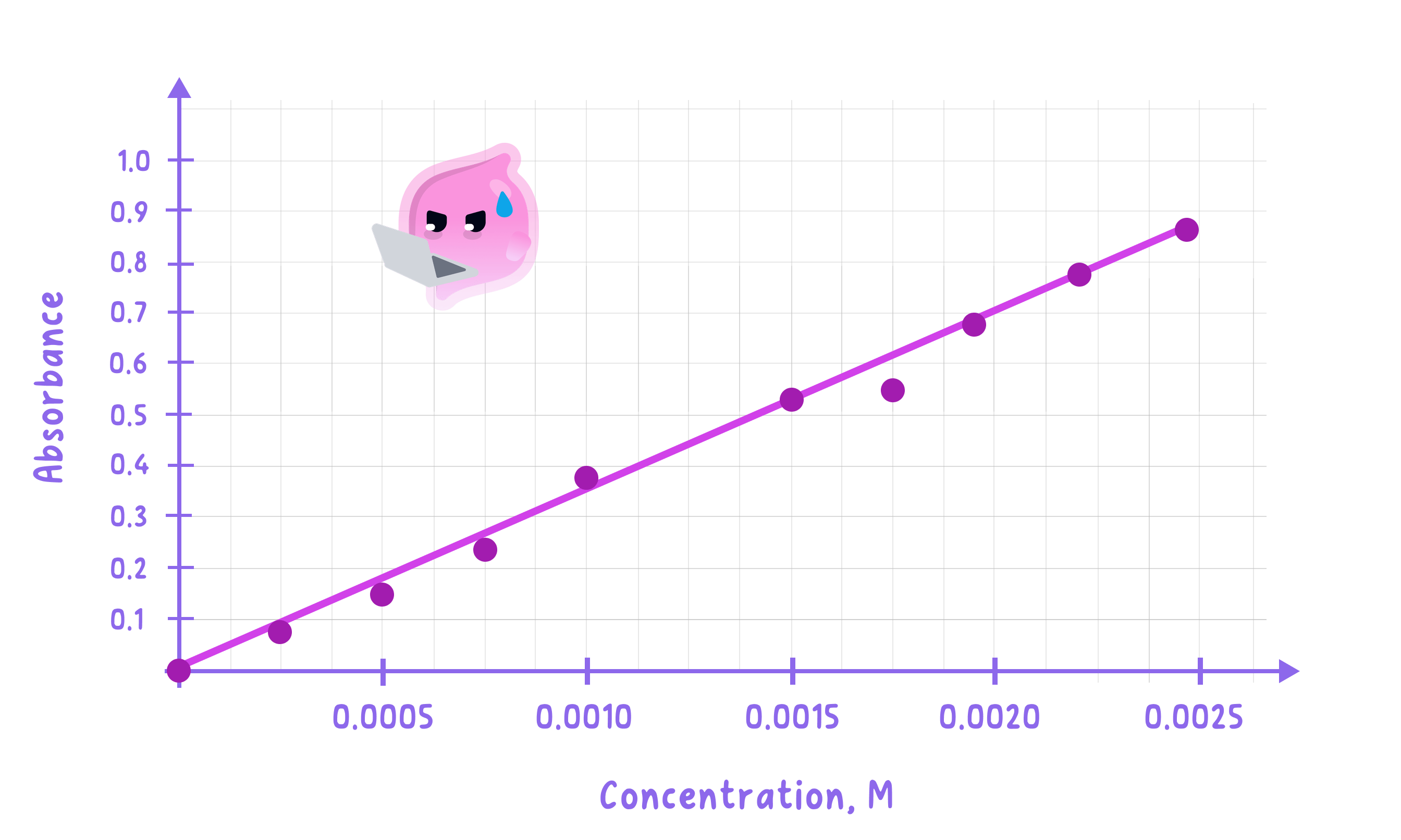
- Reading a calibration curve means going across then down, and saying so in the answer.
- An identification quotes the reference data it was compared against.
- A concentration answer carries its unit, taken from the axis of the curve.
- Give three ways instrumental methods improve on chemical tests.
- Give one advantage a chemical test still has.
- How is a metal ion identified using a flame photometer?
- How is a calibration curve produced?
- What do you do if a reading falls beyond the range of the curve?
