10.3.1 Addition polymerisation of alkenes
A polymer is built from many small repeating units
Polymer
A very large molecule formed when many small molecules join together in a repeating pattern.
Monomer
A small molecule that joins to others of its kind to form a polymer.
Repeating unit
The small group of atoms that repeats along the chain of a polymer.
- A polymer has a very high average relative molecular mass.
- It is built from many small units joined into a long chain.
- The small molecules that join together are the monomers.
- The section that repeats along the chain is the repeating unit.
- The chains in a sample are not all the same length, which is why the mass is an average.
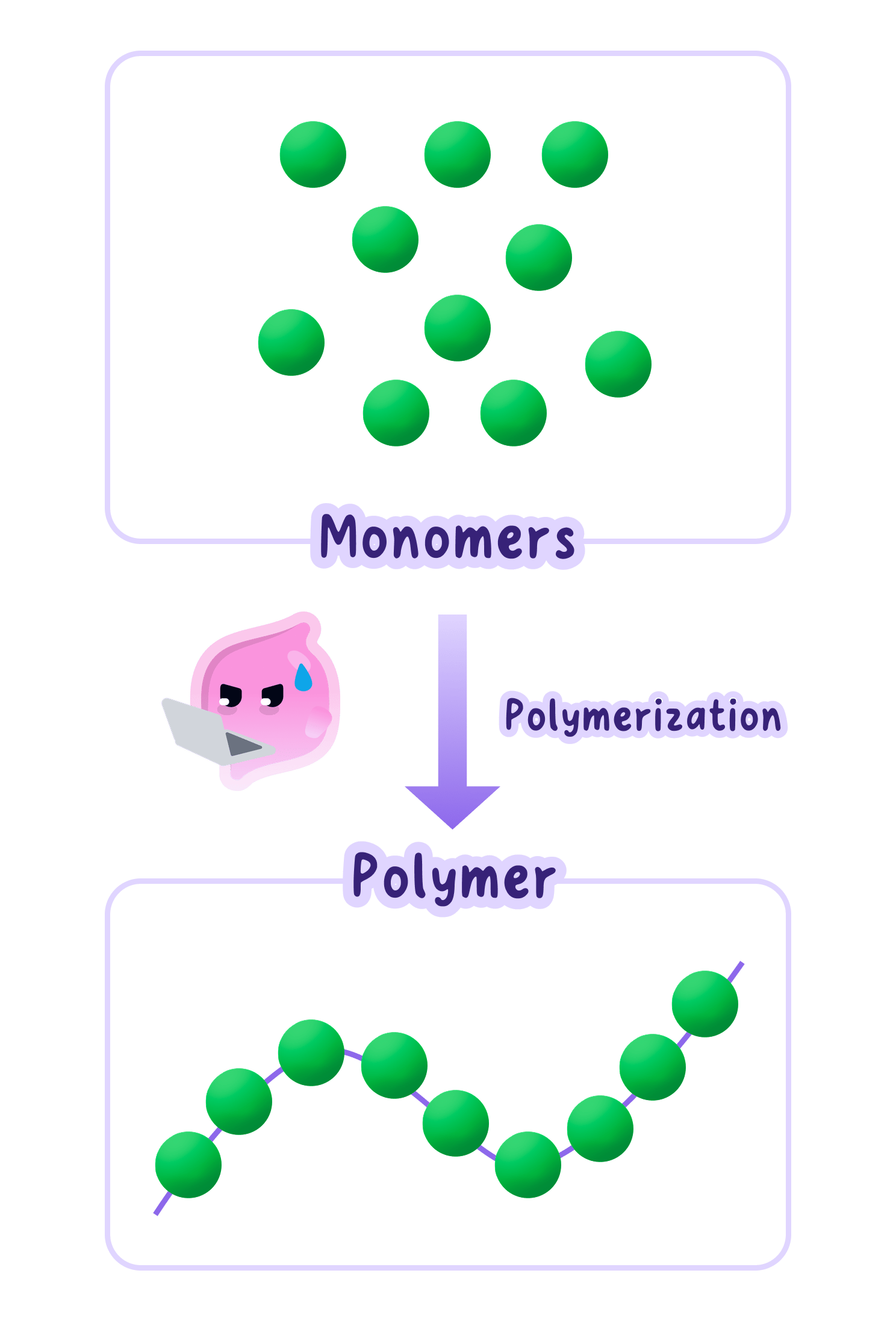
Monomer and repeating unit contain the same atoms, differing only in the bonds at each end.
Ethene molecules join to form poly(ethene)
Addition polymer
A polymer formed when many monomers containing a carbon to carbon double bond join together, with no other product formed.
- Many ethene molecules are brought together under pressure.
- The double bond in each molecule opens.
- The opened molecules join to one another end to end, forming a long chain.
- The polymer formed is poly(ethene).
- Nothing else is produced, which is what makes this an addition polymerisation.
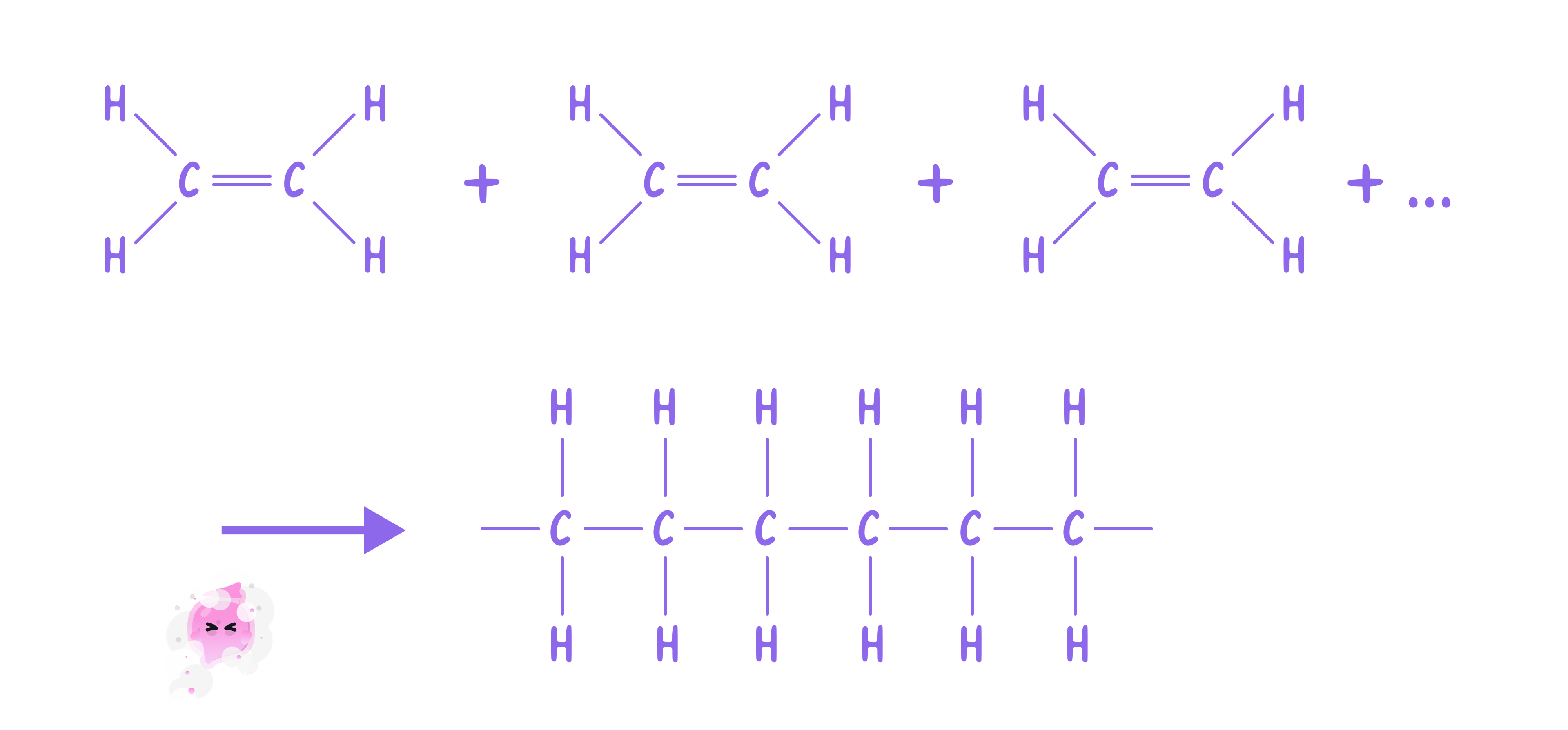
The conditions and the mechanism of the reaction are not part of this course.
Other monomers give other addition polymers
- Any monomer containing a carbon to carbon double bond can polymerise this way.
- Propene gives poly(propene).
- Chloroethene gives poly(chloroethene), known as PVC.
- Tetrafluoroethene gives poly(tetrafluoroethene), known as PTFE.
- The polymer is named by putting the monomer's name in brackets after poly.
- Ethene to poly(ethene). Propene to poly(propene).
- Chloroethene to PVC. Tetrafluoroethene to PTFE.
Deducing a monomer from a polymer
- Take one repeating unit from the chain shown.
- Remove the bonds that extend out of each end of that unit.
- Join the two end carbons with a double bond instead.
- The molecule that results is the monomer.
- Working the other way, open the monomer's double bond and draw bonds extending from each end.
- A repeating unit is drawn with a bond extending from each end, showing the chain continues.
- The monomer has a double bond where the repeating unit has a single one.
- Counting the atoms is a check: monomer and repeating unit must match.
- What is a monomer?
- Explain what happens to ethene molecules during polymerisation.
- Why is this called addition polymerisation?
- Name the polymers formed from propene and from chloroethene.
- How do you deduce the monomer from the structure of an addition polymer?
10.3.2 Uses and properties of polymers
The properties of a polymer decide its uses
- A polymer is chosen for a job because of what it does, not what it is made from.
- Flexibility, strength, rigidity and resistance to chemicals all matter.
- Whether it is a good electrical insulator decides some uses on its own.
- Behaviour when heated matters wherever the object gets warm.
- Explaining a use means naming the property and the demand it meets.
The reasoning runs both ways: a property explains a use, and a use implies the property needed.
Poly(ethene) and poly(propene)
- Poly(ethene) is flexible, cheap and easily moulded.
- It is used for plastic bags, bottles and food wrapping.
- Poly(propene) is tougher and keeps its shape better.
- It is used for crates, ropes and containers that must take a knock.
- Both are unreactive, so neither contaminates the food it holds.
- Carrier bag: poly(ethene), because it is flexible and cheap.
- Storage crate: poly(propene), because it is rigid and hard-wearing.
PVC and PTFE
- PVC is rigid and durable, and it resists weather well.
- It is used for drainpipes and window frames.
- PVC is also a good electrical insulator, so it covers electrical cable.
- PTFE is very unreactive and has a very slippery surface.
- It is used as a non-stick coating on pans and as a tape for sealing joints.
PVC can be made flexible by adding other substances to it, which is why cable covering bends.
Matching a polymer to a new job
- Start from the demands the job makes on the material.
- A job needing flexibility and low cost points to poly(ethene).
- A job needing rigidity outdoors points to PVC.
- A job needing a surface nothing sticks to points to PTFE.
- A sound answer names the polymer and the property that makes it suitable.
- Give a use of poly(ethene) and the property that suits it.
- Why is poly(propene) used for crates rather than poly(ethene)?
- Give two uses of PVC and the property behind each.
- What property makes PTFE suitable as a non-stick coating?
- Which polymer would you choose for a window frame, and why?
10.3.3 Condensation polymers and polyesters
A condensation polymer releases a small molecule
Condensation polymer
A polymer formed when monomers join and a small molecule, usually water, is released each time a link forms.
- The monomers join together to form a long chain, as in any polymerisation.
- Each time two monomers join, a small molecule is released.
- That small molecule is usually water.
- This is what distinguishes condensation from addition polymerisation.
- An addition polymerisation releases nothing, so all the atoms end up in the polymer.
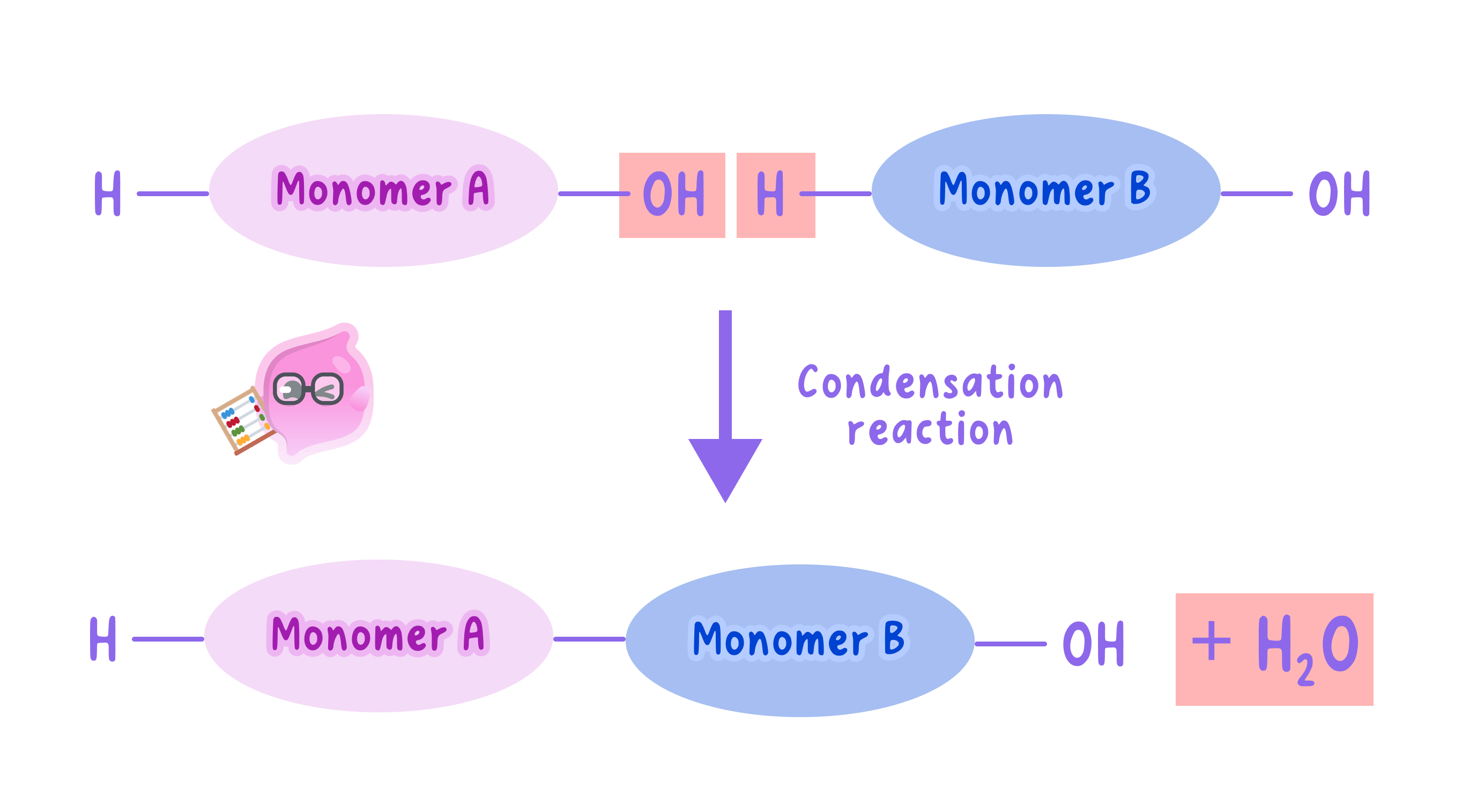
One product or two: addition gives only the polymer, condensation gives the polymer and water.
Each monomer needs two functional groups
Functional group
The group of atoms in a molecule that gives a homologous series its characteristic reactions.
- A monomer must be able to join at both ends to build a chain.
- It therefore carries a functional group at each end.
- One monomer has two carboxylic acid groups, −COOH-\text{COOH}−COOH.
- The other has two alcohol groups, −OH-\text{OH}−OH.
- A monomer with only one group would stop the chain after one join.
Two groups per monomer is what makes a chain possible rather than a single pair.
An ester link forms and water is lost
Ester link
The group of atoms joining two monomers in a polyester, formed when a carboxylic acid group reacts with an alcohol group.
- A carboxylic acid group on one monomer meets an alcohol group on the other.
- The two react and join the monomers together.
- The join formed is called an ester link.
- A molecule of water is released each time a link forms: −COOH+HO−→−COO−+H2O-\text{COOH} + \text{HO}- \rightarrow -\text{COO}- + \text{H}_2\text{O}−COOH+HO−→−COO−+H2O
- The water comes from the −OH-\text{OH}−OH of the acid and a hydrogen from the alcohol.
- One link: one molecule of water released.
- A hundred links: a hundred molecules of water released.
The polymer formed is a polyester
Polyester
A condensation polymer whose monomers are joined by ester links.
- A chain held together by ester links is a polyester.
- The two monomers alternate along the chain, acid then alcohol.
- Each monomer's second group is free to react with the next monomer along.
- The chain grows as long as monomers remain to be added.
- Polyesters are used as fibres for clothing and as plastic bottles.
- An explanation names the two groups, the link formed, and the water released.
- Saying that water is lost each time a link forms is what shows the process is condensation.
- A monomer is drawn with its group at both ends, or the chain cannot grow.
- What makes a polymerisation a condensation rather than an addition?
- Why must each monomer carry two functional groups?
- Which two functional groups react to form a polyester?
- What is the name of the link formed?
- How many molecules of water are released when fifty links form?
10.3.4 Problems with polymers and recycling
The starting materials come from crude oil
- Most polymers are made from alkenes such as ethene and propene.
- Those alkenes come from cracking the heavier fractions of crude oil.
- Crude oil is finite, so the supply of starting material is limited.
- Demand for polymers competes with demand for fuels from the same oil.
- As oil becomes scarcer, the cost of making polymers rises.
Every problem with polymers traces back either to the starting material or to what happens at disposal.
Polymers persist in landfill
Biodegradable
Describes a material that can be broken down by microorganisms.
- Most polymers are not biodegradable, so microorganisms cannot break them down.
- A polymer buried in landfill therefore persists for a very long time.
- Landfill sites fill up, and new sites take up land.
- Polymers that reach rivers and the sea remain there, harming wildlife.
- The unreactivity that makes a polymer useful is what makes it persist.
The very property that makes a polymer good for food packaging is what makes it a disposal problem.
Burning polymers releases harmful gases
- Burning a polymer releases carbon dioxide, which is a greenhouse gas.
- Incomplete combustion releases carbon monoxide, which is toxic.
- Burning PVC releases hydrogen chloride, which is acidic and corrosive.
- Those gases must be removed from the exhaust before it reaches the air.
- Burning does at least release energy that can be used, and it takes up no land.
Burning is not simply the worst option: it recovers energy and avoids landfill.
Recycling requires sorting
- Different polymers must be melted separately to be reused.
- A mixture of polymers gives a material of poor quality.
- Sorting is therefore needed before anything can be reformed.
- Sorting by hand is slow and costly, and automatic sorting needs expensive equipment.
- Items are often labelled with a code to make sorting possible.
- Sorted by type: melted and reformed into a new product of usable quality.
- Mixed together: the result is weak and fit only for low-grade uses.
Weighing the case for recycling
- Recycling saves crude oil, since less new polymer has to be made.
- It uses less energy than making the polymer from oil.
- It reduces landfill and the litter that escapes from it.
- Against that, collecting and sorting cost money and energy of their own.
- A recycled polymer is often of lower quality, so it cannot always replace new material.
- Where do the starting materials for most polymers come from?
- Why do polymers persist in landfill sites?
- Name a harmful gas released when PVC is burned.
- Why must polymers be sorted before recycling?
- Give one advantage and one disadvantage of recycling polymers.
10.3.5 Natural polymers: DNA, starch and proteins
Natural polymers are built the same way
Polymer
A very large molecule formed when many small molecules join together in a repeating pattern.
Monomer
A small molecule that joins to others of its kind to form a polymer.
- A natural polymer is made by a living organism rather than in a factory.
- It is still a long chain built from many small monomers.
- The chains are still long enough to give a high relative molecular mass.
- Three natural polymers matter here: DNA, starch and proteins.
- Each is named by the kind of monomer it is built from.
Natural and synthetic polymers differ in origin, not in how they are put together.
DNA is made from nucleotides
- DNA is the polymer that carries genetic information.
- Its monomers are called nucleotides.
- There are four different nucleotides in DNA.
- The order in which they are joined is what stores the information.
- The names of the individual nucleotides are not needed here.
Four monomers in any order along a very long chain gives an enormous number of possibilities.
Starch is a polymer of sugars
- Starch is made by plants as a store of energy.
- Its monomers are sugars.
- Many sugar molecules join into long chains to make the starch.
- Breaking starch back down releases the sugar for the organism to use.
- Starch is a natural polymer, so it is biodegradable, unlike most synthetic ones.
- DNA: built from four different nucleotides.
- Starch: built from sugars.
- Protein: built from amino acids.
Proteins are polymers of amino acids
- A protein is built from monomers called amino acids.
- Many amino acids join into a chain to make the protein.
- Different proteins contain different amino acids in a different order.
- That order is what gives each protein its own job in the organism.
- Enzymes are proteins, which is how a catalyst can be built this way.
- What is a natural polymer?
- What are the monomers of DNA, and how many kinds are there?
- What is starch a polymer of?
- What are the monomers of a protein?
- Give an example of a protein with a chemical role.
