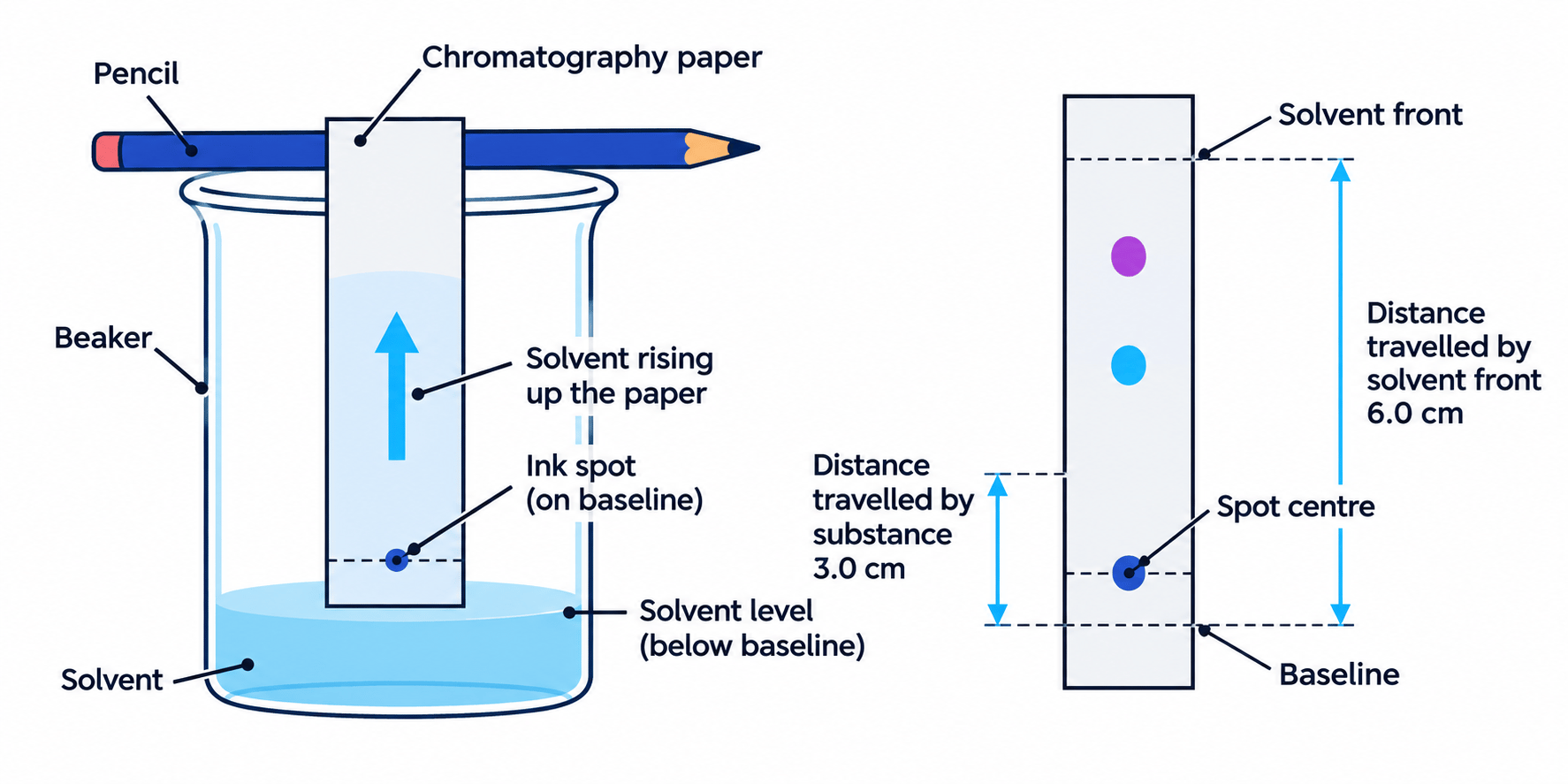
The solvent moves and the paper stays still
Definition
Mobile phase
The solvent that moves through the paper in chromatography, carrying the dissolved substances with it.
Definition
Stationary phase
The paper in chromatography, which stays in place while the solvent moves through it.
- In paper chromatography the paper is the stationary phase and the solvent is the mobile phase.
- A pencil baseline is drawn near the bottom, because pencil will not dissolve and run.
- A small spot of the mixture is placed on that baseline.
- The paper stands in solvent kept below the baseline, so the spot is not washed off into the solvent.
- The solvent rises through the paper and carries the dissolved substances with it.
- A substance that is more soluble in the solvent, and held less strongly by the paper, travels further.
- The furthest point the solvent reaches is the solvent front, marked before the paper dries.
Key Idea
- Two attractions compete: solubility in the moving solvent carries a substance up, and attraction to the paper holds it back.
- That balance differs for every substance, which is why they end up in different places.
Reading a chromatogram
Definition
Chromatogram
The pattern of spots produced on the paper once the substances in a mixture have separated.
- Each separated substance shows up as its own spot.
- A sample giving one spot is consistent with a pure substance.
- A sample giving more than one spot has to be a mixture.
- One spot is not proof of purity, because two substances can happen to travel the same distance.
- Running known substances alongside the unknown on the same paper allows the positions to be compared.
- A spot level with a known suggests that the unknown contains that substance.
- Every comparison needs the same paper, the same solvent and the same conditions.
Common Mistake
- Count only the separated spots, never the original mark on the baseline.
- Matching positions suggests rather than proves, so an RfR_fRf comparison strengthens the conclusion.
RfR_fRf values put a number on how far a substance travels
Definition
Rf value
The distance travelled by a substance divided by the distance travelled by the solvent front, a ratio with no unit and a value between 0 and 1.
- Measure from the baseline to the centre of the spot.
- Measure from the baseline to the solvent front.
- Divide the first distance by the second: Rf=distance travelled by the substancedistance travelled by the solvent frontR_f = \frac{\text{distance travelled by the substance}}{\text{distance travelled by the solvent front}}Rf=distance travelled by the solvent frontdistance travelled by the substance
- Both distances are in the same unit, so RfR_fRf carries no unit.
- RfR_fRf always lies between 000 and 111, because nothing travels further than the solvent itself.
- A spot 3.0 cm3.0\ \text{cm}3.0 cm from the baseline with the solvent front at 6.0 cm6.0\ \text{cm}6.0 cm gives Rf=3.0÷6.0=0.50R_f = 3.0 \div 6.0 = 0.50Rf=3.0÷6.0=0.50.
Example
- Measuring: baseline to spot centre 3.0 cm3.0\ \text{cm}3.0 cm, baseline to solvent front 6.0 cm6.0\ \text{cm}6.0 cm.
- Calculating: Rf=3.06.0=0.50R_f = \dfrac{3.0}{6.0} = 0.50Rf=6.03.0=0.50, a number with no unit.
Practical
- Method: simple distillation separates the solvent from the ink, and paper chromatography then separates the coloured solutes from one another.
- Result: the chromatogram shows how many different dyes the ink contains.
- Identifying a dye means comparing its spot, or its RfR_fRf value, with a known dye run alongside it.
- Fair comparison: the solvent and the paper are kept the same across every run.
- An RfR_fRf value only compares with one measured in the same solvent on the same kind of paper.
Drawing a conclusion from a chromatogram
- Count the spots to decide between a pure substance and a mixture.
- Compare the spot positions with the knowns run alongside.
- Calculate RfR_fRf for each spot where the question asks for it.
- Match each value against the RfR_fRf values of the known substances.
- Quote the evidence, which is the number of spots and the values that match.
Exam technique
- An RfR_fRf above 111 means the two distances went into the calculation the wrong way round.
- Measuring to the centre of the spot, rather than its top or bottom edge, is what makes the value reproducible.
- Naming the solvent matters, because the same substance gives a different RfR_fRf in a different solvent.
Self review
- What is the job of the mobile phase in paper chromatography?
- What does a chromatogram with three spots tell you about the sample?
- Why must the solvent level start below the baseline?
- How is an RfR_fRf value calculated?
- Why must the paper, solvent and conditions match when comparing chromatograms?