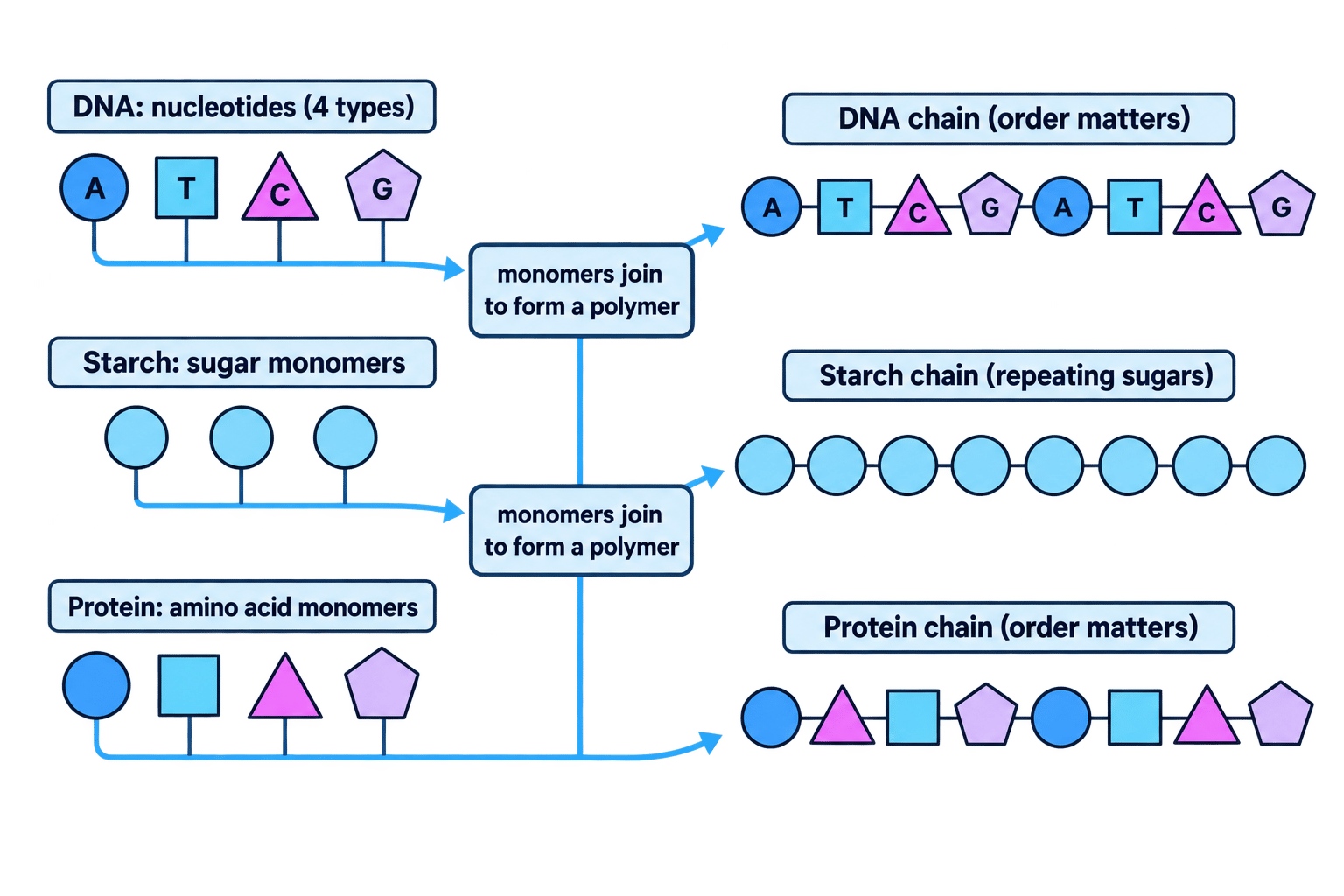
Natural polymers are built the same way
Definition
Polymer
A very large molecule formed when many small molecules join together in a repeating pattern.
Definition
Monomer
A small molecule that joins to others of its kind to form a polymer.
- A natural polymer is made by a living organism rather than in a factory.
- It is still a long chain built from many small monomers.
- The chains are still long enough to give a high relative molecular mass.
- Three natural polymers matter here: DNA, starch and proteins.
- Each is named by the kind of monomer it is built from.
Key Idea
Natural and synthetic polymers differ in origin, not in how they are put together.
DNA is made from nucleotides
- DNA is the polymer that carries genetic information.
- Its monomers are called nucleotides.
- There are four different nucleotides in DNA.
- The order in which they are joined is what stores the information.
- The names of the individual nucleotides are not needed here.
Note
Four monomers in any order along a very long chain gives an enormous number of possibilities.
Starch is a polymer of sugars
- Starch is made by plants as a store of energy.
- Its monomers are sugars.
- Many sugar molecules join into long chains to make the starch.
- Breaking starch back down releases the sugar for the organism to use.
- Starch is a natural polymer, so it is biodegradable, unlike most synthetic ones.
Example
- DNA: built from four different nucleotides.
- Starch: built from sugars.
- Protein: built from amino acids.
Proteins are polymers of amino acids
- A protein is built from monomers called amino acids.
- Many amino acids join into a chain to make the protein.
- Different proteins contain different amino acids in a different order.
- That order is what gives each protein its own job in the organism.
- Enzymes are proteins, which is how a catalyst can be built this way.
Self review
- What is a natural polymer?
- What are the monomers of DNA, and how many kinds are there?
- What is starch a polymer of?
- What are the monomers of a protein?
- Give an example of a protein with a chemical role.