One mole of any gas occupies the same volume
Definition
Molar volume
The volume occupied by one mole of any gas, which is 24 dm³ at room temperature and pressure.
Definition
Mole
The amount of a substance that contains the Avogadro constant of particles, and which has a mass in grams equal to its relative particle mass.
- At room temperature and pressure, one mole of molecules of any gas occupies the same volume.
- That volume is 24 dm324\ \text{dm}^324 dm3, which is the same as 24 000 cm324\,000\ \text{cm}^324000 cm3.
- Room temperature and pressure means about 20 ∘C20\ ^{\circ}\text{C}20 ∘C and normal atmospheric pressure.
- The identity of the gas makes no difference, so a mole of hydrogen and a mole of carbon dioxide fill the same space.
- For a gas such as helium the particles are single atoms, and a mole of them occupies 24 dm324\ \text{dm}^324 dm3 as well.
Key Idea
Gas particles are so far apart that the size of the particle makes no difference to the volume.
Converting between amount and volume of gas
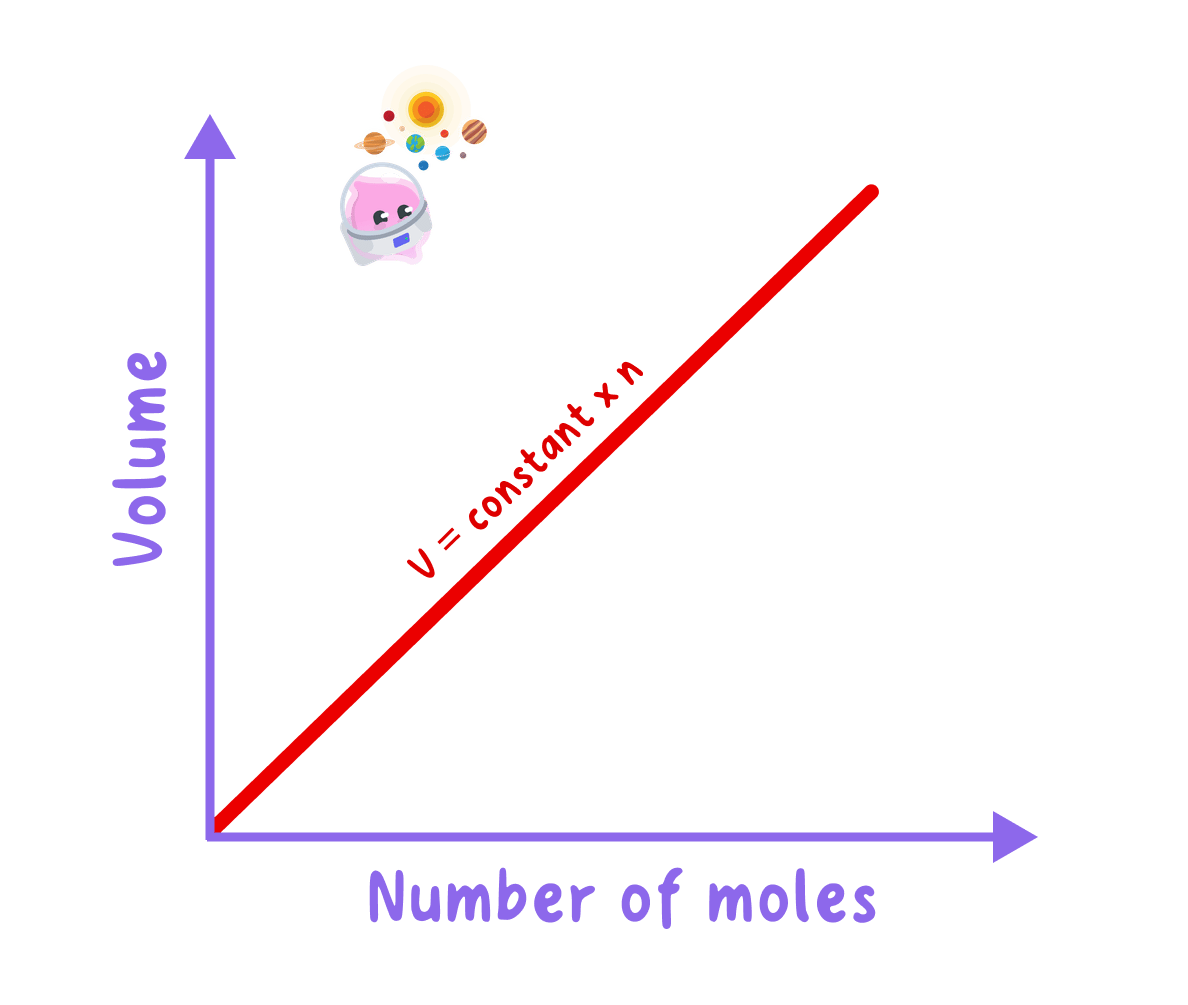
- The volume occupied by a known amount of gas is: volume in dm3=amount in mol×24\text{volume in dm}^3 = \text{amount in mol} \times 24volume in dm3=amount in mol×24
- Rearranged to give the amount from a measured volume: amount in mol=volume in dm324\text{amount in mol} = \frac{\text{volume in dm}^3}{24}amount in mol=24volume in dm3
- A volume in cm3\text{cm}^3cm3 is divided by 24 00024\,00024000 instead, or converted to dm3\text{dm}^3dm3 first.
- The amount scales the volume directly, so 0.5 mol0.5\ \text{mol}0.5 mol fills 12 dm312\ \text{dm}^312 dm3 and 2 mol2\ \text{mol}2 mol fills 48 dm348\ \text{dm}^348 dm3.
- The figure 24 dm324\ \text{dm}^324 dm3 is given whenever a calculation needs it.
Common Mistake
The molar volume applies to gases only, never to a solid or a liquid.
Linking the mass of a solid to the volume of a gas
Definition
Relative formula mass
The sum of the relative atomic masses of all the atoms shown in the formula of a substance, given the symbol Mr.
- A mass of solid is converted to an amount by dividing by its relative formula mass.
- The balancing numbers in the equation convert that amount into the amount of gas.
- Multiplying the amount of gas by 242424 gives its volume in dm3\text{dm}^3dm3.
- Heating 10 g10\ \text{g}10 g of calcium carbonate, of MrM_rMr 100100100, gives: n(CaCO3)=10100=0.10 moln(\text{CaCO}_3) = \frac{10}{100} = 0.10\ \text{mol}n(CaCO3)=10010=0.10 mol
- The equation is one to one, so the volume of carbon dioxide is: 0.10×24=2.4 dm30.10 \times 24 = 2.4\ \text{dm}^30.10×24=2.4 dm3
Example
- Mass to volume: divide by MrM_rMr, apply the ratio, multiply by 242424.
- Volume to mass: divide by 242424, apply the ratio, multiply by MrM_rMr.
Avogadro's law relates volumes of gases directly
Definition
Avogadro's law
The rule that equal volumes of gases at the same temperature and pressure contain equal numbers of particles.
- Equal volumes of gases at the same temperature and pressure hold equal numbers of particles.
- The ratio of volumes of reacting gases is therefore the ratio of the balancing numbers.
- No relative formula masses are needed, so the volumes are compared directly.
- In the formation of hydrogen chloride the balancing numbers are one, one and two: H2(g)+Cl2(g)→2HCl(g)\text{H}_2(\text{g}) + \text{Cl}_2(\text{g}) \rightarrow 2\text{HCl}(\text{g})H2(g)+Cl2(g)→2HCl(g)
- 30 cm330\ \text{cm}^330 cm3 of hydrogen therefore reacts with 30 cm330\ \text{cm}^330 cm3 of chlorine to give 60 cm360\ \text{cm}^360 cm3 of hydrogen chloride.
Note
- Avogadro's law applies only to the gases in an equation, so a solid or liquid reactant is ignored.
- The volumes all have to be measured at the same temperature and pressure.
- A reversible reaction gives only the ratio the equation allows, never the volumes an equilibrium mixture actually holds.
Common slips in gas calculations
- Dividing by 242424 when the volume is in cm3\text{cm}^3cm3 makes the answer a thousand times too large.
- Applying the molar volume to a solid or liquid gives a meaningless figure.
- Skipping the ratio from the equation is the most frequent error in a mass to volume question.
- Applying the volume ratio to a solid or liquid in the equation is the error, since only the gases have a volume to compare.
- Checking that the final unit is dm3\text{dm}^3dm3 or cm3\text{cm}^3cm3 catches most of these.
Self review
- What volume does one mole of any gas occupy at room temperature and pressure?
- What amount of gas occupies 6 dm36\ \text{dm}^36 dm3?
- What volume of carbon dioxide is made by heating 5 g5\ \text{g}5 g of calcium carbonate?
- State Avogadro's law.
- What volume of hydrogen chloride forms from 20 cm320\ \text{cm}^320 cm3 of hydrogen with excess chlorine?
