3.2.1 Pure substances and mixtures
In chemistry, pure means one substance and nothing else
Pure substance
A single element or a single compound, with the same fixed composition throughout.
Mixture
Two or more substances present together but not chemically bonded to each other.
- In everyday use, pure usually means clean, natural or with nothing added.
- Pure orange juice has nothing added to it, yet it still contains water, sugars and acids.
- Chemistry uses the word far more strictly, allowing only one element or one compound.
- Every sample of a pure substance therefore has the same fixed composition.
- The substances in a mixture are not chemically bonded to each other, so each keeps its own properties.
- The proportions in a mixture can vary from one sample to the next.
- A mixture can be separated by physical methods, with no chemical reaction involved.
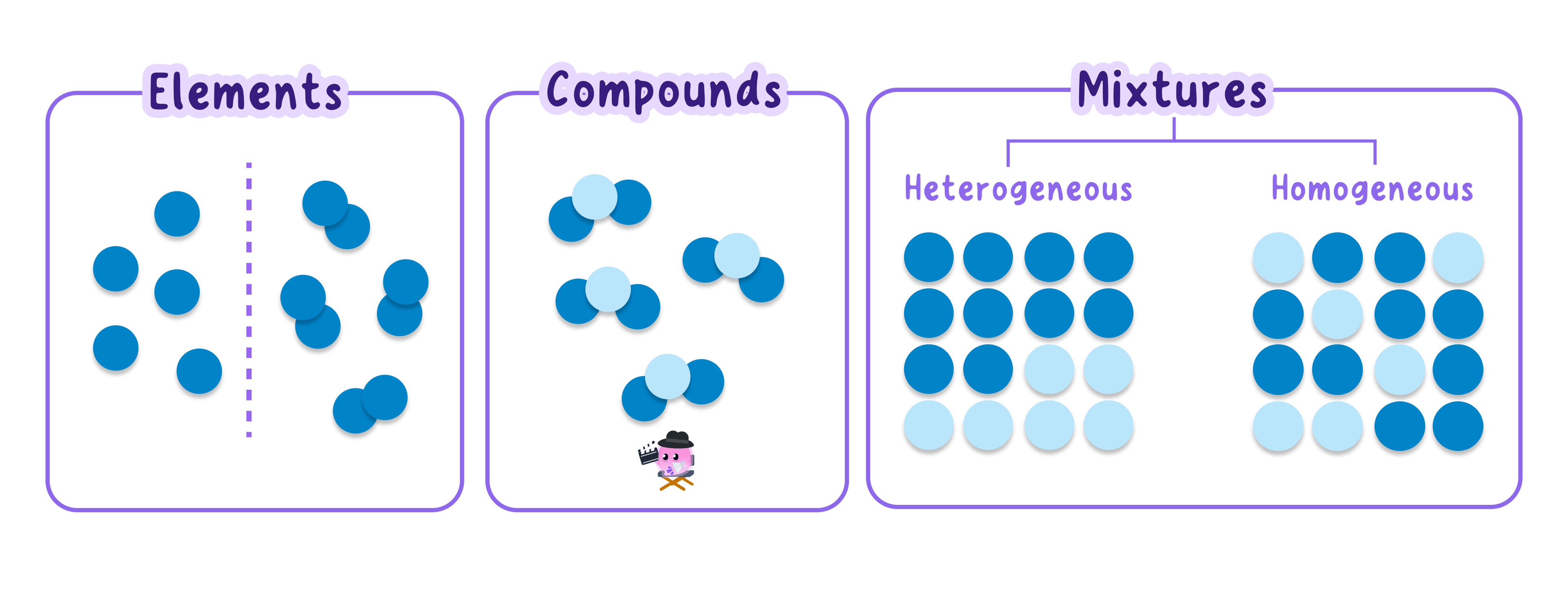
- The everyday meaning is not the chemical one, so a natural product is very often a mixture.
- A mixture is not a compound, because nothing is chemically bonded between its substances.
A pure substance melts at one sharp temperature
Melting point
The temperature at which a substance changes from a solid into a liquid, at a stated pressure.
- A pure solid melts at a single temperature, giving the same start and finish reading.
- That single value is described as a sharp melting point.
- A mixture melts over a range, beginning at one temperature and finishing at a higher one.
- The range appears because the substances in the mixture melt at different temperatures.
- Recording both the start and the finish temperature is what makes the comparison possible.
- A measured melting point well away from the accepted value is itself evidence of impurity.
- Pure: melting starts and finishes at 153 ∘C153\ ^{\circ}\text{C}153 ∘C, so the sample has a sharp melting point.
- Mixture: melting starts at 78 ∘C78\ ^{\circ}\text{C}78 ∘C and finishes at 84 ∘C84\ ^{\circ}\text{C}84 ∘C, a range of 6 ∘C6\ ^{\circ}\text{C}6 ∘C.
Boiling point data tells the same story
Boiling point
The temperature at which a liquid changes into a gas throughout the liquid, at a stated pressure.
- A pure liquid boils at a single temperature, which holds steady while it boils.
- A mixture boils over a range, and its temperature keeps climbing as boiling goes on.
- Pure water boils at 100 ∘C100\ ^{\circ}\text{C}100 ∘C at normal pressure.
- Salt water boils above 100 ∘C100\ ^{\circ}\text{C}100 ∘C, and the temperature rises further as water leaves.
- Melting and boiling data are read the same way: one fixed temperature points to a pure substance and a range points to a mixture.
- A fixed temperature is evidence, not proof, because a few mixtures also melt sharply.
- Compare against the accepted value for the substance expected, since a shifted value is a clue in itself.
Reading purity from a set of data
- Read the temperature at which melting or boiling begins.
- Read the temperature at which it finishes.
- Two equal values point to a pure substance.
- A finish higher than the start points to a mixture.
- Quote both figures in the conclusion, because those numbers are the evidence.
- What does pure mean in chemistry, and how does that differ from everyday use?
- What is the difference between an element and a compound?
- What does a sharp melting point suggest about a sample?
- How would you tell a mixture from a pure substance using melting data?
- How does the temperature behave while a mixture boils?
3.2.2 Techniques for separating mixtures
Separation uses a physical difference between the components
Soluble
Able to dissolve in a particular solvent.
Insoluble
Unable to dissolve in a particular solvent.
- The substances in a mixture are not chemically bonded, so each keeps its own physical properties.
- A separation exploits one of those differences: particle size, solubility or boiling point.
- A solution forms when a solute dissolves in a solvent, as salt does in water.
- No new substance is made, so every separation here is a physical process.
- Choosing a method starts with two questions: which property differs, and which component you want to keep.
- The difference drives the method, so identify it before naming a technique.
- Say which component you want, because the same mixture is handled differently depending on the answer.
Distillation separates by boiling point
Simple distillation
A method that separates a liquid from a solution by evaporating it and then condensing the vapour back to a liquid.
Fractional distillation
A method that separates miscible liquids with close boiling points, using a fractionating column in which vapours repeatedly condense and evaporate.
- Simple distillation recovers the solvent from a solution, such as water from salt water.
- The mixture is heated, the component with the lower boiling point evaporates first, and its vapour passes into a condenser.
- The condenser cools that vapour back to a liquid, which runs into a receiving flask as the distillate.
- The dissolved solid stays behind in the distillation flask, because it does not evaporate.
- Simple distillation also separates two liquids whose boiling points are far apart.
- When the liquids are miscible and their boiling points sit close together, fractional distillation takes over.
- A fractionating column sits between the flask and the condenser, and vapours condense and evaporate repeatedly as they rise through it.
- Each of those steps enriches the vapour in the lower-boiling liquid, which makes the separation far sharper.
- Salt water: simple distillation, because the dissolved salt does not evaporate at all.
- Ethanol and water: fractional distillation, because the two mix completely and boil only 22 ∘C22\ ^{\circ}\text{C}22 ∘C apart.
Filtration and crystallisation separate by particle size and solubility
Filtration
A method that separates an insoluble solid from a liquid by passing the mixture through filter paper.
Crystallisation
A method that obtains a dissolved solid from its solution by evaporating some of the solvent and letting crystals form as the solution cools.
- Filtration separates an insoluble solid from a liquid, because those solid particles are too large to pass through the filter paper.
- The liquid that passes through is the filtrate, and the solid held on the paper is the residue.
- Dissolved particles are small enough to pass straight through, so filtration cannot remove a solute.
- Crystallisation recovers a soluble solid from its solution.
- The solution is heated gently so that some solvent evaporates and the solution becomes more concentrated.
- Heating stops well before the solution is dry, and the concentrated solution is left to cool.
- Crystals form as it cools, because less solute can stay dissolved at the lower temperature.
- The crystals are then filtered off and dried between filter papers.
- Filtration cannot separate a dissolved solid, because its particles pass through the paper with the solvent.
- Do not evaporate to dryness, because soluble impurities are then left among the crystals and some salts lose their water of crystallisation.
Chromatography separates by how far each component travels
Paper chromatography
A method that separates a mixture of soluble substances by the different distances they travel as a solvent moves through the paper.
- Paper chromatography separates substances that dissolve in the same solvent, such as the dyes in an ink.
- A pencil line is drawn near the bottom of the paper, because pencil does not dissolve and will not run.
- A small spot of the mixture goes on that line, and the paper stands in solvent kept below it.
- The solvent rises through the paper and carries the dissolved substances up with it.
- Each substance travels its own distance, because they differ in solubility and in how strongly the paper holds them.
- The separated spots left behind make a chromatogram.
- The solvent starts below the line, so the spot travels up the paper instead of washing away into the solvent.
- Pencil, not pen, because ink would separate on the paper alongside the sample.
Choosing the right technique
- An insoluble solid in a liquid calls for filtration.
- A soluble solid you want to keep calls for crystallisation.
- A solvent you want to recover from a solution calls for simple distillation.
- Miscible liquids with close boiling points call for fractional distillation.
- Soluble substances to be separated or identified call for paper chromatography.
- Sand, salt and water needs two stages: filter off the sand, then crystallise the salt from the filtrate.
- The same mixture is handled differently depending on which component the question asks for.
- Naming the property that differs, and only then the technique, answers the question in the order it is asked.
- A method answer is judged on its steps, so the order of heating, cooling, filtering and drying matters.
- When two components are wanted, two stages are usually needed and both are worth describing.
- Which kind of mixture does filtration separate?
- Why is fractional distillation used for liquids with close boiling points?
- What happens to the dissolved solid during simple distillation?
- Why do the spots in chromatography end up in different places?
- Which method obtains salt from salt solution, and why?
3.2.3 Paper chromatography and Rf values
The solvent moves and the paper stays still
Mobile phase
The solvent that moves through the paper in chromatography, carrying the dissolved substances with it.
Stationary phase
The paper in chromatography, which stays in place while the solvent moves through it.
- In paper chromatography the paper is the stationary phase and the solvent is the mobile phase.
- A pencil baseline is drawn near the bottom, because pencil will not dissolve and run.
- A small spot of the mixture is placed on that baseline.
- The paper stands in solvent kept below the baseline, so the spot is not washed off into the solvent.
- The solvent rises through the paper and carries the dissolved substances with it.
- A substance that is more soluble in the solvent, and held less strongly by the paper, travels further.
- The furthest point the solvent reaches is the solvent front, marked before the paper dries.
- Two attractions compete: solubility in the moving solvent carries a substance up, and attraction to the paper holds it back.
- That balance differs for every substance, which is why they end up in different places.
Reading a chromatogram
Chromatogram
The pattern of spots produced on the paper once the substances in a mixture have separated.
- Each separated substance shows up as its own spot.
- A sample giving one spot is consistent with a pure substance.
- A sample giving more than one spot has to be a mixture.
- One spot is not proof of purity, because two substances can happen to travel the same distance.
- Running known substances alongside the unknown on the same paper allows the positions to be compared.
- A spot level with a known suggests that the unknown contains that substance.
- Every comparison needs the same paper, the same solvent and the same conditions.
- Count only the separated spots, never the original mark on the baseline.
- Matching positions suggests rather than proves, so an RfR_fRf comparison strengthens the conclusion.
RfR_fRf values put a number on how far a substance travels
Rf value
The distance travelled by a substance divided by the distance travelled by the solvent front, a ratio with no unit and a value between 0 and 1.
- Measure from the baseline to the centre of the spot.
- Measure from the baseline to the solvent front.
- Divide the first distance by the second: Rf=distance travelled by the substancedistance travelled by the solvent frontR_f = \frac{\text{distance travelled by the substance}}{\text{distance travelled by the solvent front}}Rf=distance travelled by the solvent frontdistance travelled by the substance
- Both distances are in the same unit, so RfR_fRf carries no unit.
- RfR_fRf always lies between 000 and 111, because nothing travels further than the solvent itself.
- A spot 3.0 cm3.0\ \text{cm}3.0 cm from the baseline with the solvent front at 6.0 cm6.0\ \text{cm}6.0 cm gives Rf=3.0÷6.0=0.50R_f = 3.0 \div 6.0 = 0.50Rf=3.0÷6.0=0.50.
- Measuring: baseline to spot centre 3.0 cm3.0\ \text{cm}3.0 cm, baseline to solvent front 6.0 cm6.0\ \text{cm}6.0 cm.
- Calculating: Rf=3.06.0=0.50R_f = \dfrac{3.0}{6.0} = 0.50Rf=6.03.0=0.50, a number with no unit.
- Method: simple distillation separates the solvent from the ink, and paper chromatography then separates the coloured solutes from one another.
- Result: the chromatogram shows how many different dyes the ink contains.
- Identifying a dye means comparing its spot, or its RfR_fRf value, with a known dye run alongside it.
- Fair comparison: the solvent and the paper are kept the same across every run.
- An RfR_fRf value only compares with one measured in the same solvent on the same kind of paper.
Drawing a conclusion from a chromatogram
- Count the spots to decide between a pure substance and a mixture.
- Compare the spot positions with the knowns run alongside.
- Calculate RfR_fRf for each spot where the question asks for it.
- Match each value against the RfR_fRf values of the known substances.
- Quote the evidence, which is the number of spots and the values that match.
- An RfR_fRf above 111 means the two distances went into the calculation the wrong way round.
- Measuring to the centre of the spot, rather than its top or bottom edge, is what makes the value reproducible.
- Naming the solvent matters, because the same substance gives a different RfR_fRf in a different solvent.
- What is the job of the mobile phase in paper chromatography?
- What does a chromatogram with three spots tell you about the sample?
- Why must the solvent level start below the baseline?
- How is an RfR_fRf value calculated?
- Why must the paper, solvent and conditions match when comparing chromatograms?
3.2.4 Making water potable
Potable water is safe to drink, not chemically pure
Potable water
Water that is safe to drink, although it may still contain dissolved substances that cause no harm.
- Water is described as potable when it is safe to drink, which is not the same as being chemically pure.
- Potable water still contains dissolved substances, and at the levels present they do no harm.
- Fresh water from rivers, lakes and the ground carries insoluble particles, dissolved substances and harmful microorganisms.
- Treatment has to deal with the particles and the microorganisms before the water is safe.
- Sea water needs different treatment, because its problem is the dissolved salt rather than the particles.
- Potable is not the same as pure, because harmless dissolved substances are allowed to remain.
- The treatment matches the problem, so the source of the water decides the method.
Fresh water is treated in three stages
Sedimentation
A stage of water treatment in which suspended insoluble particles are left to settle out under gravity.
Chlorination
A stage of water treatment in which chlorine is added to kill harmful microorganisms.
- In sedimentation the water is left to stand so that suspended insoluble particles sink under gravity.
- The settled sludge is drawn off, leaving far fewer solids for the next stage to handle.
- Filtration then passes the water through beds of sand and gravel, which trap the insoluble particles that remain.
- Dissolved substances pass straight through the filter beds along with the water.
- In chlorination, chlorine is added to kill the harmful microorganisms that filtration leaves behind.
- The three stages run in that order because each one prepares the water for the next.
- Filtration does not remove dissolved salts, because dissolved particles pass through with the water.
- Chlorine kills microorganisms rather than filtering them out, which is why it comes last.
Sea water is made potable by distillation
Desalination
The removal of dissolved salts from sea water, usually by distillation, to make it potable.
- Sea water holds so much dissolved salt that filtration and chlorination cannot make it drinkable.
- In distillation the sea water is heated until the water turns to vapour.
- The dissolved salts do not vaporise, so they stay behind in the original container.
- The vapour is cooled in a condenser and collected as liquid water carrying no dissolved salt.
- Removing the salt from sea water this way is called desalination.
- Boiling that much water takes a great deal of energy, so desalination is expensive and is used mainly where fresh water is scarce.
- Where it is used: countries with very little fresh water rely on desalination for their drinking water.
- Why it is a last resort: heating sea water costs far more energy than treating fresh water does.
Water for chemical analysis must contain no dissolved salts
- Chemical analysis tests a sample to find out which substances it contains.
- The water used in analysis must have no dissolved salts in it at all.
- Dissolved salts separate into ions, and those ions can react with the chemicals used in the test.
- A test would then respond to something that came from the water rather than from the sample.
- Tap water contains chloride ions, so it would give a white precipitate with acidified silver nitrate even when the sample contained none.
- Distilled water is used instead, because distillation leaves every dissolved salt behind.
- What does potable mean, and why is potable water not chemically pure?
- What does sedimentation remove from the water?
- Why is chlorine added after filtration rather than before it?
- How does distillation make sea water potable?
- Why must water used for chemical analysis contain no dissolved salts?
