Instrumental methods do the same job with a machine
- Chemical tests rely on an observation made by a person.
- An instrumental method takes the same measurement with a machine.
- Machines improve the sensitivity, so a far smaller amount can be detected.
- They improve the accuracy, so the result is closer to the true value.
- They improve the speed, so many samples can be analysed in the time one test takes.
Key Idea
The three advantages are sensitivity, accuracy and speed, and each answers a different weakness.
Why those three advantages matter
- A trace of an ion too small to colour a flame can still be detected by an instrument.
- A judgement between lilac and red depends on the observer, while a machine reads a number.
- A laboratory testing hundreds of samples needs the throughput a machine gives.
- An instrument also gives a numerical result, which a colour never does.
- Against that, instruments are expensive and need trained operators.
Note
Chemical tests remain useful because they are cheap and need no specialised equipment.
A flame photometer measures the light from a flame
- The sample is put into a flame, as in a flame test.
- The instrument measures the light the flame gives out.
- The pattern of light is compared with reference data to identify the metal ion.
- The intensity of the light depends on how much of the ion is present.
- No knowledge of how the instrument works is needed to use its output.
Example
- Identification: compare the measured pattern with reference data for known ions.
- Concentration: read the intensity against a calibration curve.
Using a calibration curve
Definition
Calibration curve
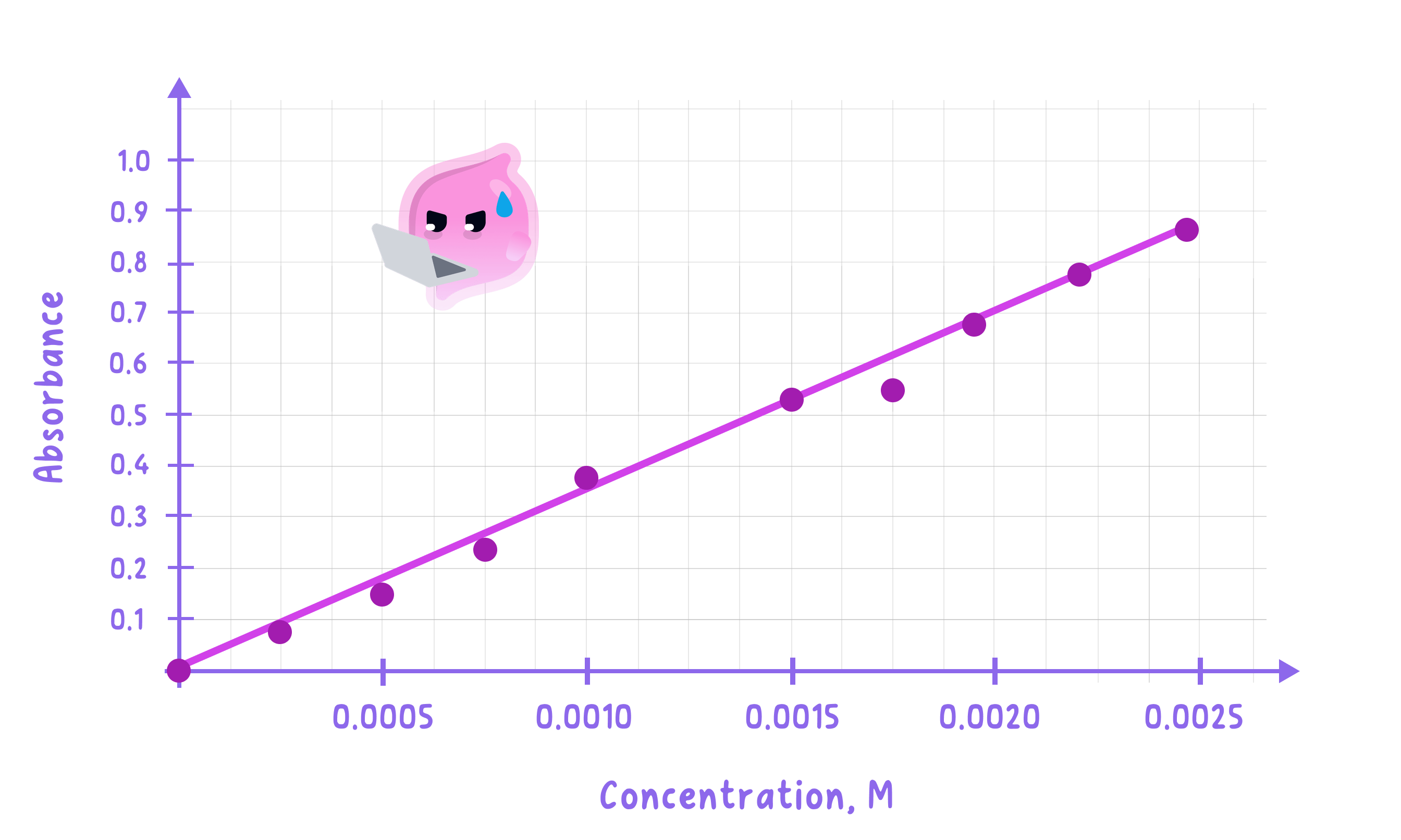
A graph of a measured quantity against known concentrations, used to find the concentration of an unknown solution.
- Solutions of known concentration are measured first.
- Their readings are plotted against concentration to give a curve.
- The unknown solution is then measured in the same instrument.
- Its reading is found on the vertical axis and traced across to the curve, then down to the concentration.
- A reading beyond the range of the curve cannot be read off, so the sample is diluted first.
Exam technique
- Reading a calibration curve means going across then down, and saying so in the answer.
- An identification quotes the reference data it was compared against.
- A concentration answer carries its unit, taken from the axis of the curve.
Self review
- Give three ways instrumental methods improve on chemical tests.
- Give one advantage a chemical test still has.
- How is a metal ion identified using a flame photometer?
- How is a calibration curve produced?
- What do you do if a reading falls beyond the range of the curve?
